


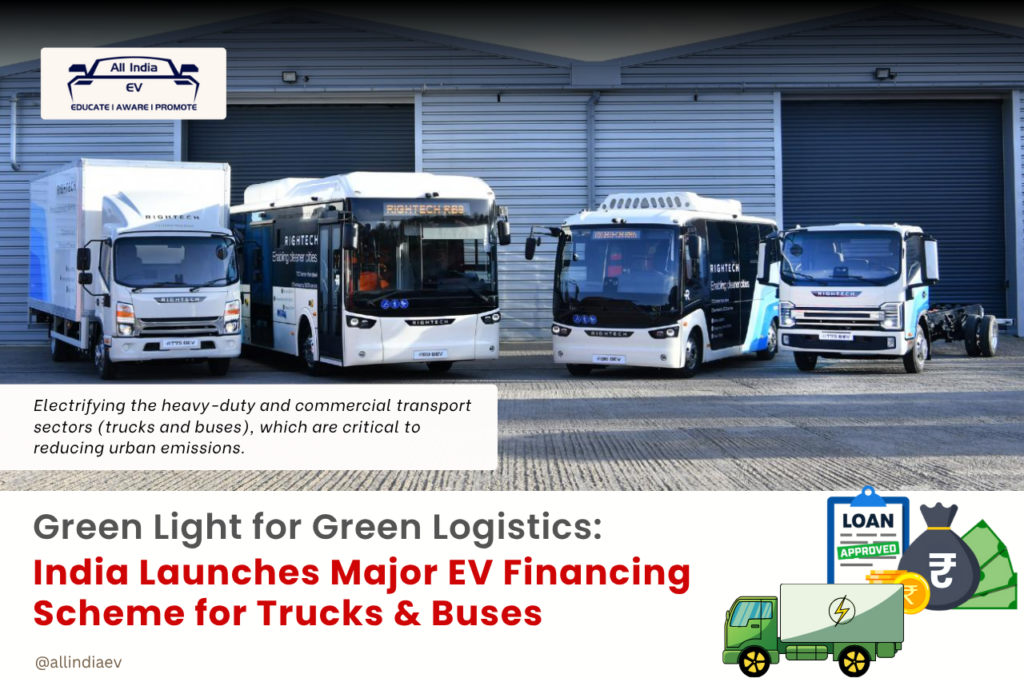
Centre Plans New Scheme to Offer Cheaper Loans for Commercial EV Buyers, Aiming to Overcome Credit Barriers in India’s Green Mobility Drive
In a major step toward deepening India’s electric mobility transition, the central government is drafting a new scheme to make financing easier for electric trucks and buses, addressing one of the most pressing bottlenecks in the country’s EV ecosystem — the lack of affordable credit for fleet operators.
The initiative, currently being discussed between the Ministry of Heavy Industries (MHI) and the Department of Financial Services (DFS) under the finance ministry, aims to incentivize lenders and create a dedicated framework for commercial electric vehicle financing, according to people familiar with the matter. The move follows a recommendation from NITI Aayog earlier this year, calling for a comprehensive approach to help small and medium fleet operators access low-cost loans for high-value EVs.
Addressing the Financing Gap in Commercial EVs
India’s commercial EV segment — which includes electric buses and heavy trucks — has lagged behind two- and three-wheelers despite growing policy support. High upfront costs, limited resale value, and a lack of financing products have prevented large-scale adoption among logistics companies and transport operators.
Under the proposed framework, banks and non-banking financial companies (NBFCs) will be encouraged to design new loan products that reduce upfront capital costs and shift part of the expense to operational payments, making ownership more viable for fleet operators.
A senior official familiar with the discussions said, “Talks have started between MHI and DFS to take forward the NITI Aayog recommendation. The proposal may include interest subventions or partial credit guarantees to lower the risk for lenders, though a funding corpus has not been finalized yet.”
According to Mordor Intelligence, India’s commercial EV financing market is projected to grow from $2.37 billion in 2025 to nearly $20 billion by 2030, reflecting a massive opportunity for lenders and investors.
More EV News

Why Commercial EV Financing Is a Challenge
Experts say lenders remain cautious about the higher capital cost and uncertain resale value of electric trucks and buses.
“Lenders encounter higher risks when financing e-trucks and e-buses, as their upfront costs are roughly 2.5 times those of comparable diesel vehicles. The absence of a mature resale market and uncertainty around residual values further elevate the perceived risk,” said Dhiraj Agrawal, Chief Business Officer at Mufin Green Finance, a leading EV financier.
Residual value — the estimated worth of a vehicle at the end of its loan term — is often harder to determine for EVs due to battery degradation. Unlike traditional diesel vehicles, EVs depend heavily on the condition of their battery packs, which lose efficiency over time. As a result, battery health tracking has become critical for lenders assessing asset quality and recovery potential.
According to Surya Khurana, Managing Director of FlixBus India, financing e-buses remains difficult because of high costs, evolving technology, and limited operational data.
“Unlike diesel buses, e-buses are a relatively new asset class. Lenders are cautious about battery life, asset value, and long-term reliability. Smaller bus operators often lack the balance sheet strength to secure favorable loan terms, increasing their perceived risk,” he said.
FlixBus India — the local arm of German intercity mobility provider FlixBus — partners with regional operators to offer long-distance electric bus services across major routes.
Higher Interest Rates for Electric Fleets
According to Mufin’s Agrawal, EV buyers face significantly higher borrowing costs compared to diesel or petrol vehicle owners.
“In the two- and three-wheeler segments, loan interest rates are 5–14 percentage points higher than ICE vehicles. For commercial EVs, especially heavy-duty ones, rates can be 5–10 percentage points higher, depending on the lender and borrower profile,” he said.
This financing premium, coupled with the lack of residual value assurance, limits EV adoption among small fleet operators.
For context, an electric bus costs ₹1–1.25 crore, while a diesel bus costs ₹25–50 lakh, depending on size. Similarly, heavy electric trucks (above 12 tonnes GVW) are priced at ₹1–1.5 crore, about three times more than their diesel counterparts. For small logistics operators and transporters, these numbers represent a major financial barrier.
Policy Push for a Greener Freight and Public Transport System
India’s EV ecosystem has gained momentum under national programs like FAME (Faster Adoption and Manufacturing of Hybrid & Electric Vehicles) and PM E-Drive, both of which focus on two-wheelers, three-wheelers, and light commercial vehicles. However, large commercial vehicles — trucks and buses — have remained on the sidelines.
NITI Aayog’s August 2025 report underscored this gap, recommending that the government establish a pooled fund using public and multilateral sources to provide low-interest loans and risk-sharing mechanisms for fleet electrification.
It also noted that truck and bus ownership in India is highly fragmented, with thousands of small operators owning one or two vehicles each — most of whom lack the credit history or collateral to access traditional financing.
“The absence of standardized frameworks for tracking battery health, degradation, and maintenance records complicates asset evaluation,” Mufin’s Agrawal added. “Lenders need consistent telematics and performance data to reduce risk and expand credit to the segment.”
Current Adoption Levels Remain Low
Despite policy efforts and pilot projects, India’s adoption of electric trucks and buses remains modest. As of 2024:
- Electric buses accounted for just 7% of total bus sales in India, compared to 50% in China and 14% in Europe.
- Heavy-duty electric truck adoption stood at 0.07%, while China’s rate was 3% and Europe’s 2%, according to NITI Aayog data.
These figures highlight the urgent need for financial innovation and credit support, rather than relying solely on subsidies.
A Shift from Subsidies to Sustainable Financing
The upcoming financing framework represents a strategic policy shift — from direct subsidies toward enabling affordable credit and risk mitigation. Such an approach aligns India with global best practices, where governments act as credit enhancers rather than direct funders.
The model is expected to attract institutional investors, boost private-sector confidence, and accelerate fleet electrification in logistics, freight, and public transport.
If implemented effectively, this could unlock billions in EV financing, helping India reduce its dependence on fuel imports and move closer to its net-zero emissions goal by 2070.
Comment by Author
India’s commercial EV sector is at a crucial inflection point. While two- and three-wheelers have already demonstrated the viability of electric mobility, the next frontier lies in electrifying heavy-duty transport — the segment that contributes most to emissions.
By reducing financing barriers and de-risking lender exposure, the government’s proposed scheme can become a game-changer, allowing small fleet owners to participate in the green transition. However, its success will depend on effective risk-sharing, standardized data systems, and consistent coordination between ministries, financiers, and OEMs.If these challenges are addressed, India could emerge as a global leader in electric commercial transport — not just in sales, but in sustainable finance innovation.