

Powering India’s Energy Future: Sodium-Ion Batteries Offer Abundant, Scalable & Cost-Effective Alternative to Lithium
As India accelerates its clean energy and electric mobility goals, experts are calling for a bold shift in battery strategy—from lithium-ion to sodium-ion. While lithium-ion batteries (LIBs) currently dominate electric vehicles (EVs) and grid-scale storage due to their high energy density and scalability, emerging challenges in global mineral access have prompted renewed interest in alternative chemistries. Sodium-ion batteries (SIBs), still in early stages, are quickly gaining traction as a promising contender.
Lithium-Ion’s Dominance Comes at a Cost
India has been rapidly ramping up battery manufacturing and associated supply chains. However, its access to critical minerals—especially lithium—is limited. In contrast, China continues to control most of the global lithium and graphite processing capabilities. In 2023, China’s restriction on graphite exports exposed the fragility of global supply chains. Despite India’s efforts to build partnerships like the Mineral Security Partnership (MSP) and initiatives such as KABIL, the country remains vulnerable to external shocks.
Adding to the complexity, China is expected to limit exports of advanced battery technologies, including those used in lithium refining and cathode development. The result: India’s lithium dependency could become a strategic bottleneck in its energy transition.
Sodium-Ion Batteries: A Strategic Alternative
Given the geopolitical risks and mineral constraints, stakeholders across government and industry are eyeing sodium-ion batteries as a more resilient, scalable solution. While SIBs have lower energy density than LIBs, they offer key advantages: greater safety, better thermal stability, and a significantly more abundant raw material—sodium.
Comparison at a glance:
| Component | Lithium-Ion (LIB) | Sodium-Ion (SIB) |
| Cathode | LFP, NMC | Layered Oxides, Prussian Blue analogues |
| Anode | Graphite | Hard carbon, soft carbon |
| Electrolyte Salt | LiPF6 | NaPF6 |
| Infrastructure | Mature | Compatible with LIB infrastructure |
echno-Commercial Potential of SIBs
More EV News
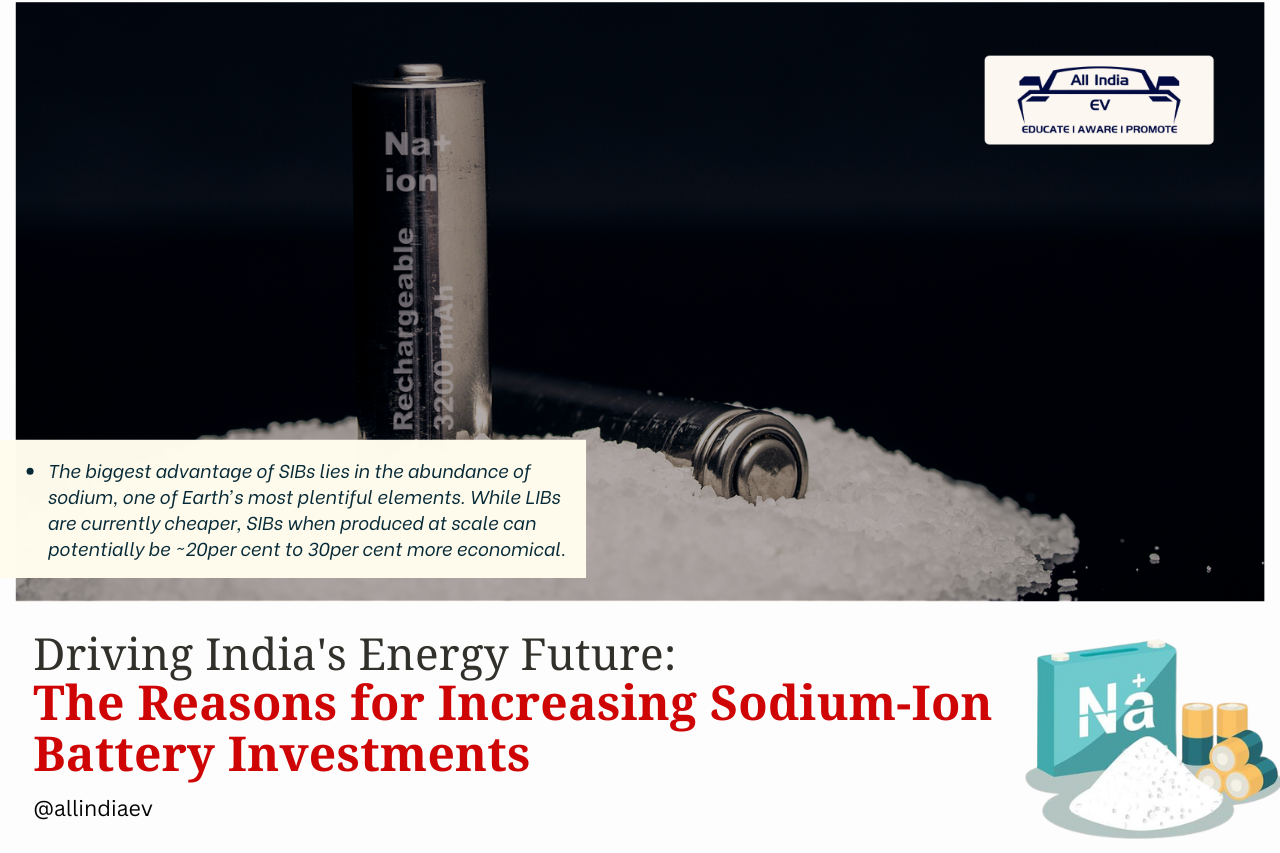
While LIBs currently enjoy cost advantages, analysts estimate that SIBs could be 20–30% cheaper once scaled. Their suitability for Battery Energy Storage Systems (BESS), thanks to higher safety margins, makes them a practical short-term deployment option.
India’s robust chemical industry provides an added edge—being capable of supplying key components of sodium-ion batteries domestically, and potentially lowering reliance on imports.
What India Needs to Do Next
To unlock the full potential of SIBs, a dual approach focusing on technology maturity and commercial deployment is vital:
1. Boosting Technology Readiness:
- Increase government funding for research focused on enhancing energy density and cycle life.
- Establish pilot manufacturing lines to bridge lab-to-market gaps.
- Forge partnerships with institutions like ARAI for prototype testing and validation.
- Promote innovation hubs and incubators to support startups and academia.
- Strategically utilize intellectual property to enable licensing and global collaboration.
2. Accelerating Commercialisation:
- Allocate the remaining 10 GWh capacity under the ACC PLI scheme to sodium-ion battery proposals.
- Offer tax breaks on raw materials and fast-track approvals for new factories.
- Support EV OEMs in launching Proof-of-Concept (PoC) projects using SIBs.
- Partner with international players from Japan and South Korea to import technology and expertise.
- Launch training programs to build a specialized workforce for gigafactories.
A Dual-Track Strategy for Energy Leadership
Most sodium-ion battery developers today are at Technology Readiness Levels (TRL) 5 to 6, still short of commercial scale (TRL 8–9). Experts suggest India continue investing in lithium-ion infrastructure while simultaneously nurturing sodium-ion battery innovation. This dual strategy would allow India to secure its place in the evolving global energy landscape—first as a participant, and eventually, as a leader.
As the world looks beyond lithium, India’s early embrace of sodium-ion technology could power a more secure, self-reliant, and scalable energy future.