
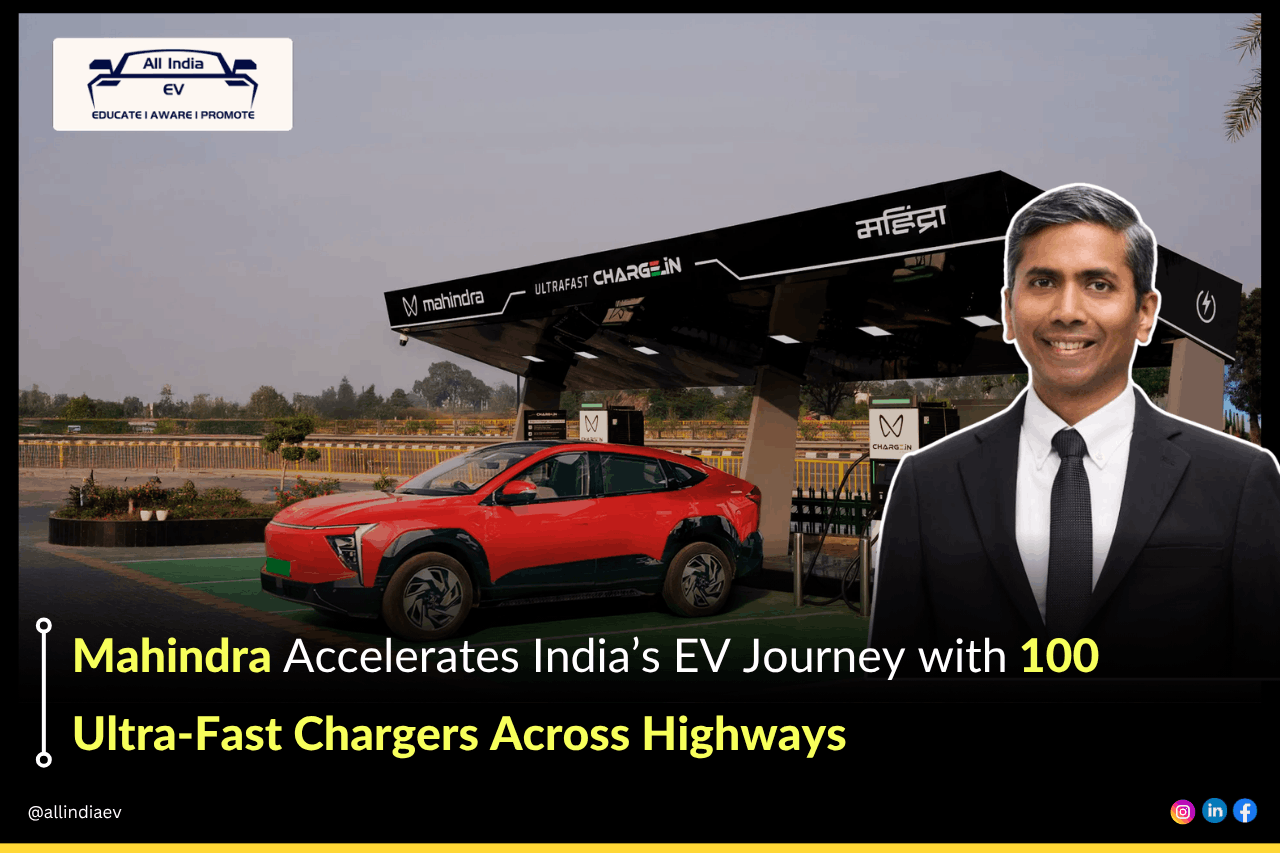

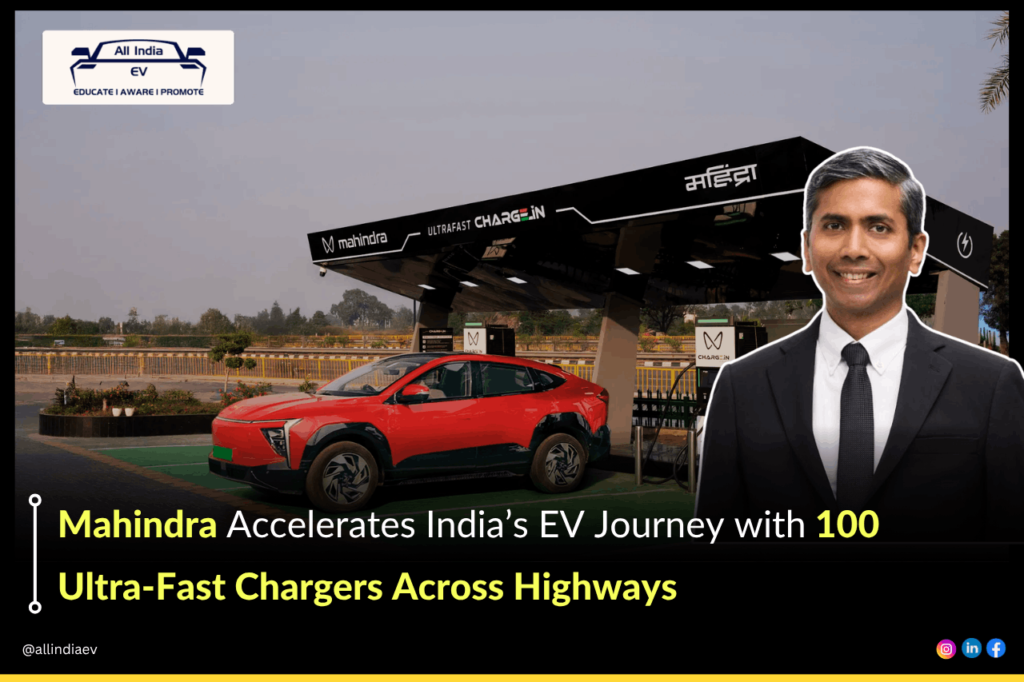
What: Mahindra & Mahindra has crossed 100 ultra-fast Charge IN charging points across 25 charging stations on 15 key highway corridors in India, expanding its public EV charging footprint for long-distance electric mobility.
The Number: 100+ charging points | 25 stations | 15 highway corridors | 180 kW dual-gun DC chargers | 1,000 charging points target by 2027.
The Impact: The Mahindra Charge_IN network expansion directly addresses highway charging gaps and range anxiety for electric SUV owners. It also strengthens India’s emerging intercity EV charging backbone at a time when premium EV adoption is accelerating.

The Core News
The Mahindra Charge IN network expansion marks one of the largest ultra-fast highway charging deployments by an Indian passenger vehicle OEM. The newly operational corridors include major intercity routes such as Mumbai–Ahmedabad, Solapur–Hyderabad, and Pune–Nashik, targeting high-traffic mobility clusters and industrial routes. The rollout is focused on enabling practical long-distance EV travel rather than only urban charging convenience.
Mahindra’s infrastructure strategy is centered around 180 kW dual-gun DC chargers capable of charging four EVs simultaneously at a station. According to the company, compatible Mahindra electric SUVs including the BE 6 and XEV lineup can charge from 20% to 80% in nearly 20 minutes under optimal conditions. The company is also following an open-network approach, allowing non-Mahindra EV users to access the chargers through the Charge IN app and aggregator platforms.
The development reflects a broader shift in India’s EV market where automakers are increasingly investing beyond vehicle manufacturing into charging ecosystems. Mahindra has already announced plans to scale the network to 250 stations and over 1,000 charging points by the end of 2027, including partnerships with fuel retail operators like Hindustan Petroleum Corporation Limited. This indicates that highway charging infrastructure is now becoming a competitive differentiator for EV brands operating in India’s premium electric SUV segment.
More EV News

Breaking Down the Update
• The Mahindra Charge_IN network now exceeds 100 ultra-fast charging points nationwide.
• The charging infrastructure currently spans 25 stations across 15 major highway corridors.
• Each station uses 180 kW dual-gun DC fast chargers supporting simultaneous charging for four EVs.
• Mahindra plans to expand the network to 250 stations with 1,000+ charging points by 2027.
• The charging network remains open to EVs from other brands through the Charge_IN app ecosystem.
• Stations are being positioned near highways, cafes, restaurants, and rest-stop infrastructure to improve charging convenience.
How Mahindra Charge_IN network expansion will help Indian EV Market
The Mahindra Charge_IN network expansion could become an important catalyst for India’s premium electric vehicle ecosystem, especially in the highway mobility segment where charging availability remains inconsistent. One of the largest barriers to EV adoption in India is range anxiety during intercity travel. By deploying 180 kW ultra-fast chargers across strategic highway routes, Mahindra is helping shift EV usage beyond city commuting into practical long-distance mobility.
The infrastructure rollout also supports India’s growing electric SUV segment. Vehicles with larger battery packs and longer driving ranges require equally capable charging ecosystems to unlock their full usability. Faster charging cycles reduce waiting time and improve route confidence for private buyers as well as commercial fleet operators.
Another important factor is interoperability. Since the network is open to non-Mahindra EV users, the deployment contributes to broader ecosystem growth rather than remaining a closed proprietary setup. This improves charger utilization and strengthens public infrastructure economics.
The Mahindra Charge IN network expansion may also encourage competing OEMs to accelerate investments in highway charging partnerships, helping India build a more mature national EV infrastructure backbone over the next three to five years.
Way Forward ….
The Mahindra Charge IN network expansion signals that Indian automakers are beginning to treat charging infrastructure as a core mobility business rather than an auxiliary support service. The next phase will depend on execution quality, charger uptime, corridor density, and interoperability with multiple EV platforms. If Mahindra successfully scales toward its 1,000-point target, it could significantly influence how highway EV mobility develops in India over the next few years.
Read More: Catch up on All India EV’s related coverage on India’s evolving commercial EV subsidies and battery swapping policies at All India EV