


Hybrid Passive Cooling System Using Heat Pipes and Nano Fluid Delivers Pump-Free, Energy-Efficient Thermal Management for Next-Gen EV Battery Safety and Performance
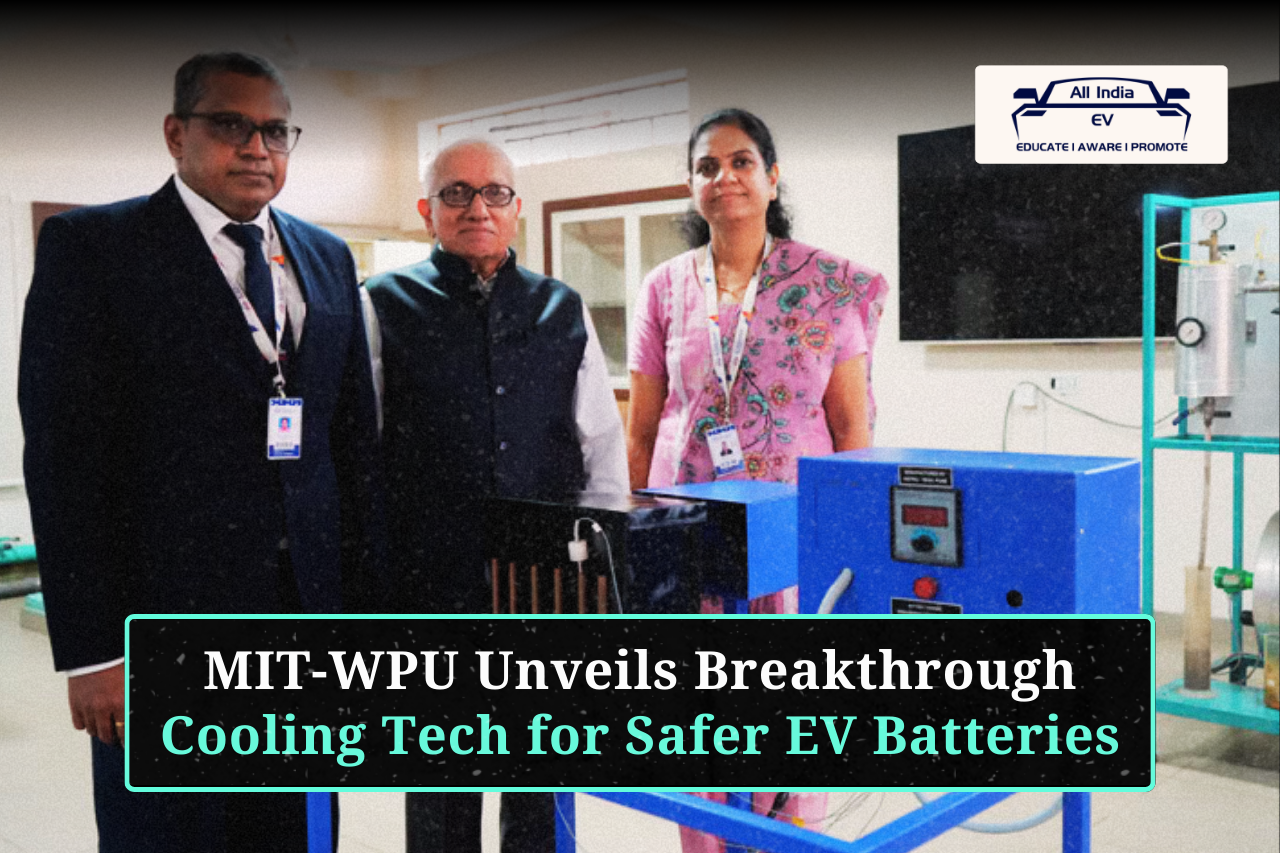
In a significant breakthrough for India’s electric mobility ecosystem, researchers at MIT World Peace University (MIT-WPU) have developed a new patented hybrid cooling system designed to make electric vehicle (EV) batteries safer, cooler, and more efficient, especially under India’s harsh climatic conditions.
The innovation, granted a patent under the title “System for Thermal Management of Battery of Vehicle,” aims to address two of the biggest challenges facing EVs in India—high ambient temperatures and the recent increase in EV fire incidents. According to the institute, the system has been engineered to deliver improved thermal stability, enhanced battery performance, and significantly better operational safety.
At the heart of the solution is a hybrid passive cooling mechanism that combines high-efficiency heat pipes with a specially formulated nano fluid. Unlike traditional cooling systems, which rely on pumps or active mechanical components, this setup provides a pump-free, energy-efficient alternative, ensuring thermal regulation without drawing additional power from the battery.
“In a high-temperature environment like India, the challenge is not just achieving performance but ensuring safety first,” said Dr. Vaibhav Deshmukh, Associate Professor, Department of Mechanical Engineering, MIT-WPU.
“Our passive hybrid cooling system keeps the battery pack within safe thermal limits without consuming vehicle power, improving both reliability and efficiency.”
Echoing this, Dr. S. Radhakrishnan, Professor Emeritus and Director of Research, Department of Materials Science & Engineering, highlighted the innovation’s focus on long-term dependability.
“We wanted to eliminate active components that can fail or consume extra energy. The result is a robust solution built for high-temperature markets and growing fire-risk concerns,” he said.
The development comes at a crucial time as EV adoption accelerates across India, pushing manufacturers and researchers to strengthen vehicle safety standards and reliability measures.
More EV News
Globally, the EV Battery Thermal Management System (BTMS) market, valued at $5.41 billion in 2024, is projected to expand to $29.09 billion by 2030, driven by demand for longer range, faster charging, and higher safety benchmarks.
In India, the market for EV battery cooling systems is expected to jump from $138 million in 2025 to nearly $470 million by 2034, while the overall Battery Management System (BMS) market may surge from $199 million in 2024 to an estimated $8.39 billion by 2035.
With safety becoming a central pillar of India’s evolving EV landscape, MIT-WPU’s patented technology marks an important step toward developing reliable, climate-suited solutions that can support the country’s expanding electric mobility ambitions.
Author’s Comment:
MIT-WPU’s patented hybrid cooling system arrives at a pivotal moment for India’s EV sector, where safety and heat management remain top priorities. As battery-related incidents and extreme temperatures continue to raise concerns, innovations like this offer a practical, power-efficient pathway to safer EV adoption. If scaled successfully, this technology could play a meaningful role in strengthening India’s EV manufacturing ecosystem and boosting consumer confidence in the transition to electric mobility.