
All India EVAll India EVAll India EV
Notification
Font ResizerAa
  • Home
  • EV News
  • EV Launch
  • Market Insights
  • Investments & Funding
  • Guest Articles
  • EV Engineering
  • Contact
Reading: Oor Cabs’ ₹25 Crore EV Bet Tests Tier-II Auto Economics
Share
All India EVAll India EV
Font ResizerAa
  • Home
  • EV News
  • EV Launch
  • Market Insights
  • Guest Articles
  • EV Engineering
  • Contact
Search
  • Home
    • Home 1
    • Home 2
    • Home 3
    • Home 4
    • Home 5
  • Home
  • Categories
    • Electric
  • Categories
  • Shows
    • Rap
  • More Foxiz
    • Blog Index
    • Contact
  • Bookmarks
    • Customize Interests
    • My Bookmarks
  • More Foxiz
    • Blog Index
    • Sitemap
Have an existing account? Sign In
Follow US
Oor Cabs
Home » Blog » Oor Cabs’ ₹25 Crore EV Bet Tests Tier-II Auto Economics
Investments & Funding

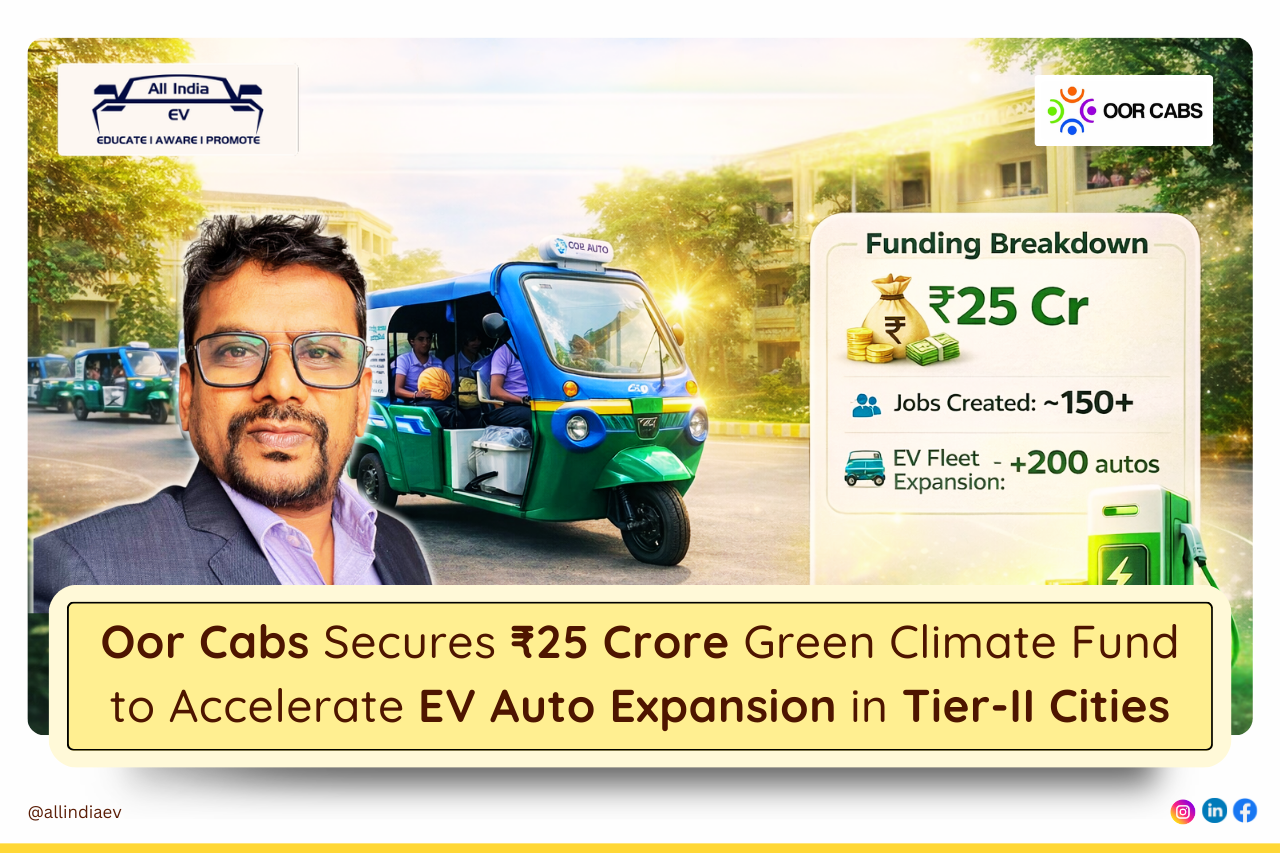
Oor Cabs’ ₹25 Crore EV Bet Tests Tier-II Auto Economics

Sunita
By
Sunita
Last updated: 26 February 2026
Share
5 Min Read
SHARE

Early-stage climate capital moves from pilots to proof in India’s peri-urban mobility cycle

Contents
  • Deal Facts
  • What the Money Must Achieve
  • Unit Economics Reality Check
  • Risks & Failure Modes
  • Who Wins / Who Gets Squeezed
  • Next 90 Days: What to Track
  • Get the Conversation Going

Oor Cabs’ latest capital is not a victory lap; it’s a test of whether electric autos can reach breakeven outside metro demand density. The structural shift is from showcase EV deployments to unit-economics discipline across Tier-II cities, where utilisation, uptime, and driver economics decide survival.


Deal Facts

  • Round size: ₹25 crore
  • Stage: Early growth / expansion capital (exact stage Not disclosed; matters because expectations on growth vs. profitability differ by stage)
  • Investor: Green Climate Fund (via programmatic climate financing; specific vehicle/partner Not disclosed, which matters for governance and reporting cadence)
  • Valuation: Not disclosed (important to gauge dilution, runway expectations, and performance pressure)
  • Use of funds: Expand electric auto fleet and charging support across Tier-II cities in Tamil Nadu and nearby markets
  • Geography focus: Tier-II and peri-urban clusters (city list Not disclosed; matters for route density and power reliability assumptions)
  • Timeline: Expansion to be executed over the next 12–18 months (exact milestones Not disclosed)
  • Operating metrics: Fleet size, daily rides, utilisation, revenue per vehicle Not disclosed (without these, ROI tracking and unit economics cannot be independently assessed)

What the Money Must Achieve

  • Product: Standardise vehicle spec (battery chemistry, swappability vs. fast-charge compatibility) to reduce downtime and maintenance variance across cities.
  • Operations: Build depot-level charging playbooks—load management, queueing protocols, uptime SLAs—so autos are on-road during peak demand windows.
  • Scale: Prove replicable rollout in 3–5 Tier-II clusters with consistent utilisation, not one-off pilots buoyed by local incentives.
  • Compliance: Tighten safety, battery lifecycle tracking, and carbon accounting demanded by climate capital; reporting discipline becomes a competitive moat.
  • GTM: Lock in driver acquisition and retention with predictable earnings—financing access, lease terms, and uptime guarantees must be codified.

Unit Economics Reality Check

For this to work, utilisation must stay above a city-specific threshold that covers fixed costs (vehicle lease/EMI, battery amortisation, charging infra) and variable costs (energy, maintenance, platform ops). Gross margins hinge on electricity pricing predictability and battery degradation curves. Customer acquisition cost (CAC) must stay low through local partnerships (stands, municipal routes, enterprise tie-ups) rather than discount-led rider growth. Payback periods on vehicles and chargers need to compress into a 24–36 month window to avoid capital being trapped in low-yield assets.

What usually breaks in India is not demand—it’s ops. Charging uptime collapses during grid volatility; depot congestion erodes peak-hour availability; service quality dips with multi-vendor vehicle fleets; compliance becomes paperwork-heavy with climate reporting; and working capital stretches when driver payouts are weekly but receivables lag. Tier-II realities—patchy power quality, fewer service centres, and thinner route density—magnify these frictions.


Risks & Failure Modes

  • Underutilisation risk: Tier-II demand density may not sustain target trips/day, stretching payback.
  • Power reliability: Grid downtime raises charging costs via diesel backup or lost operating hours.
  • Battery lifecycle mismatch: Faster-than-expected degradation inflates capex refresh cycles.
  • Driver churn: Earnings volatility triggers attrition, breaking route continuity and rider trust.
  • Reporting drag: Climate fund governance increases compliance overhead; weak data systems stall disbursements.

Who Wins / Who Gets Squeezed

Who Wins

  • Drivers with access to predictable earnings, lower fuel volatility, and structured maintenance.
  • Local charging operators that secure anchor demand from fleet depots and predictable load profiles.

Who Gets Squeezed

  • ICE auto owners in overlapping routes as fare parity improves with EV operating cost stability.
  • Small, fragmented service vendors unable to meet uptime SLAs across dispersed Tier-II footprints.

Next 90 Days: What to Track

  • [Founder] Publish a city-by-city rollout plan with utilisation targets and depot uptime SLAs.
  • [Investor] Set milestone-linked disbursement tied to trips/vehicle/day and cost per km.
  • [Customer] Pilot fixed-route reliability windows (morning/evening peaks) and publish on-time metrics.
  • [CPO/OEM] Finalise a single battery/charging standard per cluster to reduce spares complexity.
  • [Supplier] Lock energy tariffs with DISCOMs or private providers to cap per-km variability.
  • [Policy] Secure municipal stand access and curbside charging permissions to de-risk first-mile ops.

Get the Conversation Going

  1. What is the minimum trips/day an electric auto needs in Tier-II cities to clear cash breakeven?
  2. Can climate capital tolerate slower payback if emissions reporting is strong—but margins lag?
  3. Should Tier-II fleets prioritise battery swapping to hedge grid volatility, or is fast-charge now viable?


All India EV Community

More EV News

Hero MotoCorp to Increase Stake in Euler Motors
IBC Targets $15M For India Battery Boom
Vajram Electric Acquires 40% Stake in Varcas Automobiles
BluSmart Explores Partnership with JSW MG for EV Growth
India Boosts EV Adoption with $1.3 Billion Incentive

Click here for more such EV Updates

Loading
Tata Motors
Tata Motors Charts Aggressive ₹₹33,000-35,000 Cr Investment Plan with EVs at the Core of Future Strategy
EV Buses to Get a INR 700 Crore Push in Goa, Says CM
Vecmocon Technologies Closes $18 Million Series A Funding Round to Accelerate Global EV Innovation
Volt14 Raises $1.87 Million to Power Next-Gen Battery Innovation for Electric Vehicles
Neuron Energy Scores Rs 20 Cr Funding

Sign Up For Daily Newsletter

Be keep up! Get the latest breaking news delivered straight to your inbox.
Loading
By signing up, you agree to our Terms of Use and acknowledge the data practices in our Privacy Policy. You may unsubscribe at any time.
Share This Article
Facebook Whatsapp Whatsapp LinkedIn Copy Link Print
Leave a Comment

Leave a Reply Cancel reply

Your email address will not be published. Required fields are marked *

Follow US
XFollow
InstagramFollow
YoutubeSubscribe
LinkedInFollow
Haryana cabinet approves new rules: No petrol, diesel vehicles for cab aggregators in NCR
21 May 2026
Ultraviolette and Bolt.Earth Expand Type-6 DC Fast Charging Infrastructure Across India
Ultraviolet and Bolt. Earth Expand Type-6 DC Fast Charging Infrastructure Across India
21 May 2026
What: India’s finance ministry has directed public sector banks, insurers, and financial institutions to reduce operational spending and accelerate adoption of electric vehicles across official fleets. The move is part of a wider austerity push linked to rising global economic uncertainty and fuel-related risks. The Number: The directive impacts major public institutions including State Bank of India, Bank of Baroda, and Life Insurance Corporation of India, covering millions of employees and thousands of operational vehicles nationwide. The Impact: The policy signals a new phase of institutional fleet electrification in India, where EV adoption is now being tied directly to fiscal discipline, fuel import management, and public-sector operational efficiency. The Core News India’s finance ministry has formally instructed state-run financial institutions to implement strict expenditure controls while simultaneously accelerating EV adoption for official transport operations. The directive from the Department of Financial Services asks organisations to replace petrol and diesel vehicles used at head offices and branch operations with electric vehicles “as far as possible.” The order comes amid growing concern over the economic impact of prolonged geopolitical instability in West Asia, which threatens to increase crude oil prices, widen India’s import bill, and pressure the rupee. Alongside the EV transition mandate, the government has also pushed virtual meetings, reduced foreign travel, and tighter administrative spending controls across public-sector institutions. For India’s EV ecosystem, the directive is strategically important because it expands demand visibility beyond state transport undertakings and government departments into the financial sector itself. PSU banks and insurers operate one of the country’s largest distributed office networks, including regional offices, branch fleets, field operations, and administrative mobility services. Even a phased transition could create a sizeable procurement pipeline for electric passenger vehicles, charging infrastructure providers, and fleet management companies. Breaking Down the Update • The Department of Financial Services issued the austerity and EV adoption directive to PSU banks, insurers, and financial institutions. • The government wants petrol and diesel vehicles used in official operations to be progressively replaced by EVs wherever operationally feasible. • The policy push follows Prime Minister Narendra Modi’s appeal for fuel conservation and controlled discretionary spending amid global energy uncertainty. • The directive also mandates greater use of video conferencing to reduce travel-related operational expenditure. • The move could indirectly support domestic EV OEMs, leasing firms, and charging infrastructure operators through institutional procurement demand. • The banking and insurance sector may emerge as a new enterprise fleet electrification category in India’s EV transition roadmap. How PSU banks EV adoption will help Indian EV Market The expansion of PSU banks EV adoption could create a strong institutional demand layer for India’s electric mobility sector. Public sector banks and insurers operate thousands of branch offices across urban, semi-urban, and rural India. Their transition to EV fleets can generate predictable procurement volumes for domestic automakers, especially in the electric sedan, compact SUV, and commercial mobility segments. Beyond vehicle sales, the policy may also accelerate deployment of workplace charging infrastructure at bank headquarters, zonal offices, and regional branches. This can support charger utilisation economics while helping normalise EV infrastructure in tier-2 and tier-3 cities. Another important impact is signalling. When large state-linked financial institutions adopt EVs as operational assets rather than pilot projects, it improves confidence across the broader enterprise mobility market. Private banks, NBFCs, and insurance firms could eventually follow similar fleet transition models to reduce long-term fuel and maintenance costs. PSU banks EV adoption also aligns with India’s larger energy security strategy. Lower petroleum consumption in institutional fleets directly supports efforts to reduce crude import dependence while stabilising operational expenditure during periods of volatile global oil prices. Conclusion & Next Steps The government’s push toward PSU banks EV adoption reflects a broader shift where EV deployment is increasingly being linked with macroeconomic resilience rather than only sustainability targets. Execution, however, will depend on procurement timelines, charging infrastructure readiness, and operational suitability across
India directs state-run banks, insurance firms to cut costs, shift to EVs
21 May 2026
All India EV: Edition 49
What all happened in April 2026?
Click Here
All India EV

Daily EV Industry updates for you…

Categories

  • EV News
  • EV Launch
  • Investments & Funding
  • Market Insights
  • Guest Articles
  • EV Engineering

Quick Links

  • Community
  • Content Services
  • Branding Services
  • My EV Charger
  • Substack

© Developed and Managed by “The Energy Log”

Welcome Back!

Sign in to your account

Username or Email Address
Password

Lost your password?

Not a member? Sign Up