

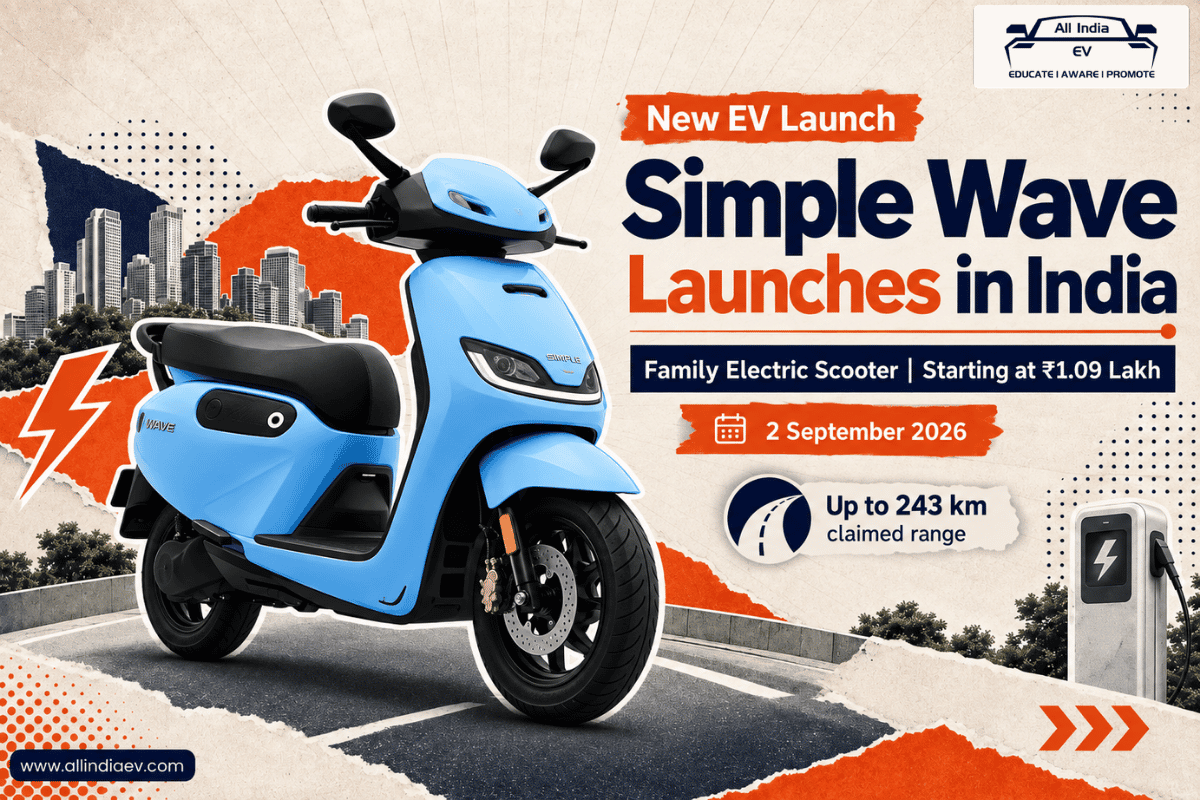
Simple Energy has launched the Simple Wave electric scooter in India, marking the company’s move into the family-oriented electric scooter segment. Prices start at ₹1,09,999 ex-showroom and extend to ₹1,89,999 for the top-spec Wave Plus, while deliveries are scheduled to begin from 25 September 2026.
Unlike the sharper, performance-focused styling associated with Simple Energy’s existing scooters, the Wave has been designed around everyday usability. The company is targeting buyers who want an electric scooter capable of handling commuting, family use and routine urban trips while still offering relatively high claimed range.
Simple Wave Gets Up to 243 km Claimed Range
The Simple Wave electric scooter is offered across three main trims — Wave S, Wave and Wave Plus — with multiple battery and equipment configurations.
The entry-level Wave S can be had with 2.2kWh and 2.7kWh battery options, offering claimed ranges of 110 km and 132 km, respectively. The standard Wave uses a 3.7kWh battery and offers up to 171 km of claimed range, while the flagship Wave Plus gets a 5kWh battery with a claimed range of up to 243 km.
Power comes from a 6.4kW electric motor. The Wave and Wave Plus can accelerate from 0-40 km/h in 3.3 seconds and reach a claimed top speed of 90 km/h. The Wave S has a claimed top speed of 75 km/h, with the 0-40 km/h sprint taking four seconds.
Practicality Becomes the Main Focus
One of the Wave’s biggest differentiators is practicality. Simple Energy has equipped the scooter with a 920 mm-long seat, a spacious floorboard and 70 litres of underseat storage. Additional storage compartments are integrated into the body panels, along with an apron cubby for smaller everyday items.
The chassis setup consists of telescopic front forks, twin rear shock absorbers and 12-inch alloy wheels. Braking duties are handled by a disc brake at the front and a drum brake at the rear.
Higher variants receive a seven-inch TFT instrument console with smartphone connectivity, turn-by-turn navigation and call/SMS alerts. Electronic equipment also includes hill-hold assist and traction control, while connected safety functions include geo-fencing, time-fencing, theft alerts and tow alerts.
Simple Energy Is Expanding Beyond Performance
The launch is strategically important for Simple Energy because the Wave takes the company beyond a primarily performance-led product proposition.
At ₹1.09 lakh, the entry point gives Simple Energy a product aimed at a much broader commuter and family audience, while the 243 km claimed range on the top-end variant allows the company to retain range as an important product differentiator.
That also puts the Wave into one of India’s most competitive electric two-wheeler categories. It will compete for family-scooter buyers against established electric products including the TVS iQube and Bajaj Chetak, along with newer offerings entering the same segment.
What This Means
Specifications alone, however, will not determine the Wave’s success. Simple Energy will also have to demonstrate dealership reach, dependable aftersales support and consistent ownership experience as it targets a larger customer base.
With deliveries beginning on 25 September, the Simple Wave gives Simple Energy a significantly broader product play — from a ₹1.09 lakh entry point to a flagship offering with 243 km of claimed range. The bigger question now is whether that wider portfolio can help the brand build meaningful scale in India’s increasingly crowded electric scooter market.