
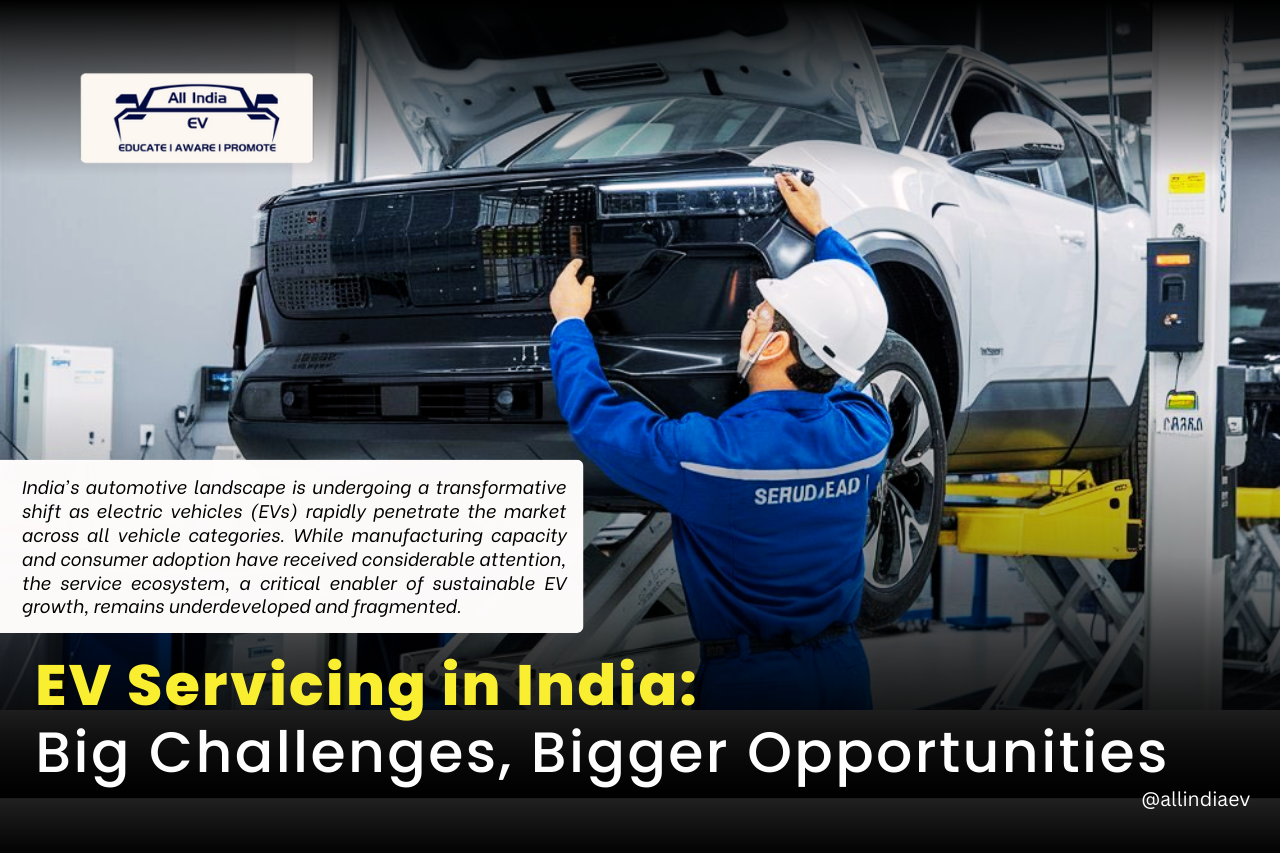

India’s automotive landscape is undergoing a transformative shift as electric vehicles (EVs) rapidly penetrate the market across all vehicle categories. While EV manufacturing and consumer adoption have received significant attention, the service ecosystem, a critical enabler of sustainable EV growth, remains underdeveloped and fragmented.
- The EV Penetration Story: Faster-Growing Categories
- EV Service Infrastructure: The Critical Gap
- Infrastructure Requirements for Key EV Service Functions
- Specialized Service Needs: Battery, Charging, and Powertrain
- Battery Management: From Replacement to Reconditioning
- Charging Infrastructure and Standardization
- Powertrain and Power Electronics
- The Skill Deficit: An Existential Threat
- Emerging Opportunities in the EV Service Sector
- Government and Industry Response
- Shifted Customer Expectations in the EV Era
- Emerging Service Models and Disruption
- Converted ICE Vehicles and Aftermarket Challenges
- Replacement Over Repair: The Emerging Service Model
- Critical Success Factors for EV Service Development
- Conclusion:
This article examines the current state of EV service infrastructure, identifies capability gaps, and explores emerging trends that are poised to shape India’s aftersales service sector through the remainder of this decade.
The urgency of this discourse cannot be overstated. India sold over 2 million electric vehicles in 2024, with EV penetration accelerating steadily. Yet, the service infrastructure lags far behind demand, creating a looming crisis that threatens customer confidence and the long-term sustainability of EV adoption. Unlike traditional internal combustion engine (ICE) vehicles, which benefited from a century-long evolution of roadside mechanics and service centers, EV servicing requires specialized knowledge, infrastructure, and equipment, currently scarce across India’s vast geography.
The EV Penetration Story: Faster-Growing Categories
India’s EV market has demonstrated remarkable resilience and growth, particularly in urban and semi-urban segments. However, this growth is uneven across vehicle categories, with two-wheelers and three-wheelers leading the charge.
Two-Wheeler and Three-Wheeler Dominance
Two-wheeler electric vehicles have become the mass-market segment for EV adoption in India. In FY 2024–25, e-two-wheelers accounted for 59.4% of total EV sales, representing 1.15 million units with a year-on-year growth of 21.2%.
The three-wheeler segment has emerged as the most electrified vehicle category in India, with e-three-wheelers capturing 29.7% average monthly penetration in 2025 (January–August), a substantial increase from 18.2% in the same period of 2024. 122,794 units were registered between January and August 2025 alone.
This segment represents an optimal use case for electrification: predictable daily usage, fixed terminal charging points, lower operational costs, and strong economic incentives for fleet operators.
More EV News

Four-Wheeler Expansion
While four-wheelers remain a smaller segment, electric passenger vehicles crossed the 100,000-unit milestone in 2025, showing 18.2% growth, indicating adoption among premium and mid-segment consumers. This category is expected to drive the next wave of service infrastructure development, particularly in metropolitan areas and affluent consumer hubs.
Strategic Observation: Differential adoption rates reflect end-use suitability and cost sensitivity. Two and three-wheelers electrify faster because operational savings quickly offset battery costs. This pattern has significant implications for service infrastructure planning: the service needs of a two-wheeler operator differ fundamentally from a four-wheeler owner.
EV Service Infrastructure: The Critical Gap
While manufacturing has scaled and consumer adoption has accelerated, the physical and human infrastructure required to service these vehicles remains inadequate and fragmented.
Current Infrastructure Landscape
India’s EV charging infrastructure, the most visible component of the service ecosystem, expanded from 1,800 public chargers in early 2022 to over 16,000 by November 2025, a nine-fold increase in just three years.
However, this growth is misleading when compared to projected demand. India will require nearly 1.32 million charging stations to support an estimated 50 million EVs by 2030. At current rates, the country is tracking toward less than 2% of required infrastructure.
Urban-centric deployment further exacerbates the issue. Cities like Delhi, Mumbai, and Bangalore dominate, while northeastern and remote regions face acute infrastructure scarcity. Since two and three-wheelers dominate EV sales, and are often used in semi-urban or rural areas, this creates a critical vulnerability for widespread adoption.
Service Centre Availability
Beyond charging infrastructure, dedicated EV service centres are limited. Traditional dealership networks, the backbone of passenger vehicle aftersales, are slowly transitioning to EV-specific services.
Many independent service providers, critical for two and three-wheeler servicing, lack technical capabilities, equipment, and certifications. Government-operated charging stations function at approximately 72% uptime, well below the required 97%, primarily due to shortages of trained personnel.
This operational deficit reflects deeper systemic challenges: insufficient skill development, unclear career pathways, and inadequate compensation for specialized EV technicians.
Infrastructure Requirements for Key EV Service Functions
EV service infrastructure differs significantly from ICE vehicle servicing. Key requirements include:
- High-voltage DC charging stations (7 kW to 350 kW) with smart grid integration and real-time diagnostics
- Battery diagnostic and thermal management systems for monitoring state-of-health (SOH) degradation
- Motor and power electronics repair capabilities using oscilloscopes, thermal cameras, and battery testers
- Software diagnostic systems linked to OEM platforms for firmware updates and optimization
- Battery swapping facilities for commercial fleets and standardized platforms
- Thermal management stations for battery cooling, critical in India’s hot climate zones
Most service centres in India lack even half of these capabilities. Setting up a fully equipped EV service centre ranges from INR 50-100 lakhs for basic setups to 2+ crores for comprehensive facilities. This capital barrier discourages independent service providers, leaving a void partially filled by OEM-authorized dealerships.
Specialized Service Needs: Battery, Charging, and Powertrain
Battery Management: From Replacement to Reconditioning
Unlike ICE vehicles, battery diagnostics and health monitoring are continuous functions for EVs. Batteries degrade predictably (~2–3% capacity per year), but premature degradation can result from thermal stress, incomplete charging cycles, or high ambient temperatures.
Service needs include:
- Battery state-of-health (SOH) diagnostics
- Thermal management to maintain optimal operating temperatures
- Cell balancing and recalibration
- Module replacement to extend battery life
- Repurposing and second-life applications for extracted batteries
Currently, most Indian service providers lack diagnostic equipment and OEM software access, limiting independent multi-brand servicing.
Charging Infrastructure and Standardization
The explosive growth of EV charging has created a fragmented ecosystem with multiple connector types, protocols, and payment systems. Key service requirements:
- On-site charger installation and certification at residences and commercial locations
- Troubleshooting intermittent charging failures from software or power quality issues
- Maintenance of DC fast-charging stations including cooling systems
- Charging port replacement and standardization
- Grid integration and load management to prevent local stress
Proliferation of proprietary charging networks (Ather, Fortum, Exicom, Raise, Shell Recharge) complicates service and creates consumer friction, often requiring support from multiple stakeholders.
Powertrain and Power Electronics
EV powertrain servicing remains nascent in India. Components like inverters, DC-DC converters, BMS, and motors are prone to failures and require specialized expertise:
- Motor winding diagnostics and replacement
- Inverter troubleshooting and reprogramming
- Thermal management of power electronics
- Software updates and recalibration
- Brake fluid and cooling system servicing
Few independent service providers have the expertise beyond component replacement, creating bottlenecks and extended service lead times.
The Skill Deficit: An Existential Threat
India faces an acute shortage of skilled EV service technicians. According to SIAM, 100,000–200,000 EV professionals will be required by 2030 across manufacturing, assembly, after-sales, and charging infrastructure maintenance.
Magnitude of the Skill Gap
- 523 automotive training centres exist in India, capacity ~54,000 students
- Fewer than 40 job roles focus on EV-specific skills
- Only 8 of 34 apprenticeship courses cover EV and charging technologies
- Current output: ~15,000–20,000 trained EV technicians annually
This deficit affects service quality, contributing to low uptime at government charging stations and limited confidence among consumers.
Roadside Mechanic Uncertainty
Traditional mechanics lack confidence to service EVs due to perceived complexity, while high attrition rates among EV service personnel reflect low income, unclear career paths, and limited recognition compared to ICE specialists.
Nature of Required Competencies
EV service technicians require a fundamentally different skill set:
- High-voltage electrical safety (400V–800V systems)
- Battery chemistry and thermal management
- Power electronics and signal processing
- Software diagnostics and programming (OEM telematics and firmware updates)
- Mechanical adaptation for EV-specific cooling, braking, and suspension systems
These competencies span electrical, electronics, software, and mechanical domains, far exceeding traditional automotive training, with few Indian institutions offering comprehensive curricula.
Emerging Opportunities in the EV Service Sector
Despite challenges, several opportunities are emerging:
- Franchise and multi-brand service networks to serve urban, semi-urban, and rural EV owners
- Battery repurposing businesses for second-life energy storage
- Integrated charging and service hubs combining fast charging with maintenance services
- Skill development partnerships between OEMs, government bodies, and training institutions
- Software-as-a-service platforms for remote battery diagnostics and predictive maintenance
As EV adoption accelerates, innovative business models will be essential to fill service gaps and ensure customer satisfaction.
Government and Industry Response
The Government of India has recognized the need for EV-focused green jobs, incorporating them into the national skill development agenda. Yet, implementation remains patchy. Existing initiatives include linking government training centres with original equipment manufacturers (OEMs) and leading EV companies to develop curricula and placement programs. While such partnerships are emerging, they remain ad-hoc rather than systematic, limiting their impact on national skill-building efforts.
Some progressive companies, including Tata Electric, Ather Energy, and Bajaj, have invested in proprietary training programs for technicians at authorized service centres. This ensures a high skill level in OEM-authorized centres but inadvertently creates a two-tier service ecosystem, leaving independent service providers under-skilled. Over time, this dynamic may lead to consolidation, reducing competition and consumer choice in EV servicing.
Shifted Customer Expectations in the EV Era
EV ownership introduces fundamentally new customer behaviors and service expectations compared to internal combustion engine (ICE) vehicles.
1. Predictability and Reduced Maintenance Dependency- ICE vehicle owners are accustomed to regular maintenance cycles—oil changes, filter replacements, and transmission servicing. In contrast, EVs require significantly less routine maintenance. Regenerative braking eliminates traditional brake wear, oil changes are unnecessary, and transmissions are simpler.
However, this “maintenance-lite” perception creates a paradox: while routine services are reduced, diagnostic monitoring becomes crucial. EV owners need regular battery health checks, software updates, and cooling system inspections, which lack the tangible cues of traditional maintenance. Service advisors face challenges convincing customers of these essential interventions.
2. Charging-Centric Service Anxiety- For two- and three-wheeler owners, charging infrastructure directly affects vehicle usability. Unlike ICE vehicles, EV users cannot refuel at any station, and charging failures at home or public stations are perceived as service failures. Service centres must now manage issues spanning hardware (chargers), software (apps), and network operations (charging operators)—domains far beyond traditional automotive servicing.
3. Digital Connectivity and Service Transparency- EV owners, often early technology adopters, expect real-time battery dashboards, predictive maintenance alerts, remote diagnostics, and transparent service tracking. Most Indian service providers lack the digital infrastructure to meet these expectations, creating reputational risks for OEMs as dissatisfied customers share negative experiences on social media and online platforms.
4. Multi-Brand Service Preferences- Unlike ICE vehicle owners, EV customers frequently switch between OEM-authorized and independent service providers due to:
- Cost sensitivity: EV owners are often environmentally conscious and budget-aware.
- Geographic convenience: Limited OEM service centres lead customers to prefer nearby alternatives.
- Multi-brand ownership: Households owning multiple EV brands demand multi-brand service expertise.
This shift presents both challenges and opportunities, threatening OEM exclusivity while opening space for independent service networks.
Emerging Service Models and Disruption
India’s EV service ecosystem is evolving beyond traditional dealership models, giving rise to multiple parallel service delivery models.
1. Multi-Brand Service Chains- Startups like EV Point, EVTech, and regional operators are establishing multi-brand EV service centres using standardized diagnostics and training protocols. Advantages include:
- Economies of scale for expensive diagnostic tools
- Geographic distribution outside OEM networks
- Customer convenience via one-stop multi-brand servicing
- Pricing transparency, benefiting consumers
Challenges include limited OEM software access, difficulty attracting trained technicians, and capital constraints. OEMs often view independent networks as threats, restricting support and parts availability.
2. Battery Swapping and Modular Service Infrastructure- In the commercial segment (three-wheelers and small EVs), battery swapping is emerging as a solution to charging anxiety. Companies like Sun Mobility and BatterySmart operate swap networks, requiring:
- Fast charging infrastructure
- Battery diagnostics to remove degraded units
- Logistics optimization for battery flow
- Payment and accounting systems for swap tracking
This decouples vehicle ownership from battery ownership, creating new revenue streams. However, the lack of standardized battery formats limits nationwide adoption.
3. Franchise and Asset-Light Models- Several companies are franchising EV expertise to existing repair shops, training mechanics, leasing equipment, and providing diagnostic software. This asset-light model enables rapid network expansion but quality control and brand consistency remain concerns.
4. OEM-Direct Service Evolution- Leading OEMs, including Tesla, Tata Electric, Ola Electric, and Ather, are investing in owned service infrastructure, recognizing that traditional ICE dealer networks cannot effectively support EVs. Advantages include better brand control and service quality, but geographic coverage remains uneven.
Converted ICE Vehicles and Aftermarket Challenges
A growing segment in India involves retrofitting ICE vehicles with electric powertrains. These “converted EVs” face unique service challenges:
- Lack of OEM support
- Requirement for hybrid expertise (ICE + EV)
- Spare parts sourcing from aftermarket suppliers
- Warranty ambiguity between converters and component makers
This segment creates opportunities for independent technicians but also risks inconsistent quality and consumer dissatisfaction.
Replacement Over Repair: The Emerging Service Model
Unlike ICE vehicles, EVs in India often favor component replacement over repair, due to:
- Power electronics failures: Replacing an inverter is cheaper than repairing
- Battery modules: Entire modules are replaced rather than individual cells
- Motor replacement: Replacement is simpler than rewinding windings
- Charging ports: Replacement standardizes repair
This approach prioritizes uptime over component longevity, especially in commercial two- and three-wheeler segments, but raises environmental and e-waste concerns.
Critical Success Factors for EV Service Development
A mature EV service ecosystem requires coordinated action across stakeholders:
1. Standardization and Interoperability- National standards for charging connectors, battery interfaces, and diagnostic protocols are critical. Fragmentation slows network growth. Adoption of global standards (CCS2, IEC 62196) is essential.
2. Skills Development at Scale- Government and industry must expand training infrastructure:
- Update curricula in 500+ automotive centres
- Improve technician compensation to attract talent
- Provide clear career pathways linking training to advancement
- Develop industry-education partnerships for placements
Target: 20,000+ EV-ready technicians annually by 2028.
3. Regulatory Clarity and Service Standards- Mandatory service standards for EV diagnostics, battery safety, and charging infrastructure will professionalize the sector. Certification for EV technicians and service centres should be formalized.
4. Capital Mobilization for Service Infrastructure- Government incentives, similar to FAME II, should support EV service centre establishment, particularly in underserved markets. Tax incentives, accelerated depreciation, and concessional financing can reduce barriers for independent providers.
5. Software Access and Data Democratization- OEMs should be incentivized to provide diagnostic software access to certified multi-brand service providers. Vehicle diagnostics and battery health data should be accessible to owners and providers, reducing information asymmetries and enhancing consumer trust.
Conclusion:
India’s EV dream is real, powerful, and accelerating. But the nation stands at a crossroads. Without a strong service backbone, the EV revolution risks losing momentum at the very moment when global climate imperatives demand accelerated adoption.
Today’s ecosystem is characterised by:
- Severe infrastructure gaps
- Accute skill shortages
- Fragmented service models
- Geographic inequality in service availability
Yet, the opportunities are equally vast:
- Rise of multi-brand EV service chains
- Expansion of battery swapping ecosystems
- Digital-first service models
- Government support for EV infrastructure
- New-age startups filling market gaps
The next phase of India’s EV journey will not be defined by vehicle launches or sales numbers — but by the strength of its service ecosystem. If India successfully solves the service challenge, it will not only sustain but accelerate its path toward becoming one of the world’s largest and most resilient EV markets.
If not, service dissatisfaction will become the single biggest barrier to mass adoption.
The time to act is now. The next 3–5 years will shape India’s electric future.
Author’s Comment:
India’s EV revolution is accelerating, but its service ecosystem is racing to catch up. Severe infrastructure gaps, a critical shortage of skilled technicians, and fragmented service models threaten to slow adoption just as demand surges.
At the same time, opportunities abound—from multi-brand service chains and battery swapping networks to digital-first maintenance solutions. The coming 3–5 years will be decisive: how India builds a robust, accessible, and future-ready EV service infrastructure will determine whether the nation leads the electric mobility transformation or struggles with avoidable setbacks.