
All India EVAll India EVAll India EV
Notification
Font ResizerAa
  • Home
  • EV News
  • EV Launch
  • Market Insights
  • Investments & Funding
  • Guest Articles
  • EV Engineering
  • Contact
Reading: India Plans Battery Swapping Hubs to Support Long-Distance EV Travel
Share
All India EVAll India EV
Font ResizerAa
  • Home
  • EV News
  • EV Launch
  • Market Insights
  • Guest Articles
  • EV Engineering
  • Contact
Search
  • Home
    • Home 1
    • Home 2
    • Home 3
    • Home 4
    • Home 5
  • Home
  • Categories
    • Electric
  • Categories
  • Shows
    • Rap
  • More Foxiz
    • Blog Index
    • Contact
  • Bookmarks
    • Customize Interests
    • My Bookmarks
  • More Foxiz
    • Blog Index
    • Sitemap
Have an existing account? Sign In
Follow US
Home » Blog » India Plans Battery Swapping Hubs to Support Long-Distance EV Travel
EV News

India Plans Battery Swapping Hubs to Support Long-Distance EV Travel

Sunita
By
Sunita
Last updated: 29 April 2025
Share
4 Min Read
SHARE

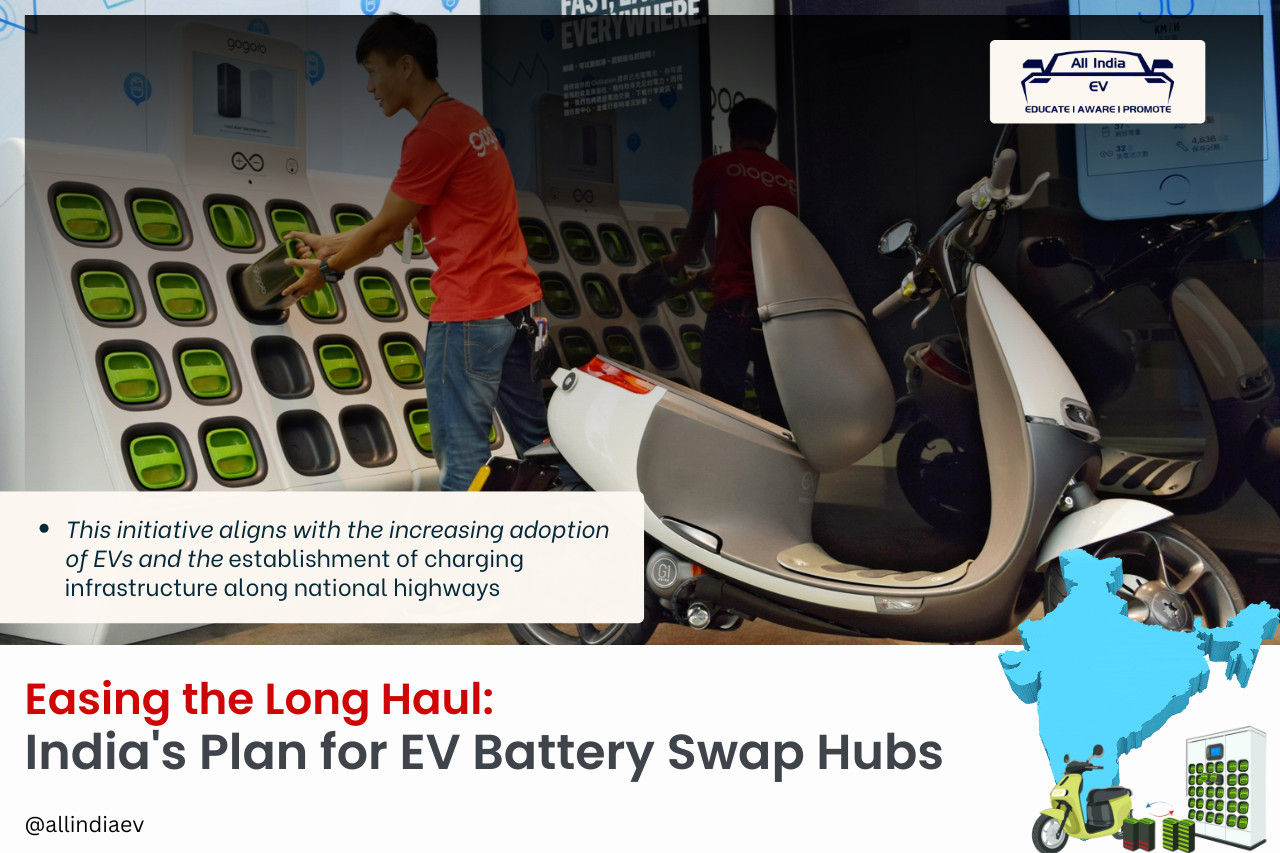
India’s plan for EV battery swap hubs aims to ease long-distance travel and boost electric mobility.

Contents
  • Subsidy Scheme in the Works for Battery Swapping Stations
  • High-Level Talks and Strategic Planning
  • EV Adoption Is Soaring
  • National Highways to Host Swapping and Charging Hubs
  • Priority Corridors Identified for Early Rollout
  • A Vision for the Future of EV Mobility

As India accelerates its transition to electric mobility, the government is now focusing on creating battery swapping stations along major national highways to support seamless long-distance EV travel. The move aims to minimize vehicle downtime and eliminate long charging waits, especially for electric buses, trucks, and two- and three-wheelers.


Subsidy Scheme in the Works for Battery Swapping Stations

The central government is planning to introduce subsidies for setting up battery swapping infrastructure, making it easier for EV users to exchange discharged batteries for fully charged ones in minutes. This initiative is expected to benefit commercial and fleet vehicles, helping them maintain operational efficiency on long-haul routes.

“The details of subsidies are being worked out, but the initial focus will be on heavy-duty and public mobility vehicles,” said a government official.

While battery swapping for electric cars is not immediately in the pipeline—due to the absence of standardized protocols—the government is actively working toward its inclusion in the near future.


High-Level Talks and Strategic Planning

The proposal was recently discussed at length in a high-level meeting involving officials from the Prime Minister’s Office and key ministries. The initiative is part of a broader strategy to address the growing number of EVs on Indian roads and ensure reliable, fast-charging alternatives for long-distance drivers.

EV Adoption Is Soaring

India’s electric vehicle ecosystem is expanding rapidly. According to official data, EVs now constitute 7.3% of all registered vehicles in the country in 2024–25, a massive jump from just 0.01% in 2014–15. Over 56.8 lakh EVs have been registered to date—and the numbers are expected to grow exponentially due to consistent government support and infrastructure expansion.

More EV News

Tesla’s
Tesla’s $1 Trillion Pay Package for Elon Musk Sparks Governance Concerns
Delhi CM Lays Foundation for ₹420-Cr Multi-Level Electric Bus Depot, Aims to Boost EV Mobility
India’s EV Pivot: 18 R&D Picks to Build the Core Hardware at Home
Tata and HPCL Aim to Establish 5,000 EV Charging Stations Nationwide by 2024
China’s EV slowdown could trigger the industry’s biggest global reset

National Highways to Host Swapping and Charging Hubs

To complement this growth, the government has identified 61 national highway corridors, covering a total of 25,639 km, for the rollout of charging and battery swapping infrastructure. The key deployment plan includes:

  • Charging/swapping stations every 100 km for buses and trucks
  • Stations every 20 km for cars, on both sides of the corridor
  • Battery swapping stations may either function as standalone centers or be co-located with EV public charging stations, offering flexible options to developers and users alike.

Priority Corridors Identified for Early Rollout

Several key national highway stretches have been marked for priority implementation of EV battery facilities, including:

  • Delhi–Chandigarh
  • Delhi–Jaipur
  • Bengaluru–Mumbai
  • Coimbatore–Bengaluru
  • Goa–Pune
  • Chennai–Bengaluru
  • Kochi–Kanyakumari
  • Prayagraj–Patna
  • Guwahati–Jorhat
  • Kharagpur–Visakhapatnam

A Vision for the Future of EV Mobility

Once the battery swapping protocols for cars are finalized and notified, experts believe it will revolutionize the Indian EV landscape, making electric vehicles a truly viable option for intercity and highway travel.This initiative marks another important step in India’s commitment to greener transport, reduced emissions, and building a future-ready EV infrastructure for all.

Join All India EV Community

Click here for more such EV Updates

Switch Mobility suspends Spanish manufacturing project, plans exports from India this year
Skoda’s Mass-Market Electric SUV: 2027 India Launch
Volkswagen to develop low-cost electric car to tackle Chinese rivals
Delhi Extends EV Policy to Combat Air Pollution Until March 2025
OnEv Plans to Expand Fleet with 500 E3W and 100 E4W This Fiscal Year

Sign Up For Daily Newsletter

Be keep up! Get the latest breaking news delivered straight to your inbox.
Loading
By signing up, you agree to our Terms of Use and acknowledge the data practices in our Privacy Policy. You may unsubscribe at any time.
Share This Article
Facebook Whatsapp Whatsapp LinkedIn Copy Link Print
Leave a Comment

Leave a Reply Cancel reply

Your email address will not be published. Required fields are marked *

Follow US
XFollow
InstagramFollow
YoutubeSubscribe
LinkedInFollow
What Happened: JBM Auto’s arm has secured ₹750 crore in funding from Motilal Oswal to support the expansion of its electric bus rollout. The capital is expected to strengthen fleet deployment and execution capacity as India’s e-bus market scales up. The Key Number: ₹750 crore. Why It Matters: This is a strong financing signal for India’s electric bus ecosystem, where large upfront costs often slow deployment. Fresh funding can accelerate production, procurement, and route expansion for clean public transport.
JBM Auto arm gets ₹750 crore funding from Motilal Oswal to expand e-bus rollout
25 June 2026
Tata Motors secures 3,400 ECV orders signals scale-up of electric commercial mobility in India
25 June 2026
Himadri raises IBC stake
25 June 2026
All India EV: Edition 50
What all happened in May 2026?
Click Here
All India EV

Daily EV Industry updates for you…

Categories

  • EV News
  • EV Launch
  • Investments & Funding
  • Market Insights
  • Guest Articles
  • EV Engineering

Quick Links

  • Community
  • Content Services
  • Branding Services
  • My EV Charger
  • Substack

© Developed and Managed by “The Energy Log”

Welcome Back!

Sign in to your account

Username or Email Address
Password

Lost your password?

Not a member? Sign Up