
All India EVAll India EVAll India EV
Notification
Font ResizerAa
  • Home
  • EV News
  • EV Launch
  • Market Insights
  • Investments & Funding
  • Guest Articles
  • EV Engineering
  • Contact
Reading: India-EU Matchmaking: Fostering EV Battery Recycling
Share
All India EVAll India EV
Font ResizerAa
  • Home
  • EV News
  • EV Launch
  • Market Insights
  • Guest Articles
  • EV Engineering
  • Contact
Search
  • Home
    • Home 1
    • Home 2
    • Home 3
    • Home 4
    • Home 5
  • Home
  • Categories
    • Electric
  • Categories
  • Shows
    • Rap
  • More Foxiz
    • Blog Index
    • Contact
  • Bookmarks
    • Customize Interests
    • My Bookmarks
  • More Foxiz
    • Blog Index
    • Sitemap
Have an existing account? Sign In
Follow US
India-EU Matchmaking: Fostering EV Battery Recycling
Home » Blog » India-EU Matchmaking: Fostering EV Battery Recycling
EV News

India-EU Matchmaking: Fostering EV Battery Recycling

Ankit Sharma
By
Ankit Sharma
ByAnkit Sharma
Follow:
Last updated: 7 October 2024
Share
4 Min Read
SHARE
India-EU Matchmaking: Fostering EV Battery Recycling

India-EU Matchmaking: Fostering EV Battery Recycling

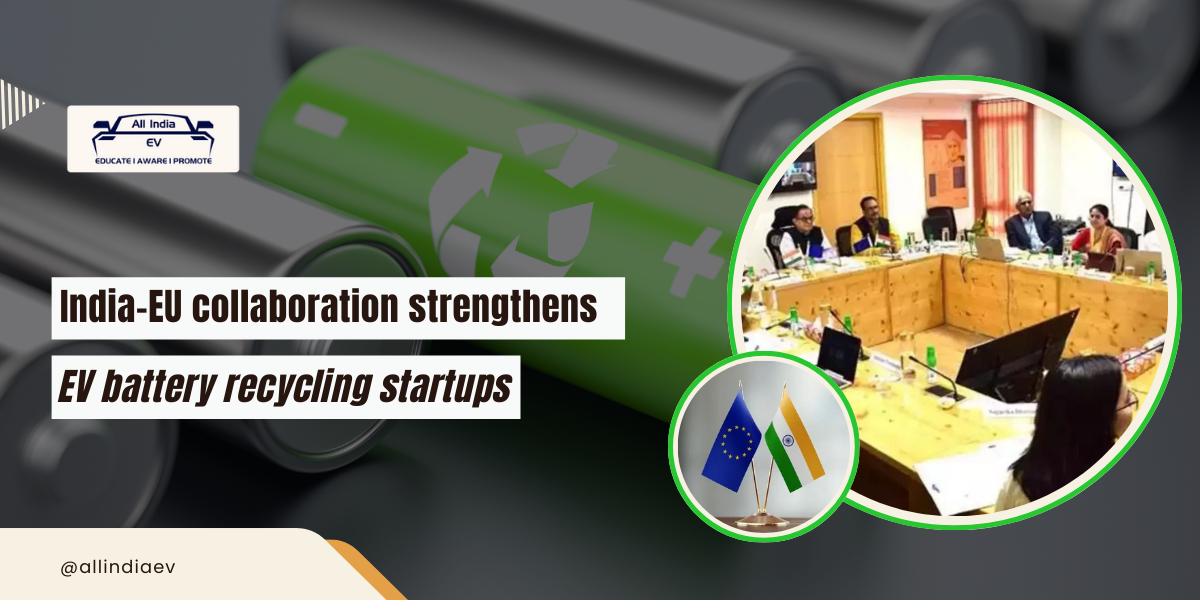
The Office of the Principal Scientific Adviser (PSA) to the Government of India hosted a delegation from the European Union (EU) today. The delegation included representatives from startups specializing in battery recycling technologies from EU member states, officials from the Delegation of the EU to India, and members from select Indian startups.

This important meeting focused on learnings gained by the startups through their recent immersion visits. These visits were an outcome of the Electric Vehicle (EV) battery recycling matchmaking event held on June 20th, 2024, under the India-EU Trade and Technology Council’s Working Group 2 (WG2) on Green & Clean Energy Technologies.

The discussion was chaired by Prof. Ajay Kumar Sood, Principal Scientific Adviser to the Government of India. He emphasized the importance of collaboration between India and the EU in fostering innovation for clean and green energy technologies. Dr. Parvinder Maini, Scientific Secretary at the Office of the PSA, joined Prof. Sood in underlining the significance of this partnership.

Shared Vision: India, EU Emphasize Innovation in EV Battery Recycling

Distinguished guests included Dr. Ewa Suwara, Deputy Head of the EU Delegation to India, and D.Ing. Pierrick Fillon-Ashida, Head of Research & Innovation, EU Delegation to India. Representatives from the Office of the PSA, Dr. Monoranjan Mohanty and Dr. Hafsa Ahmad, also participated.

The interaction highlighted the significant progress made in fostering collaboration between Indian and European startups in the critical area of EV battery recycling technologies. Key speakers emphasized the shared commitment of India and the EU to innovation, sustainability, and the transition to a circular economy.

“This collaboration opens up new opportunities for technology transfer, market access, and co-development, … It is essential for fostering economic resilience and sustainable development.”

Prof. Ajay Kumar Sood, Principal Scientific Adviser

EU and Indian Startups Join Forces for Sustainable EV Future

More EV News

Hyundai Motor and TVS Motor Formalize Partnership to Drive Electric Three-Wheeler Commercialization in India]
Hyundai Motor and TVS Motor Formalize Partnership to Drive Electric Three-Wheeler Commercialization in India
Finayo targets to disburse Rs 100 crore funds for EV financing in FY2024
Volkswagen Doubles Down on EV Future with $800M Rivian Investment
Bounce Infinity Teams Up With BaaYu To Boost EV Adoption In Assam
Kozhikode Entrepreneur Pioneers Sustainable Transportation in Malawi with EV Initiative

“Recycling EV batteries is a critical issue for both geopolitics and climate change. Every ounce recovered enhances energy security and fuels green growth. This partnership between EU and Indian startups is a shining example of collaboration in action, shaping a more sustainable tomorrow.”

Dr. Ewa Suwara, Deputy Head of the EU Delegation to India.

During the event, Indian startups who were winners of the June 2024 matchmaking event shared their experiences from immersion trips to the EU. These insights included valuable learnings and potential market opportunities. In parallel, EU startups currently visiting India for immersion trips also shared their expectations and vision, contributing to a deeper understanding of cross-regional collaboration. Participating startups from India included BatX Energies, Evergreen Lithium Recycling Pvt Ltd., LW3 Pvt Ltd. and Lohum, while startups from the EU included Ecomet Refining and Eneris.  

About the India-EU Trade and Technology Council (TTC)

The India-EU TTC was established in February 2023 as a strategic coordination mechanism to address challenges at the intersection of trade, trusted technology, and security. This council deepens cooperation between India and the EU in these fields and is a key step towards a strengthened strategic partnership.  

The TTC consists of three Working Groups:

  • Working Group 1: Strategic Technologies, Digital Governance and Digital Connectivity
  • Working Group 2: Green and Clean Energy Technologies
  • Working Group 3: Trade, Investment and Resilient Value Chains

The matchmaking event on EV battery recycling technologies was one of the key short-term actions implemented under Working Group 2 on Green and Clean Energy Technologies.Sources and related content.

Join All India EV Community

Click here for more such EV Updates

Boosting Property Value in Tier-2 & 3 Cities with EV Charging
Coal India Partners with US Company to Explore Lithium Assets in Argentina
Omega Seiki and Attero Team Up to Transform EV Industry and Advance Battery Recycling
Let’s DriEV: Green Mobility Innovation in Tier 2 and beyond
Hindalco Drives EV Revolution with Copper Foil Production
TAGGED:EUEV BatteryEV IndiaIndiaIndia EU

Sign Up For Daily Newsletter

Be keep up! Get the latest breaking news delivered straight to your inbox.
Loading
By signing up, you agree to our Terms of Use and acknowledge the data practices in our Privacy Policy. You may unsubscribe at any time.
Share This Article
Facebook Whatsapp Whatsapp LinkedIn Copy Link Print
Leave a Comment

Leave a Reply Cancel reply

Your email address will not be published. Required fields are marked *

Follow US
XFollow
InstagramFollow
YoutubeSubscribe
LinkedInFollow
Haryana cabinet approves new rules: No petrol, diesel vehicles for cab aggregators in NCR
21 May 2026
Ultraviolette and Bolt.Earth Expand Type-6 DC Fast Charging Infrastructure Across India
Ultraviolet and Bolt. Earth Expand Type-6 DC Fast Charging Infrastructure Across India
21 May 2026
What: India’s finance ministry has directed public sector banks, insurers, and financial institutions to reduce operational spending and accelerate adoption of electric vehicles across official fleets. The move is part of a wider austerity push linked to rising global economic uncertainty and fuel-related risks. The Number: The directive impacts major public institutions including State Bank of India, Bank of Baroda, and Life Insurance Corporation of India, covering millions of employees and thousands of operational vehicles nationwide. The Impact: The policy signals a new phase of institutional fleet electrification in India, where EV adoption is now being tied directly to fiscal discipline, fuel import management, and public-sector operational efficiency. The Core News India’s finance ministry has formally instructed state-run financial institutions to implement strict expenditure controls while simultaneously accelerating EV adoption for official transport operations. The directive from the Department of Financial Services asks organisations to replace petrol and diesel vehicles used at head offices and branch operations with electric vehicles “as far as possible.” The order comes amid growing concern over the economic impact of prolonged geopolitical instability in West Asia, which threatens to increase crude oil prices, widen India’s import bill, and pressure the rupee. Alongside the EV transition mandate, the government has also pushed virtual meetings, reduced foreign travel, and tighter administrative spending controls across public-sector institutions. For India’s EV ecosystem, the directive is strategically important because it expands demand visibility beyond state transport undertakings and government departments into the financial sector itself. PSU banks and insurers operate one of the country’s largest distributed office networks, including regional offices, branch fleets, field operations, and administrative mobility services. Even a phased transition could create a sizeable procurement pipeline for electric passenger vehicles, charging infrastructure providers, and fleet management companies. Breaking Down the Update • The Department of Financial Services issued the austerity and EV adoption directive to PSU banks, insurers, and financial institutions. • The government wants petrol and diesel vehicles used in official operations to be progressively replaced by EVs wherever operationally feasible. • The policy push follows Prime Minister Narendra Modi’s appeal for fuel conservation and controlled discretionary spending amid global energy uncertainty. • The directive also mandates greater use of video conferencing to reduce travel-related operational expenditure. • The move could indirectly support domestic EV OEMs, leasing firms, and charging infrastructure operators through institutional procurement demand. • The banking and insurance sector may emerge as a new enterprise fleet electrification category in India’s EV transition roadmap. How PSU banks EV adoption will help Indian EV Market The expansion of PSU banks EV adoption could create a strong institutional demand layer for India’s electric mobility sector. Public sector banks and insurers operate thousands of branch offices across urban, semi-urban, and rural India. Their transition to EV fleets can generate predictable procurement volumes for domestic automakers, especially in the electric sedan, compact SUV, and commercial mobility segments. Beyond vehicle sales, the policy may also accelerate deployment of workplace charging infrastructure at bank headquarters, zonal offices, and regional branches. This can support charger utilisation economics while helping normalise EV infrastructure in tier-2 and tier-3 cities. Another important impact is signalling. When large state-linked financial institutions adopt EVs as operational assets rather than pilot projects, it improves confidence across the broader enterprise mobility market. Private banks, NBFCs, and insurance firms could eventually follow similar fleet transition models to reduce long-term fuel and maintenance costs. PSU banks EV adoption also aligns with India’s larger energy security strategy. Lower petroleum consumption in institutional fleets directly supports efforts to reduce crude import dependence while stabilising operational expenditure during periods of volatile global oil prices. Conclusion & Next Steps The government’s push toward PSU banks EV adoption reflects a broader shift where EV deployment is increasingly being linked with macroeconomic resilience rather than only sustainability targets. Execution, however, will depend on procurement timelines, charging infrastructure readiness, and operational suitability across
India directs state-run banks, insurance firms to cut costs, shift to EVs
21 May 2026
All India EV: Edition 49
What all happened in April 2026?
Click Here
All India EV

Daily EV Industry updates for you…

Categories

  • EV News
  • EV Launch
  • Investments & Funding
  • Market Insights
  • Guest Articles
  • EV Engineering

Quick Links

  • Community
  • Content Services
  • Branding Services
  • My EV Charger
  • Substack

© Developed and Managed by “The Energy Log”

Welcome Back!

Sign in to your account

Username or Email Address
Password

Lost your password?

Not a member? Sign Up