

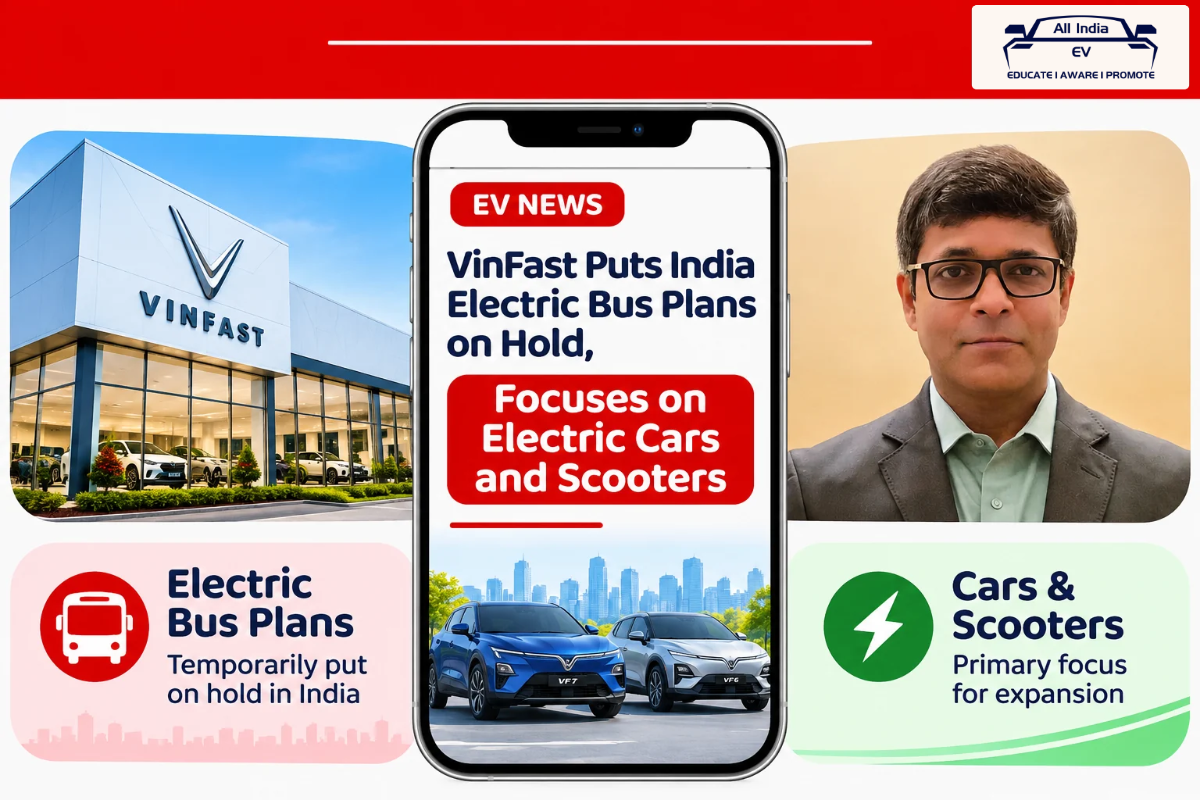
Vietnamese electric vehicle manufacturer VinFast has put its plans to enter India’s electric bus market on hold as the company shifts its immediate attention towards expanding its electric passenger vehicle portfolio and establishing its electric two-wheeler business. The decision marks a change in the company’s earlier strategy of entering multiple electric mobility segments in India simultaneously.
VinFast had previously planned to introduce electric buses and electric two-wheelers in India during the second half of 2026. However, the company has now decided to adopt a phased expansion strategy to strengthen its presence in the passenger electric vehicle market before moving into additional segments.
Speaking about the decision, Tapan Ghosh, CEO of VinFast Asia, said the company does not want to rush multiple product launches simultaneously, as doing so could affect its ability to execute each business effectively. He confirmed that electric bus plans have been postponed and that the company will prioritise four-wheelers and two-wheelers for now.
The decision comes nearly a year after VinFast signed an agreement with the Tamil Nadu government in December 2025 to expand its manufacturing operations in the state. Under the agreement, the government proposed allocating approximately 500 acres of additional land, while VinFast announced plans to invest $500 million in dedicated manufacturing facilities and production lines for electric buses and scooters. This investment was part of the company’s broader $2 billion commitment to India.
However, VinFast has not announced a revised timeline for its electric bus entry or clarified whether the postponement will affect its previously announced manufacturing investment.
VinFast Strengthens Its Electric Car Portfolio in India
VinFast currently sells four electric passenger vehicle models in India: the VF6 and VF7 electric SUVs, along with the MPV7 and Limo Green. The company has been witnessing a steady improvement in its sales performance since entering the Indian market.
Its monthly vehicle registrations have increased from approximately 300 units during the initial months to around 2,500–3,000 units, including personal and fleet vehicles.
According to VAHAN data, VinFast registered 14,637 electric passenger vehicles between September 6, 2025, and October 14, 2026. This gave the company approximately 4% market share and placed it fourth in India’s electric passenger vehicle market.
During the first half of FY27, the company dispatched 13,307 vehicles, according to SIAM wholesale data. The Limo Green electric MPV accounted for more than 7,000 units, followed by the VF7 with 3,519 units and the VF6 with 2,076 units.
As part of its next expansion phase, VinFast is preparing to introduce the VF5 electric SUV in India in 2027. The smaller electric SUV is expected to help the company reach more price-conscious customers and compete with established models such as the Tata Nexon.
Electric Scooter Launch Planned for Early 2027
Alongside passenger vehicles, VinFast is preparing to enter India’s electric two-wheeler market in early 2027. The company plans to introduce electric scooters based on its existing Vietnamese models, including the Evo, Kyo and Kinet.
These scooters will receive India-specific modifications to their chassis, design and specifications to suit local road conditions and customer requirements.
VinFast has already signed agreements with more than 50 dealer partners across 34 cities in 15 states. It is also developing a dedicated electric two-wheeler production line at its Thoothukudi manufacturing facility.
The proposed production infrastructure has the potential to scale up to one million electric two-wheelers annually. However, the company has not finalised its initial production capacity, and future investments will depend on market demand.
India’s Electric Bus Market Continues to Expand
VinFast’s decision to postpone its electric bus plans comes at a time when India’s electric bus market is witnessing increasing opportunities through government-backed procurement programmes.
Under the PM E-DRIVE scheme, the government had allocated 14,000 electric buses as of August 2026, with 13,800 buses earmarked for seven major cities, including Delhi, Bengaluru, Mumbai, Hyderabad and Pune.
While VinFast has temporarily stepped back from this segment, its future entry into the electric bus market remains open, although the company has not announced a revised launch schedule.
For now, VinFast is concentrating on strengthening its electric car portfolio, preparing its scooter launch and expanding domestic manufacturing capabilities. Its future investments and production expansion will largely depend on customer response and market demand.
The company’s phased approach highlights its intention to establish a stronger position in India’s competitive electric passenger vehicle and two-wheeler markets before expanding into additional electric mobility segments.