

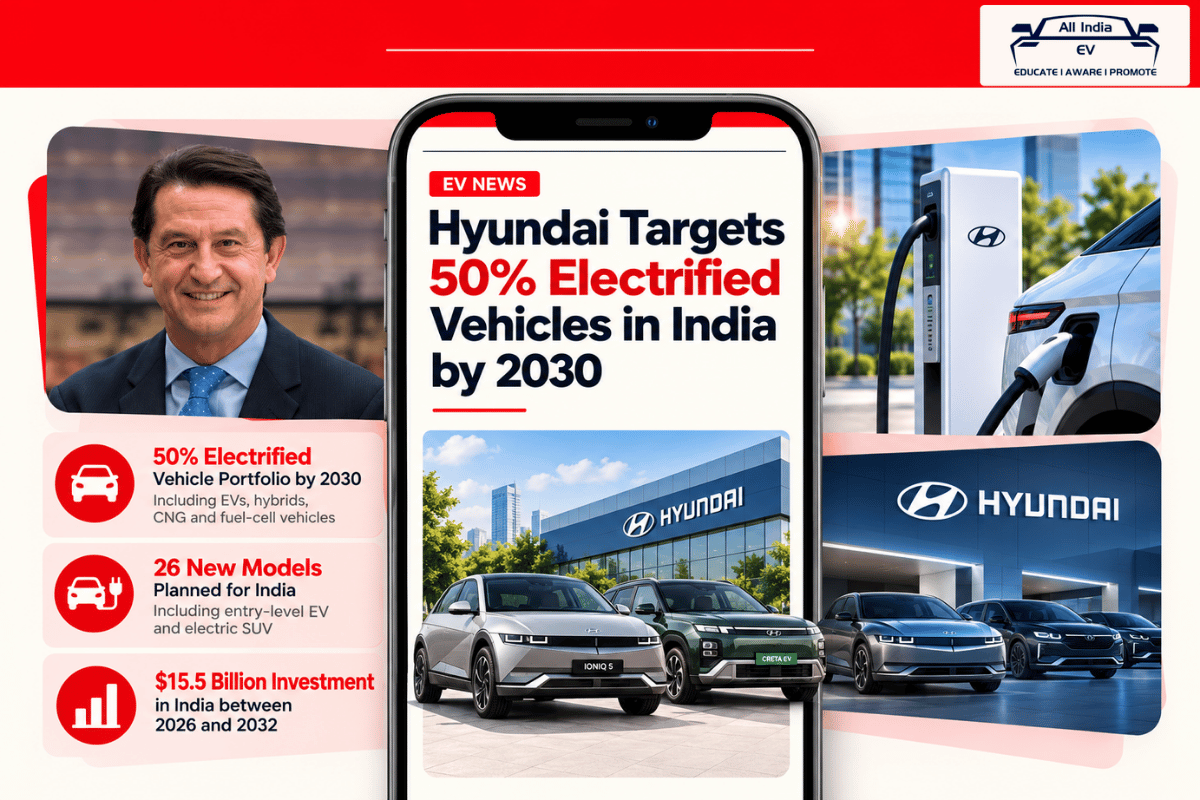
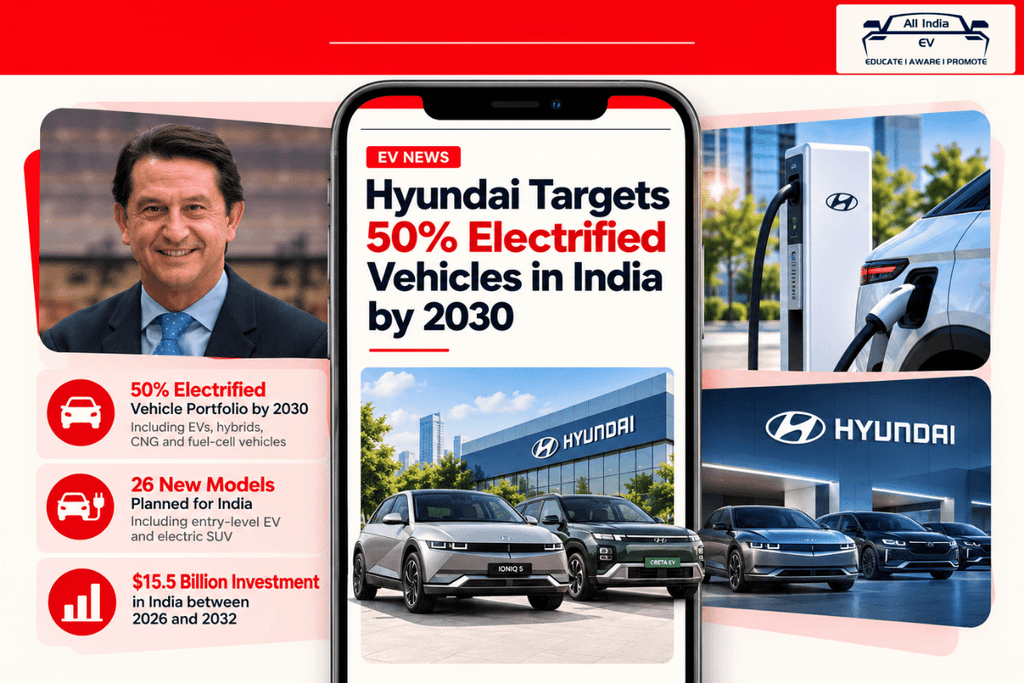
Hyundai Motor Company has announced an ambitious electrification roadmap for India, aiming to make around 50% of its vehicle portfolio electrified by 2030. The plan includes electric vehicles (EVs), hybrid models, CNG-powered vehicles and fuel-cell vehicles, reflecting the automaker’s strategy to expand cleaner mobility options in one of its key global markets.
The company also plans to introduce 26 new vehicles in India, including electric models across multiple segments. Hyundai Motor Company President and CEO José Muñoz highlighted India’s growing importance to the company’s long-term investment strategy, particularly as the global automotive industry navigates changing trade policies, geopolitical uncertainties and evolving consumer preferences.
Hyundai Plans 26 New Models for India
Hyundai’s upcoming product lineup is expected to cover a wider range of customer requirements, from affordable entry-level vehicles to premium SUVs and off-road models. The company has indicated that its future offerings will include an entry-level electric vehicle and an electric SUV, strengthening its presence in India’s expanding EV market.
The planned launches are intended to support Hyundai’s growth ambitions while giving Indian customers more options across different vehicle categories. By expanding its product portfolio, the company aims to respond to rising demand for fuel-efficient vehicles and alternative powertrains.
Hyundai has maintained that electrification remains a key part of its long-term strategy, even as automotive manufacturers worldwide reassess the pace and economics of the transition to electric mobility. Its broader approach recognises that India’s market requires multiple powertrain technologies to serve customers with different budgets, driving patterns and infrastructure needs.
Manufacturing Expansion and Investment in India
Alongside its electrification plans, Hyundai is strengthening its manufacturing capabilities in India. The company has inaugurated its Talegaon facility in Pune, Maharashtra, and plans to increase the plant’s annual production capacity to 320,000 units by 2030. Combined with its Chennai operations, Hyundai Motor India’s total annual manufacturing capacity is expected to reach nearly 1.14 million vehicles.
The expansion is expected to support new vehicle launches, improve production flexibility and strengthen India’s position in Hyundai’s global manufacturing and export network. Greater local manufacturing could also help the company improve supply-chain efficiency and make future electric models more competitive.
Hyundai Motor Group has announced plans to invest $15.5 billion in India between 2026 and 2032, covering manufacturing, research and development, localisation and emerging mobility technologies. The investment programme reflects the group’s long-term commitment to the Indian automotive market.
Focus on Electric Vehicles and Charging Infrastructure
A key part of Hyundai’s strategy is to expand its electric vehicle portfolio while developing the supporting ecosystem. The company is preparing to introduce additional EVs and strengthen its presence in segments where demand for affordable electric mobility is growing.
Hyundai Motor India has also highlighted the importance of localising EV components and improving access to charging infrastructure. Investments in battery technology, power electronics and local supply chains could help reduce dependence on imported components and support the long-term growth of electric mobility in India.
The company’s plans also reflect the need to address practical concerns among Indian EV buyers, including vehicle prices, charging availability and driving range. A broader range of electric models could help Hyundai cater to customers looking for different vehicle sizes, features and price points.
What Hyundai’s 2030 Roadmap Means for India’s EV Market
Hyundai’s target of making around half its Indian vehicle portfolio electrified by 2030 signals a significant shift in its product strategy. However, the target includes CNG, hybrid and fuel-cell vehicles alongside battery-electric vehicles. It should not be interpreted as a commitment to make 50% of its portfolio fully electric.
For India’s EV industry, Hyundai’s expansion could intensify competition, encourage greater investment in local manufacturing and widen customer access to alternative powertrains. The introduction of new electric SUVs and entry-level EVs could be particularly important as automakers compete to make electric mobility more accessible.
The company’s success will depend on how effectively it launches new models, improves localisation, expands charging support and delivers competitive pricing. With manufacturing expansion and a broader product pipeline planned, Hyundai is positioning India as a major market in its transition towards cleaner mobility.
As the 2030 deadline approaches, Hyundai’s strategy could contribute to the evolution of India’s passenger vehicle market, where electric vehicles, hybrids and other lower-emission technologies are expected to play an increasingly important role.