
All India EVAll India EVAll India EV
Notification
Font ResizerAa
  • Home
  • EV News
  • EV Launch
  • Market Insights
  • Investments & Funding
  • Guest Articles
  • EV Engineering
  • Contact
Reading: What is Open Charge Point Protocol?
Share
All India EVAll India EV
Font ResizerAa
  • Home
  • EV News
  • EV Launch
  • Market Insights
  • Guest Articles
  • EV Engineering
  • Contact
Search
  • Home
    • Home 1
    • Home 2
    • Home 3
    • Home 4
    • Home 5
  • Home
  • Categories
    • Electric
  • Categories
  • Shows
    • Rap
  • More Foxiz
    • Blog Index
    • Contact
  • Bookmarks
    • Customize Interests
    • My Bookmarks
  • More Foxiz
    • Blog Index
    • Sitemap
Have an existing account? Sign In
Follow US
Open Charge Point Protocol (OCPP): The Backbone of Interoperable EV Charging Infrastructure
Home » Blog » What is Open Charge Point Protocol?
EV Engineering

What is Open Charge Point Protocol?

Ankit Sharma
By
Ankit Sharma
ByAnkit Sharma
Follow:
Last updated: 29 December 2024
Share
7 Min Read
SHARE
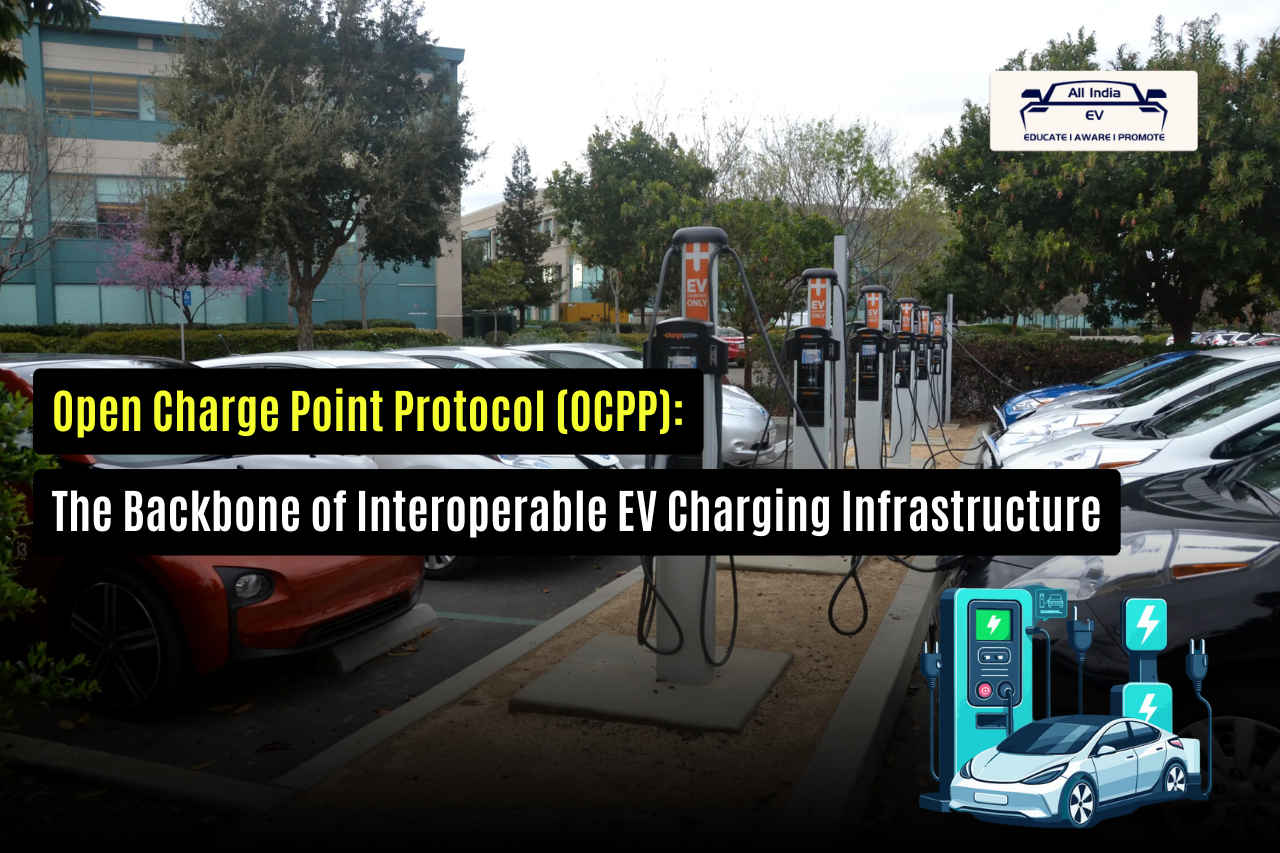
Open Charge Point Protocol (OCPP): The Backbone of Interoperable EV Charging Infrastructure

Open Charge Point Protocol (OCPP): The Backbone of Interoperable EV Charging Infrastructure

As the electric vehicle (EV) market expands, the need for seamless, interoperable, and efficient EV charging networks has become critical. At the heart of this ecosystem lies the Open Charge Point Protocol (OCPP)—an open standard that facilitates communication between EV chargers and backend systems. This article delves into the technical aspects of OCPP, its importance in modern EV infrastructure, and how it shapes the future of EV charging.

Contents
    • Open Charge Point Protocol (OCPP): The Backbone of Interoperable EV Charging Infrastructure
  • What is OCPP?
    • Key Features of OCPP
  • How OCPP Works
    • Core Components of OCPP Communication
    • Protocol Layers
  • Open Charge Point Protocol (OCPP) Versions and Their Features
    • OCPP 1.6
    • OCPP 2.0 and 2.0.1
  • Technical Benefits of OCPP
  • Why OCPP Matters in EV Charging
  • Use Cases of OCPP
  • Challenges with OCPP
  • Future of OCPP
  • Conclusion

What is OCPP?

The Open Charge Point Protocol (OCPP) is a communication protocol developed to standardize the interaction between Electric Vehicle Supply Equipment (EVSE) and Charging Station Management Systems (CSMS). It is an open-source standard, meaning it is not owned by any single company, and can be implemented freely by hardware manufacturers, software developers, and network operators.

Key Features of OCPP

  1. Interoperability: Enables charging stations from different manufacturers to communicate with various CSMS providers.
  2. Scalability: Supports small, independent networks as well as large, multi-station deployments.
  3. Cost Efficiency: Reduces vendor lock-in, allowing operators to mix and match components without being tied to a single manufacturer.
  4. Future-Ready: Regular updates ensure compatibility with evolving EV technologies and business models.

How OCPP Works

OCPP acts as a middle layer, standardizing communication between EVSE and the backend management systems.

Core Components of OCPP Communication

  1. EV Charger (Charge Point):
    • Hardware that delivers electricity to EVs.
    • Sends operational data (e.g., energy usage, status) to the CSMS.
  2. CSMS (Charging Station Management System):
    • Backend software that monitors, manages, and controls charging stations.
    • Provides functionalities such as billing, load management, and remote diagnostics.
  3. Communication Protocol:
    • OCPP specifies message types, data formats, and sequences for seamless interaction.

Protocol Layers

  • Physical Layer: OCPP supports communication over the internet using standard protocols like WebSocket or HTTP.
  • Message Layer: Defines message structures, ensuring both EVSE and CSMS interpret the data correctly.
  • Transport Layer: Ensures reliable delivery of data between the EVSE and CSMS.

Open Charge Point Protocol (OCPP) Versions and Their Features

OCPP has undergone several iterations, each adding more capabilities and refinements:

OCPP 1.6

  • Key Features:
    • Support for smart charging, including load balancing and demand response.
    • Firmware Management: Remote updates for charger software.
    • Diagnostics: Enhanced troubleshooting tools.
  • Communication Protocol: Introduced WebSocket support for real-time communication.

OCPP 2.0 and 2.0.1

  • Advanced Features:
    • Security: Implements transport layer security (TLS) and secure firmware updates.
    • Device Management: Enhanced control over individual charging station components (e.g., meters, power modules).
    • Improved Smart Charging:
      • Energy Management: Dynamic adjustments based on grid demand.
      • Pricing Models: Time-of-use pricing and energy cost calculations.
    • Plug & Charge: Compatibility with ISO 15118 for automated authentication and payment.
    • V2G Support: Integration with Vehicle-to-Grid (V2G) systems.
  • Backward Compatibility: Ensures smooth transitions for operators using earlier versions.

Technical Benefits of OCPP

  1. Standardization:
    • Facilitates compatibility across diverse hardware and software ecosystems.
    • Ensures global adoption, with OCPP used in over 90% of public chargers worldwide.
  2. Remote Management:
    • Enables operators to monitor station performance, diagnose issues, and deploy fixes without on-site visits.
    • Reduces downtime and operational costs.
  3. Smart Charging Capabilities:
    • Supports load management to avoid grid overloads.
    • Integrates with renewable energy sources for sustainable charging.
  4. Security:
    • Advanced encryption and secure firmware updates protect against cyberattacks.
    • Compliance with security standards like ISO 27001.

Why OCPP Matters in EV Charging

1. Interoperability: OCPP fosters a competitive and flexible market, preventing proprietary protocols from monopolizing the industry. This interoperability ensures that:

  • Operators can deploy chargers from multiple vendors.
  • Drivers can access chargers from various networks seamlessly.

2. Cost Savings: By adopting an open standard, businesses avoid vendor lock-in, allowing for cost-effective system upgrades and maintenance.

3. Future-Proofing: Regular updates to OCPP ensure compatibility with emerging technologies like Wireless charging, Integration with smart grids and IoT systems, and Advanced energy management systems.
More EV News

Battery Management System (BMS) Architecture: A Technical Overview
From BaaS to BaaB: A Paradigm Shift in EV Ownership
Introduction to Motor Controllers in EVs
Controller Design Considerations for Electric Motors
Part 3: Experimental verification, Experimental setup

Use Cases of OCPP

  1. Public Charging Networks: Large-scale operators like ChargePoint, EVBox, and Enel X use OCPP to manage diverse charger fleets efficiently.
  2. Fleet Management: Corporate and municipal EV fleets utilize OCPP for centralized charging and cost optimization.
  3. Energy Providers: Utilities integrate OCPP with grid management systems to enable demand response and load balancing.
  4. Residential and Workplace Charging: Home and workplace chargers connected to OCPP-compliant systems can integrate with energy storage and solar PV setups.

Challenges with OCPP

While OCPP offers numerous benefits, it also presents challenges:

  1. Implementation Complexity: Standard compliance requires robust software development and testing.
  2. Security Risks: Despite security features, vulnerabilities may arise if implementations are not rigorously audited.
  3. Market Fragmentation: Variations in adoption rates and version compatibility can create inconsistencies.

Future of OCPP

As EV adoption grows, OCPP will remain pivotal in advancing charging technology and infrastructure. Upcoming developments are likely to focus on:

  1. Enhanced Security: Improved encryption and threat detection mechanisms.
  2. V2G Integration: Supporting bi-directional energy flow for grid stabilization.
  3. AI and IoT: Leveraging artificial intelligence for predictive maintenance and dynamic load management.
  4. Global Standardization: Encouraging adoption across emerging markets to ensure uniformity worldwide.

Conclusion

The Open Charge Point Protocol (OCPP) has become the cornerstone of modern EV charging networks, enabling interoperability, scalability, and smart charging features. By fostering collaboration across manufacturers and operators, OCPP ensures a cohesive and efficient EV charging ecosystem. As the industry evolves, this open standard will continue to drive innovation, making EV charging more accessible, secure, and sustainable for all stakeholders.

Join All India EV Community

Click here for more such EV Updates

Cell-to-Cell Insulation: Enhance EV Battery Safety
Cell-to-Cell Insulation: The Critical Frontier for EV Battery Safety
Battery manufacturing: Quality and Consistency control
Solid-State Batteries: Performance and Applications
Role of Microcontrollers, sensors, and driver circuit in EV controllers
EV Skateboard Explain: Types, Features and Manufactures

Sign Up For Daily Newsletter

Be keep up! Get the latest breaking news delivered straight to your inbox.
Loading
By signing up, you agree to our Terms of Use and acknowledge the data practices in our Privacy Policy. You may unsubscribe at any time.
Share This Article
Facebook Whatsapp Whatsapp LinkedIn Copy Link Print
Leave a Comment

Leave a Reply Cancel reply

Your email address will not be published. Required fields are marked *

Follow US
XFollow
InstagramFollow
YoutubeSubscribe
LinkedInFollow
What: India’s finance ministry has directed public sector banks, insurers, and financial institutions to reduce operational spending and accelerate adoption of electric vehicles across official fleets. The move is part of a wider austerity push linked to rising global economic uncertainty and fuel-related risks. The Number: The directive impacts major public institutions including State Bank of India, Bank of Baroda, and Life Insurance Corporation of India, covering millions of employees and thousands of operational vehicles nationwide. The Impact: The policy signals a new phase of institutional fleet electrification in India, where EV adoption is now being tied directly to fiscal discipline, fuel import management, and public-sector operational efficiency. The Core News India’s finance ministry has formally instructed state-run financial institutions to implement strict expenditure controls while simultaneously accelerating EV adoption for official transport operations. The directive from the Department of Financial Services asks organisations to replace petrol and diesel vehicles used at head offices and branch operations with electric vehicles “as far as possible.” The order comes amid growing concern over the economic impact of prolonged geopolitical instability in West Asia, which threatens to increase crude oil prices, widen India’s import bill, and pressure the rupee. Alongside the EV transition mandate, the government has also pushed virtual meetings, reduced foreign travel, and tighter administrative spending controls across public-sector institutions. For India’s EV ecosystem, the directive is strategically important because it expands demand visibility beyond state transport undertakings and government departments into the financial sector itself. PSU banks and insurers operate one of the country’s largest distributed office networks, including regional offices, branch fleets, field operations, and administrative mobility services. Even a phased transition could create a sizeable procurement pipeline for electric passenger vehicles, charging infrastructure providers, and fleet management companies. Breaking Down the Update • The Department of Financial Services issued the austerity and EV adoption directive to PSU banks, insurers, and financial institutions. • The government wants petrol and diesel vehicles used in official operations to be progressively replaced by EVs wherever operationally feasible. • The policy push follows Prime Minister Narendra Modi’s appeal for fuel conservation and controlled discretionary spending amid global energy uncertainty. • The directive also mandates greater use of video conferencing to reduce travel-related operational expenditure. • The move could indirectly support domestic EV OEMs, leasing firms, and charging infrastructure operators through institutional procurement demand. • The banking and insurance sector may emerge as a new enterprise fleet electrification category in India’s EV transition roadmap. How PSU banks EV adoption will help Indian EV Market The expansion of PSU banks EV adoption could create a strong institutional demand layer for India’s electric mobility sector. Public sector banks and insurers operate thousands of branch offices across urban, semi-urban, and rural India. Their transition to EV fleets can generate predictable procurement volumes for domestic automakers, especially in the electric sedan, compact SUV, and commercial mobility segments. Beyond vehicle sales, the policy may also accelerate deployment of workplace charging infrastructure at bank headquarters, zonal offices, and regional branches. This can support charger utilisation economics while helping normalise EV infrastructure in tier-2 and tier-3 cities. Another important impact is signalling. When large state-linked financial institutions adopt EVs as operational assets rather than pilot projects, it improves confidence across the broader enterprise mobility market. Private banks, NBFCs, and insurance firms could eventually follow similar fleet transition models to reduce long-term fuel and maintenance costs. PSU banks EV adoption also aligns with India’s larger energy security strategy. Lower petroleum consumption in institutional fleets directly supports efforts to reduce crude import dependence while stabilising operational expenditure during periods of volatile global oil prices. Conclusion & Next Steps The government’s push toward PSU banks EV adoption reflects a broader shift where EV deployment is increasingly being linked with macroeconomic resilience rather than only sustainability targets. Execution, however, will depend on procurement timelines, charging infrastructure readiness, and operational suitability across
India directs state-run banks, insurance firms to cut costs, shift to EVs
20 May 2026
Uttar Pradesh To Get 714 New EV Charging Stations Under Centre’s Rs 500 Crore Infrastructure Push
20 May 2026
China’s EV slowdown could trigger the industry’s biggest global reset
20 May 2026
All India EV: Edition 49
What all happened in April 2026?
Click Here
All India EV

Daily EV Industry updates for you…

Categories

  • EV News
  • EV Launch
  • Investments & Funding
  • Market Insights
  • Guest Articles
  • EV Engineering

Quick Links

  • Community
  • Content Services
  • Branding Services
  • My EV Charger
  • Substack

© Developed and Managed by “The Energy Log”

Welcome Back!

Sign in to your account

Username or Email Address
Password

Lost your password?

Not a member? Sign Up