
All India EVAll India EVAll India EV
Notification
Font ResizerAa
  • Home
  • EV News
  • EV Launch
  • Market Insights
  • Investments & Funding
  • Guest Articles
  • EV Engineering
  • Contact
Reading: Cell-to-Cell Insulation: The Critical Frontier for EV Battery Safety
Share
All India EVAll India EV
Font ResizerAa
  • Home
  • EV News
  • EV Launch
  • Market Insights
  • Guest Articles
  • EV Engineering
  • Contact
Search
  • Home
    • Home 1
    • Home 2
    • Home 3
    • Home 4
    • Home 5
  • Home
  • Categories
    • Electric
  • Categories
  • Shows
    • Rap
  • More Foxiz
    • Blog Index
    • Contact
  • Bookmarks
    • Customize Interests
    • My Bookmarks
  • More Foxiz
    • Blog Index
    • Sitemap
Have an existing account? Sign In
Follow US
Cell-to-Cell Insulation: Enhance EV Battery Safety
Home » Blog » Cell-to-Cell Insulation: The Critical Frontier for EV Battery Safety
EV Engineering

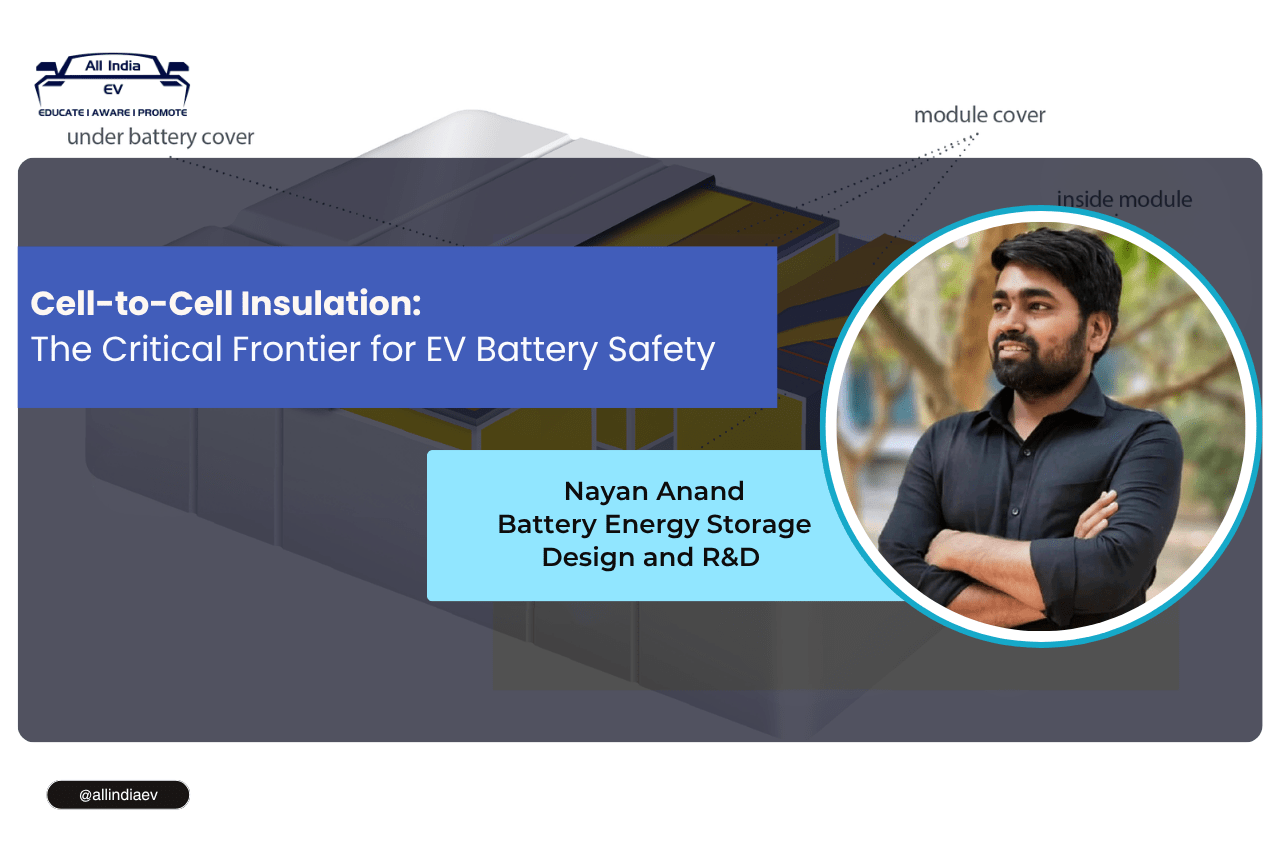
Cell-to-Cell Insulation: The Critical Frontier for EV Battery Safety

Ankit Sharma
By
Ankit Sharma
ByAnkit Sharma
Follow:
Last updated: 9 July 2025
Share
4 Min Read
SHARE
Cell-to-Cell Insulation: Enhance EV Battery Safety

Cell-to-Cell Insulation: Enhance EV Battery Safety

As electric vehicles (EVs) dominate automotive innovation, battery safety has emerged as the defining challenge of the decade. One concept stands out for its transformative potential: cell-to-cell insulation. Far from being a marginal design choice, it is the key to preventing catastrophic failures in EV battery packs.

Contents
  • Cell-to-Cell Insulation: Enhance EV Battery Safety
  • Moving Beyond Delay: Cell-to-Cell Insulation Stops Thermal Propagation
  • The Material Science Behind Thermal Barriers
    • 1. Aerogel Barriers
    • 2. Silicone Compression Pads
    • 3. Resin-Impregnated Mica
    • 4. Mica Sheets
  • Comparing Thermal Barrier Options
  • The Road Ahead
  • About The Author

Moving Beyond Delay: Cell-to-Cell Insulation Stops Thermal Propagation

Traditionally, thermal management strategies aimed to delay thermal propagation in the event of a cell failure. But in high-density EV battery packs, delay is no longer enough. A single cell undergoing thermal runaway can trigger a chain reaction, compromising the entire pack.

The solution? Don’t just delay thermal propagation. Stop it.

Cell-to-cell insulation acts as a thermal barrier, ensuring that heat from a failing cell doesn’t spread to adjacent cells. For manufacturers, this means the difference between a minor incident and a catastrophic fire.


The Material Science Behind Thermal Barriers

Not all thermal barrier materials are created equal. The EV industry now has a spectrum of options, each with trade-offs in thermal resistance, mechanical strength, cost, and ease of handling.

1. Aerogel Barriers

  1. Best for: Extreme thermal protection where space and weight are critical (aerospace, premium EV packs).
  2. Performance: Ultra-low thermal conductivity, with temperature resistance up to 650°C.
  3. Challenges: Brittle and fragile; requires support. High cost.

2. Silicone Compression Pads

  1. Best for: Thermal interface and insulation at contact zones (e.g., between cells and cooling plates).
  2. Performance: Moderate thermal insulation; excellent electrical insulation.
  3. Challenges: Limited temperature resistance (~200–250°C); heavier than aerogels.

3. Resin-Impregnated Mica

  1. Best for: All-round fire barriers between cells/modules.
  2. Performance: Withstands up to 1000°C; excellent fire resistance; strong and stable under heat.
  3. Challenges: Medium weight; cost-effective.

4. Mica Sheets

  1. Best for: High-temperature, rigid insulation, especially in structural or terminal zones.
  2. Performance: Handles up to 1000°C; excellent electrical insulation.
  3. Challenges: Brittle and prone to cracking; brittle during handling.

Comparing Thermal Barrier Options

FactorAerogelSilicone PadResin MicaMica Sheet
Thermal InsulationBest-in-classModerateGoodGood
Temp ResistanceUp to 650°C~200–250°CUp to 1000°CUp to 1000°C
Mechanical StrengthBrittle (needs support)Soft, flexibleStrong, heat-stableBrittle
Fire ResistanceNon-combustibleUL94-V0 gradesExcellent, non-flammableExcellent
Electrical InsulationGoodExcellentExcellentExcellent
CostHighModerateCost-effectiveLow to moderate
WeightUltra-lightHeavier than aerogelMediumMedium
Ease of HandlingDusty, fragileConformable, easy cutEasy to cut and layerBrittle when cut

The Road Ahead

As India accelerates its EV ambitions, battery safety innovations like cell-to-cell insulation must take center stage. Regulations are tightening, and consumer confidence hinges on manufacturers implementing robust thermal management solutions. The choice of thermal barrier material isn’t just a technical detail; it’s a strategic decision with far-reaching implications for performance, safety, and brand reputation.

The future is electric. Let’s ensure it’s also safe.

More EV News

Manufacturing Techniques for Solid State Batteries
Manufacturing Techniques for Solid-State Batteries
Part 4: Experimental results
Dual Battery Challenges Solved with Single Atom-Scale Solution
Unveiling Battery Cell Manufacturing: An Insightful Guide
Thermal Cooling Tubes: Compact Cooling for EV Batteries

About The Author

Nayan Anand: nayan.anand94@gmail.com

As a Battery Energy Storage Design and R&D professional passionate about sustainable energy, I’ve dedicated my career to building safer, more efficient, and innovative energy storage solutions. From pioneering India’s indigenously developed Al-Air cells and batteries to filing multiple design patents in metal-air technology, I’ve always believed that the smallest design decisions can make the biggest impact.

With hands-on experience across BESS for grid applications, mobility, and next-gen chemistries, I thrive at the intersection of creativity, engineering, and real-world impact. I’m driven by the mission to create technologies that not only solve technical challenges but also contribute to a cleaner, more resilient future.
Join All India EV Community

Click here for more such EV Updates

Vehicle-to-Grid Technology: An Overview
Aluminum’s Role in the Decarbonization of Batteries: A Sustainable Future
Role of Microcontrollers, sensors, and driver circuit in EV controllers
Understanding the Battery Management System
What is Open Charge Point Protocol?

Sign Up For Daily Newsletter

Be keep up! Get the latest breaking news delivered straight to your inbox.
Loading
By signing up, you agree to our Terms of Use and acknowledge the data practices in our Privacy Policy. You may unsubscribe at any time.
Share This Article
Facebook Whatsapp Whatsapp LinkedIn Copy Link Print
Leave a Comment

Leave a Reply Cancel reply

Your email address will not be published. Required fields are marked *

Follow US
XFollow
InstagramFollow
YoutubeSubscribe
LinkedInFollow
What: India’s finance ministry has directed public sector banks, insurers, and financial institutions to reduce operational spending and accelerate adoption of electric vehicles across official fleets. The move is part of a wider austerity push linked to rising global economic uncertainty and fuel-related risks. The Number: The directive impacts major public institutions including State Bank of India, Bank of Baroda, and Life Insurance Corporation of India, covering millions of employees and thousands of operational vehicles nationwide. The Impact: The policy signals a new phase of institutional fleet electrification in India, where EV adoption is now being tied directly to fiscal discipline, fuel import management, and public-sector operational efficiency. The Core News India’s finance ministry has formally instructed state-run financial institutions to implement strict expenditure controls while simultaneously accelerating EV adoption for official transport operations. The directive from the Department of Financial Services asks organisations to replace petrol and diesel vehicles used at head offices and branch operations with electric vehicles “as far as possible.” The order comes amid growing concern over the economic impact of prolonged geopolitical instability in West Asia, which threatens to increase crude oil prices, widen India’s import bill, and pressure the rupee. Alongside the EV transition mandate, the government has also pushed virtual meetings, reduced foreign travel, and tighter administrative spending controls across public-sector institutions. For India’s EV ecosystem, the directive is strategically important because it expands demand visibility beyond state transport undertakings and government departments into the financial sector itself. PSU banks and insurers operate one of the country’s largest distributed office networks, including regional offices, branch fleets, field operations, and administrative mobility services. Even a phased transition could create a sizeable procurement pipeline for electric passenger vehicles, charging infrastructure providers, and fleet management companies. Breaking Down the Update • The Department of Financial Services issued the austerity and EV adoption directive to PSU banks, insurers, and financial institutions. • The government wants petrol and diesel vehicles used in official operations to be progressively replaced by EVs wherever operationally feasible. • The policy push follows Prime Minister Narendra Modi’s appeal for fuel conservation and controlled discretionary spending amid global energy uncertainty. • The directive also mandates greater use of video conferencing to reduce travel-related operational expenditure. • The move could indirectly support domestic EV OEMs, leasing firms, and charging infrastructure operators through institutional procurement demand. • The banking and insurance sector may emerge as a new enterprise fleet electrification category in India’s EV transition roadmap. How PSU banks EV adoption will help Indian EV Market The expansion of PSU banks EV adoption could create a strong institutional demand layer for India’s electric mobility sector. Public sector banks and insurers operate thousands of branch offices across urban, semi-urban, and rural India. Their transition to EV fleets can generate predictable procurement volumes for domestic automakers, especially in the electric sedan, compact SUV, and commercial mobility segments. Beyond vehicle sales, the policy may also accelerate deployment of workplace charging infrastructure at bank headquarters, zonal offices, and regional branches. This can support charger utilisation economics while helping normalise EV infrastructure in tier-2 and tier-3 cities. Another important impact is signalling. When large state-linked financial institutions adopt EVs as operational assets rather than pilot projects, it improves confidence across the broader enterprise mobility market. Private banks, NBFCs, and insurance firms could eventually follow similar fleet transition models to reduce long-term fuel and maintenance costs. PSU banks EV adoption also aligns with India’s larger energy security strategy. Lower petroleum consumption in institutional fleets directly supports efforts to reduce crude import dependence while stabilising operational expenditure during periods of volatile global oil prices. Conclusion & Next Steps The government’s push toward PSU banks EV adoption reflects a broader shift where EV deployment is increasingly being linked with macroeconomic resilience rather than only sustainability targets. Execution, however, will depend on procurement timelines, charging infrastructure readiness, and operational suitability across
India directs state-run banks, insurance firms to cut costs, shift to EVs
20 May 2026
Uttar Pradesh To Get 714 New EV Charging Stations Under Centre’s Rs 500 Crore Infrastructure Push
20 May 2026
China’s EV slowdown could trigger the industry’s biggest global reset
20 May 2026
All India EV: Edition 49
What all happened in April 2026?
Click Here
All India EV

Daily EV Industry updates for you…

Categories

  • EV News
  • EV Launch
  • Investments & Funding
  • Market Insights
  • Guest Articles
  • EV Engineering

Quick Links

  • Community
  • Content Services
  • Branding Services
  • My EV Charger
  • Substack

© Developed and Managed by “The Energy Log”

Welcome Back!

Sign in to your account

Username or Email Address
Password

Lost your password?

Not a member? Sign Up