
All India EVAll India EVAll India EV
Notification
Font ResizerAa
  • Home
  • EV News
  • EV Launch
  • Market Insights
  • Investments & Funding
  • Guest Articles
  • EV Engineering
  • Contact
Reading: Kerala Notifies New Renewable Energy Regulations with Provisions for Vehicle-to-Grid Integration
Share
All India EVAll India EV
Font ResizerAa
  • Home
  • EV News
  • EV Launch
  • Market Insights
  • Guest Articles
  • EV Engineering
  • Contact
Search
  • Home
    • Home 1
    • Home 2
    • Home 3
    • Home 4
    • Home 5
  • Home
  • Categories
    • Electric
  • Categories
  • Shows
    • Rap
  • More Foxiz
    • Blog Index
    • Contact
  • Bookmarks
    • Customize Interests
    • My Bookmarks
  • More Foxiz
    • Blog Index
    • Sitemap
Have an existing account? Sign In
Follow US
vehicle-to-grid
Home » Blog » Kerala Notifies New Renewable Energy Regulations with Provisions for Vehicle-to-Grid Integration
Policy

Kerala Notifies New Renewable Energy Regulations with Provisions for Vehicle-to-Grid Integration

Sunita
By
Sunita
Last updated: 12 November 2025
Share
5 Min Read
SHARE

Kerala Sets ₹10 per Unit Tariff for Energy Export from Vehicle-to-Grid (V2G) Systems Under New Renewable Energy Regulations

Contents
  • V2G to Offer ₹10 Per Unit Tariff During Peak Hours
  • Special Time-of-Use Tariff and Dynamic Prici
  • Kerala’s Growing Focus on V2G Pilots
  • Rights and Responsibilities Defined
  • Implementation and Duration

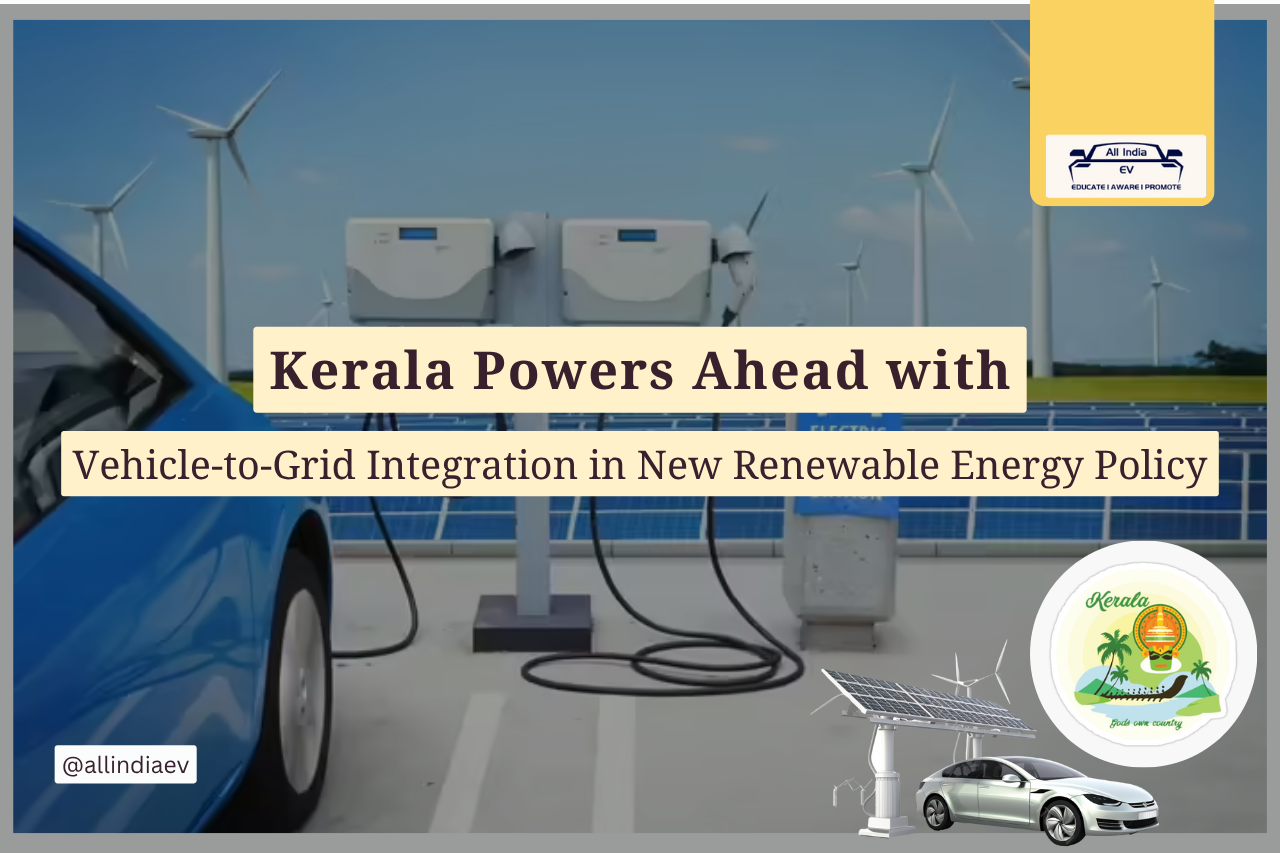
Kerala has taken a major step toward modernizing its power ecosystem by officially including vehicle-to-grid (V2G) technology in its new renewable energy regulations. The Kerala State Electricity Regulatory Commission (KSERC) has issued a regulatory framework enabling bi-directional energy flow between electric vehicles (EVs) and the power grid, marking a first-of-its-kind move in the State’s renewable energy roadmap.


Vehicle-to-Grid (V2G): The Future of Smart EV Charging in India


V2G to Offer ₹10 Per Unit Tariff During Peak Hours

Under the KSERC (Renewable Energy and Related Matters) Regulations, 2025, notified on November 5, the Commission has proposed a tariff of ₹10 per unit for electricity exported from V2G systems to the grid during peak demand hours.

The new rules officially recognize EVs as mobile energy storage units, allowing owners to supply power back to the grid and help balance electricity loads during high-demand periods. This step is expected to strengthen Kerala’s renewable energy infrastructure and support grid stability in a state increasingly dependent on distributed solar power.

Special Time-of-Use Tariff and Dynamic Prici

The regulations mandate the introduction of a special Time-of-Use (ToU) tariff to encourage EV owners to participate in V2G operations.

More EV News
EV import policy
India’s EV import policy Sees No Response from Industry
Karnataka Electricity Regulatory Commission relief sparks EV infra boom at petrol pumps
Rub of Green for EV Buyers Nationwide: Women May Get ₹30,000 Subsidy Under Delhi EV Policy 2.0
Maharashtra EV Policy Boosts Charging Network
Seven High-Impact Projects (e-Nodes) Selected for Support Under MAHA-EV Mission

“Dynamic pricing mechanisms shall be explored to compensate EV owners based on real-time grid conditions,” the Commission stated.

This means EV users could earn varying rates for exporting energy depending on grid demand and power supply availability, creating a smart, flexible energy marketplace.

Kerala’s Growing Focus on V2G Pilots

Kerala’s push for V2G adoption comes amid multiple pilot programs already underway. In July 2025, the Kerala State Electricity Board (KSEB) signed an MoU with IIT Bombay to test V2G systems through a two-phase pilot project. Around the same time, the Agency for New and Renewable Energy Research and Technology (ANERT) installed a demo V2G charging station at its headquarters in Thiruvananthapuram to raise public awareness about the technology.

These pilots have provided key insights into the technical feasibility and public response to grid-interactive EV charging — setting the stage for wider implementation.

Rights and Responsibilities Defined

The regulations clarify that all EV owners will have the right to export stored energy from their vehicles through authorized V2G-enabled charging stations.
Distribution licensees, on their part, are required to:

  • Facilitate seamless grid integration of V2G-capable vehicles.
  • Deploy smart meters and monitoring systems to track bi-directional power flow.
  • Ensure transparent energy accounting and settlement mechanisms.

All stakeholders — including EV owners, charging operators, and utilities — are eligible to participate in this system, fostering a collaborative clean-energy network.


Implementation and Duration

The KSERC will soon issue detailed procedures for implementing V2G participation, including energy accounting, settlement rules, and verification protocols. These will be finalised after pilot studies conducted by distribution licensees or designated agencies.

The new renewable energy regulations will remain in force until March 31, 2030, giving Kerala a clear timeline to scale up V2G technology and build a resilient, decentralized power grid.With this move, Kerala becomes one of India’s first states to formally recognize and regulate vehicle-to-grid integration, setting a benchmark for EV-driven energy innovation and smart grid modernization in the country.

Comment by Author:


Kerala’s inclusion of vehicle-to-grid (V2G) integration in its renewable energy regulations marks a defining moment in India’s clean energy journey. By officially recognizing EVs as mobile power assets, the state is transforming vehicles from simple modes of transport into active contributors to grid stability and energy resilience.

The ₹10 per unit peak-hour tariff and dynamic pricing mechanisms highlight a forward-thinking approach that rewards EV owners while supporting grid flexibility. As Kerala pioneers this model, it sets the stage for smart, decentralized energy systems that blend mobility, technology, and sustainability — a blueprint the rest of India can look to replicate.

Join All India EV Community

Click here for more such EV Updates

Loading

Maharashtra Unveils Ambitious EV Policy, Eyes 30% Adoption by 2030
Odisha Unveils EV Policy 2.0: Sets 50% EV Target by 2036, Boosts Charging Infrastructure and Incentives
Govt targets emission cut to 78.9 g/km under CAFE-III by FY32; industry backs credit trading, EV push
Karnataka will set up 1243 high capacity EV chargers
EV Incentives in UP to Apply Only for Locally Built Vehicles from October 14

Sign Up For Daily Newsletter

Be keep up! Get the latest breaking news delivered straight to your inbox.
Loading
By signing up, you agree to our Terms of Use and acknowledge the data practices in our Privacy Policy. You may unsubscribe at any time.
Share This Article
Facebook Whatsapp Whatsapp LinkedIn Copy Link Print
Leave a Comment

Leave a Reply Cancel reply

Your email address will not be published. Required fields are marked *

Follow US
XFollow
InstagramFollow
YoutubeSubscribe
LinkedInFollow
What: India’s finance ministry has directed public sector banks, insurers, and financial institutions to reduce operational spending and accelerate adoption of electric vehicles across official fleets. The move is part of a wider austerity push linked to rising global economic uncertainty and fuel-related risks. The Number: The directive impacts major public institutions including State Bank of India, Bank of Baroda, and Life Insurance Corporation of India, covering millions of employees and thousands of operational vehicles nationwide. The Impact: The policy signals a new phase of institutional fleet electrification in India, where EV adoption is now being tied directly to fiscal discipline, fuel import management, and public-sector operational efficiency. The Core News India’s finance ministry has formally instructed state-run financial institutions to implement strict expenditure controls while simultaneously accelerating EV adoption for official transport operations. The directive from the Department of Financial Services asks organisations to replace petrol and diesel vehicles used at head offices and branch operations with electric vehicles “as far as possible.” The order comes amid growing concern over the economic impact of prolonged geopolitical instability in West Asia, which threatens to increase crude oil prices, widen India’s import bill, and pressure the rupee. Alongside the EV transition mandate, the government has also pushed virtual meetings, reduced foreign travel, and tighter administrative spending controls across public-sector institutions. For India’s EV ecosystem, the directive is strategically important because it expands demand visibility beyond state transport undertakings and government departments into the financial sector itself. PSU banks and insurers operate one of the country’s largest distributed office networks, including regional offices, branch fleets, field operations, and administrative mobility services. Even a phased transition could create a sizeable procurement pipeline for electric passenger vehicles, charging infrastructure providers, and fleet management companies. Breaking Down the Update • The Department of Financial Services issued the austerity and EV adoption directive to PSU banks, insurers, and financial institutions. • The government wants petrol and diesel vehicles used in official operations to be progressively replaced by EVs wherever operationally feasible. • The policy push follows Prime Minister Narendra Modi’s appeal for fuel conservation and controlled discretionary spending amid global energy uncertainty. • The directive also mandates greater use of video conferencing to reduce travel-related operational expenditure. • The move could indirectly support domestic EV OEMs, leasing firms, and charging infrastructure operators through institutional procurement demand. • The banking and insurance sector may emerge as a new enterprise fleet electrification category in India’s EV transition roadmap. How PSU banks EV adoption will help Indian EV Market The expansion of PSU banks EV adoption could create a strong institutional demand layer for India’s electric mobility sector. Public sector banks and insurers operate thousands of branch offices across urban, semi-urban, and rural India. Their transition to EV fleets can generate predictable procurement volumes for domestic automakers, especially in the electric sedan, compact SUV, and commercial mobility segments. Beyond vehicle sales, the policy may also accelerate deployment of workplace charging infrastructure at bank headquarters, zonal offices, and regional branches. This can support charger utilisation economics while helping normalise EV infrastructure in tier-2 and tier-3 cities. Another important impact is signalling. When large state-linked financial institutions adopt EVs as operational assets rather than pilot projects, it improves confidence across the broader enterprise mobility market. Private banks, NBFCs, and insurance firms could eventually follow similar fleet transition models to reduce long-term fuel and maintenance costs. PSU banks EV adoption also aligns with India’s larger energy security strategy. Lower petroleum consumption in institutional fleets directly supports efforts to reduce crude import dependence while stabilising operational expenditure during periods of volatile global oil prices. Conclusion & Next Steps The government’s push toward PSU banks EV adoption reflects a broader shift where EV deployment is increasingly being linked with macroeconomic resilience rather than only sustainability targets. Execution, however, will depend on procurement timelines, charging infrastructure readiness, and operational suitability across
India directs state-run banks, insurance firms to cut costs, shift to EVs
20 May 2026
Uttar Pradesh To Get 714 New EV Charging Stations Under Centre’s Rs 500 Crore Infrastructure Push
20 May 2026
China’s EV slowdown could trigger the industry’s biggest global reset
20 May 2026
All India EV: Edition 49
What all happened in April 2026?
Click Here
All India EV

Daily EV Industry updates for you…

Categories

  • EV News
  • EV Launch
  • Investments & Funding
  • Market Insights
  • Guest Articles
  • EV Engineering

Quick Links

  • Community
  • Content Services
  • Branding Services
  • My EV Charger
  • Substack

© Developed and Managed by “The Energy Log”

Welcome Back!

Sign in to your account

Username or Email Address
Password

Lost your password?

Not a member? Sign Up