
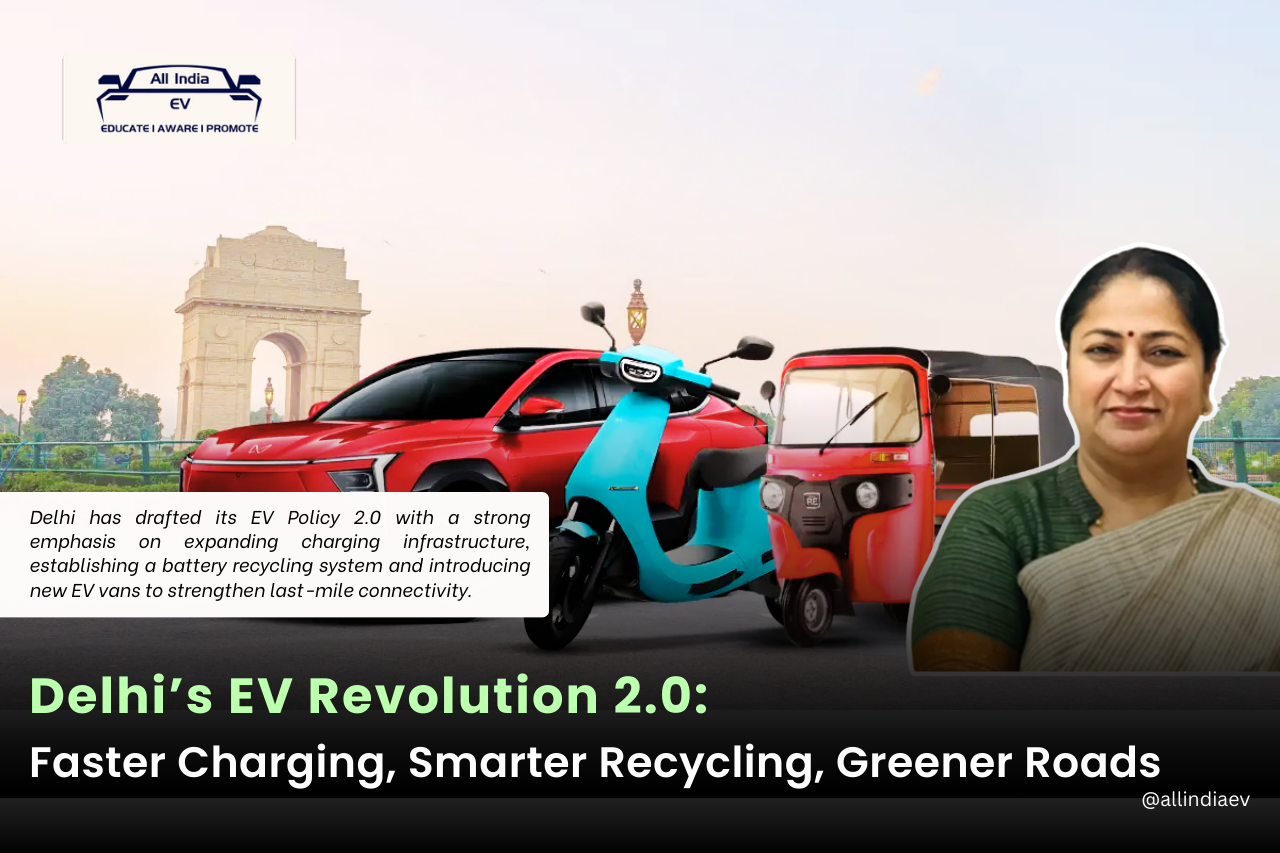

Delhi’s EV Policy 2.0 Focuses on Expanding Charging Infrastructure, Building Battery Recycling Systems & Introducing EV Vans for Last-Mile Connectivity
- Key Focus Areas of EV Policy 2.0: Charging, Recycling & Public Transport Strengthening
- 1. A Structured Battery Recycling System
- 2. Large-Scale Expansion of EV Charging Infrastructure
- Up to 50% Subsidy Proposed
- Charging Network Targets
- 3. Introduction of New EV Vans for Last-Mile Transport
- Policy Implementation Expected From New Year
- A Cleaner, Smarter Mobility Future for Delhi
The Delhi government has prepared the draft of its ambitious Electric Vehicle (EV) Policy 2.0, aiming to intensify the national capital’s shift toward clean mobility. Chief Minister Rekha Gupta has called a meeting of the Group of Ministers (GoM) on Thursday for final deliberations. Once approved, the draft will be released for public consultation to gather feedback from industry stakeholders, experts, and citizens.
Key Focus Areas of EV Policy 2.0: Charging, Recycling & Public Transport Strengthening
Sources familiar with the draft confirm that the new policy focuses sharply on three major pillars essential for accelerating EV adoption in Delhi:
1. A Structured Battery Recycling System
For the first time, Delhi plans to set up an organised and efficient battery recycling chain to address the growing challenge of used lithium-ion battery disposal.
The new system includes:
- Organised collection channels
- Standardised recycling processes
- Safe and environmentally compliant disposal mechanisms
This initiative is expected to significantly reduce battery waste and support the city’s sustainability goals.
2. Large-Scale Expansion of EV Charging Infrastructure
Delhi’s EV Policy 2.0 places major emphasis on building a widespread and reliable charging network across the capital.
More EV News

The government plans to substantially increase the number of public charging stations and is proposing attractive incentives to encourage more vehicle owners to switch to electric.
Up to 50% Subsidy Proposed
A provision of up to 50% subsidy is being considered to make EV adoption faster and more affordable. The subsidy will apply to:
- Conversion of ICE vehicles to electric
- Duties and costs related to purchasing new EVs
However, the final structure of these incentives will be decided by the Cabinet.
Officials clarified that subsidies will not be the central focus this time. Data reveals that many private and commercial EV buyers are no longer dependent on subsidies when choosing an electric vehicle. While incentives will remain part of the policy, EV adoption today is increasingly self-driven by performance, lower running costs, and environmental benefits.
Charging Network Targets
The government aims to install 5,000 public charging stations by 2030, with each station offering 4–5 charging points. These stations will be set up at:
- Market complexes
- Multi-level parking zones
- Residential societies and RWAs
- Government offices and buildings
- Major road corridors
Authorities stress that accessible, fast, and dependable charging remains the single biggest catalyst for EV adoption in Delhi.
3. Introduction of New EV Vans for Last-Mile Transport
To strengthen last-mile mobility, EV Policy 2.0 proposes the introduction of compact electric vans (7 passengers + driver). These vans—similar to the “Gramin Sewa” model—will operate in:
- Narrow residential lanes
- Crowded market areas
- Metro station zones where buses cannot operate
Additionally, a detailed route-mapping plan for e-rickshaws is part of the proposal to streamline operations and reduce congestion.
Policy Implementation Expected From New Year
The current EV Policy, introduced in August 2020, expires on December 31. Although extended multiple times, it did not deliver the expected boost in EV sales. To address these shortcomings, the Chief Minister formed a review committee led by Cabinet Minister Ashish Sood, which has now submitted the EV Policy 2.0 draft for final assessment.
Officials indicate that the new policy will be rolled out from the beginning of the New Year.
A Cleaner, Smarter Mobility Future for Delhi
The proposed stronger charging framework, structured battery recycling system, and introduction of EV vans are expected to significantly enhance Delhi’s daily mobility experience. If implemented effectively, EV Policy 2.0 could become a cornerstone of Delhi’s efforts to build a cleaner, greener, and more efficient urban transport ecosystem.
Author’s Comment:
Delhi’s EV Policy 2.0 sets a clear direction for the city’s electric mobility future by emphasising stronger charging infrastructure, responsible battery recycling, and smarter last-mile connectivity through EV vans.
If the government executes this roadmap with consistency and transparency, Delhi could emerge as a benchmark for sustainable urban transport in India.