
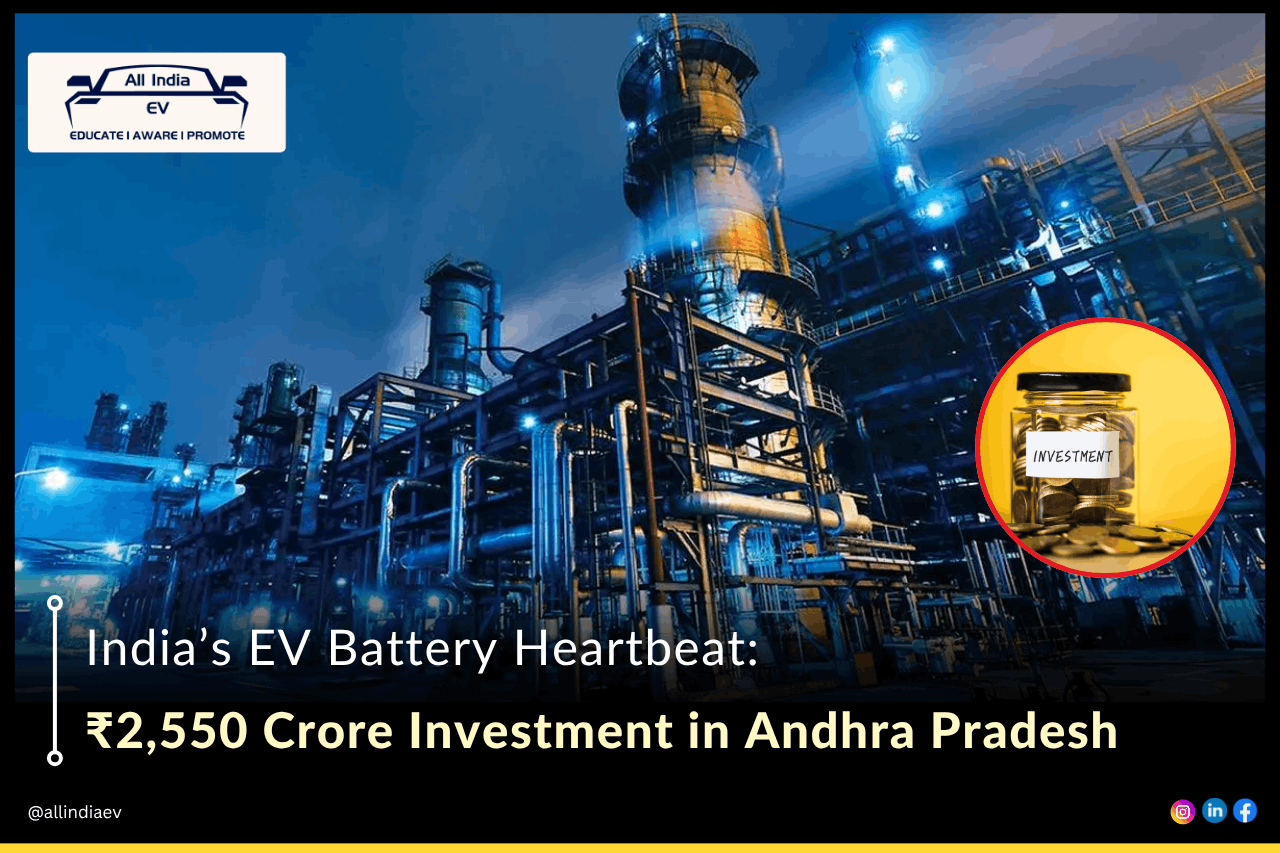

What: Andhra Pradesh has approved a ₹2,550 crore investment to set up a cathode material manufacturing facility in Chittoor by NPSPL Speciality Chemicals.
The Number: ₹2,550 crore investment | 105 acres land | ~400 direct jobs
The Impact: This project targets localization of a critical lithium-ion battery component, directly strengthening India’s EV and battery supply chain.

The Core News
Cathode Material Plant in AP: Rs 2,550 Cr Investment marks a strategic shift in India’s battery value chain, moving upstream into advanced materials manufacturing. The Andhra Pradesh government has cleared the project under its Electronics Component Manufacturing Policy (2025–30), positioning the state as a key node in EV supply chain localization.
The facility will manufacture cathode materials, one of the most critical and cost-intensive components in lithium-ion batteries. These materials directly influence battery energy density, lifecycle, and safety, making them central to EV performance and energy storage efficiency.
From a policy standpoint, the project reflects a targeted push toward import substitution. India currently depends heavily on global supply chains for battery materials. By incentivizing domestic production through capital subsidies, electricity duty exemptions, and power cost support, Andhra Pradesh is attempting to anchor early-stage battery manufacturing within India.
More EV News
Breaking Down the Update
• Investment cleared under Andhra Pradesh Electronics Component Manufacturing Policy (2025–30)
• Facility to be developed in Chittoor district across 105 acres
• Cathode materials identified as a strategic bottleneck in global battery supply chains
• Incentives include 100% electricity duty exemption for 10 years and capital subsidies
• Expected to generate ~400 direct jobs and catalyze EV ecosystem development
• Targets reduction in import dependence for critical battery materials
How Cathode Material Plant in AP: Rs 2,550 Cr Investment will help Indian EV Market
The Cathode Material Plant in AP: Rs 2,550 Cr Investment is a foundational move for India’s EV ecosystem, particularly in reducing reliance on imported battery components. Cathode materials account for a significant share of battery costs and technological differentiation, meaning domestic production can directly impact EV pricing and competitiveness.
For Indian EV manufacturers, localized cathode supply reduces exposure to volatile global supply chains, especially those concentrated in a few countries. This improves cost stability, supply security, and production planning, critical for scaling EV adoption.
The project also strengthens backward integration in India’s battery ecosystem. Instead of relying solely on cell imports or assembly, India begins to build capability in core materials, which is essential for long-term industrial independence.
Additionally, this investment is likely to trigger cluster development. Battery manufacturers, EV OEMs, and ancillary chemical industries tend to co-locate near such upstream facilities, creating a manufacturing ecosystem rather than isolated plants.
In the medium term, such projects could enable India to compete in global battery supply chains, not just as a market but as a production hub.
Way Forward ….
The Cathode Material Plant in AP: Rs 2,550 Cr Investment signals a clear shift toward deep localization of EV supply chains in India. The next phase to watch will be execution timelines, technology partnerships, and whether similar investments follow in anode materials and cell manufacturing. If scaled effectively, this could mark the beginning of India’s serious entry into the global battery materials race.
Read More: Catch up on All India EV’s related coverage on India’s evolving commercial EV subsidies and battery swapping policies at All India EV