
All India EVAll India EVAll India EV
Notification
Font ResizerAa
  • Home
  • EV News
  • EV Launch
  • Market Insights
  • Investments & Funding
  • Guest Articles
  • EV Engineering
  • Contact
Reading: India–EU Trade Pact to Ease Car Imports, But Benefits May Be Limited for Mass Market
Share
All India EVAll India EV
Font ResizerAa
  • Home
  • EV News
  • EV Launch
  • Market Insights
  • Guest Articles
  • EV Engineering
  • Contact
Search
  • Home
    • Home 1
    • Home 2
    • Home 3
    • Home 4
    • Home 5
  • Home
  • Categories
    • Electric
  • Categories
  • Shows
    • Rap
  • More Foxiz
    • Blog Index
    • Contact
  • Bookmarks
    • Customize Interests
    • My Bookmarks
  • More Foxiz
    • Blog Index
    • Sitemap
Have an existing account? Sign In
Follow US
India-EU Trade
Home » Blog » India–EU Trade Pact to Ease Car Imports, But Benefits May Be Limited for Mass Market
EV News

India–EU Trade Pact to Ease Car Imports, But Benefits May Be Limited for Mass Market

Sunita
By
Sunita
Last updated: 28 January 2026
Share
6 Min Read
SHARE

Lower tariffs may boost Europe’s luxury carmakers, but localisation norms and mass-market dynamics cap the wider impact, even as India’s auto components sector benefits.

Contents
  • What the tariff cuts mean
  • A departure from past FTAs
  • Localisation limits price impact
  • Opportunities for global players
  • Boost expected for auto components

India’s recently concluded free trade agreement (FTA) with the European Union promises to reshape automotive trade flows but industry experts warn that the gains may remain confined to premium carmakers rather than the broader domestic market.

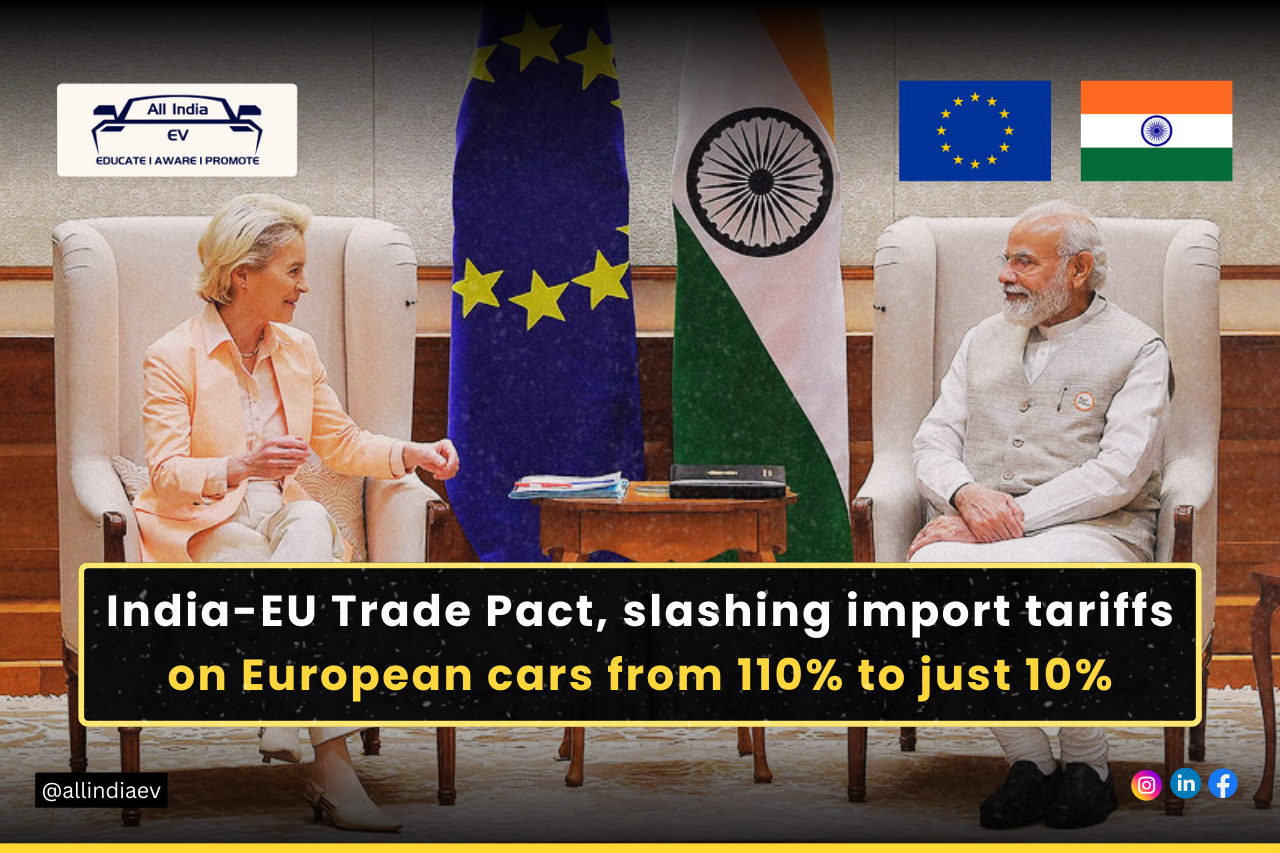
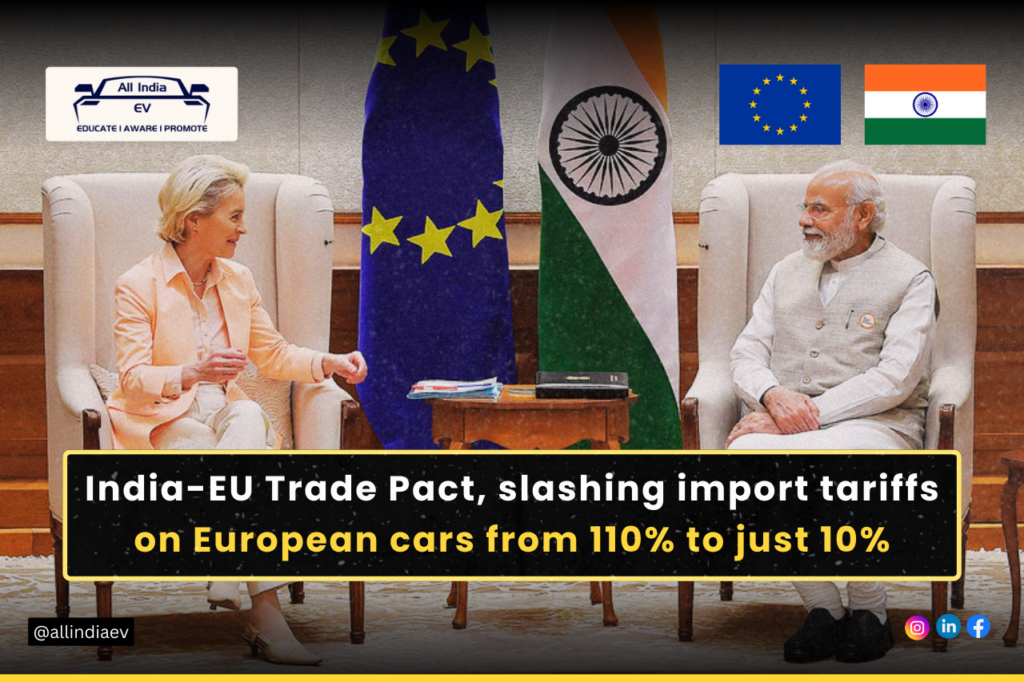
Under the agreement, India has committed to slashing import tariffs on European-built passenger vehicles from 110 per cent to 10 per cent, allowing up to 2,50,000 vehicles to enter the country at concessional duty rates. This marks one of India’s largest-ever tariff concessions in the auto sector, significantly exceeding quotas offered in other recent trade deals.

According to trade data, India imported motor vehicles worth more than €1.6 billion from the EU in 2024, underlining the bloc’s importance as a trading partner.


What the tariff cuts mean

Of the total quota agreed under the pact, around 1,60,000 internal combustion engine (ICE) vehicles will see import duties gradually reduced to 10 per cent within five years, while 90,000 electric vehicles (EVs) will be eligible for similar tariff benefits only by the tenth year of implementation.

Analysts say the move is likely to benefit Europe-based luxury automakers such as Audi, BMW and Mercedes-Benz, which import select models into India. However, its impact on the core of India’s auto market may be marginal.

India’s passenger vehicle landscape continues to be dominated by small and mid-sized cars priced between ₹10 lakh and ₹25 lakh, led by domestic and mass-market players such as Maruti Suzuki, Tata Motors, Mahindra & Mahindra and Hyundai Motor India.

More EV News

What: India’s finance ministry has directed public sector banks, insurers, and financial institutions to reduce operational spending and accelerate adoption of electric vehicles across official fleets. The move is part of a wider austerity push linked to rising global economic uncertainty and fuel-related risks. The Number: The directive impacts major public institutions including State Bank of India, Bank of Baroda, and Life Insurance Corporation of India, covering millions of employees and thousands of operational vehicles nationwide. The Impact: The policy signals a new phase of institutional fleet electrification in India, where EV adoption is now being tied directly to fiscal discipline, fuel import management, and public-sector operational efficiency. The Core News India’s finance ministry has formally instructed state-run financial institutions to implement strict expenditure controls while simultaneously accelerating EV adoption for official transport operations. The directive from the Department of Financial Services asks organisations to replace petrol and diesel vehicles used at head offices and branch operations with electric vehicles “as far as possible.” The order comes amid growing concern over the economic impact of prolonged geopolitical instability in West Asia, which threatens to increase crude oil prices, widen India’s import bill, and pressure the rupee. Alongside the EV transition mandate, the government has also pushed virtual meetings, reduced foreign travel, and tighter administrative spending controls across public-sector institutions. For India’s EV ecosystem, the directive is strategically important because it expands demand visibility beyond state transport undertakings and government departments into the financial sector itself. PSU banks and insurers operate one of the country’s largest distributed office networks, including regional offices, branch fleets, field operations, and administrative mobility services. Even a phased transition could create a sizeable procurement pipeline for electric passenger vehicles, charging infrastructure providers, and fleet management companies. Breaking Down the Update • The Department of Financial Services issued the austerity and EV adoption directive to PSU banks, insurers, and financial institutions. • The government wants petrol and diesel vehicles used in official operations to be progressively replaced by EVs wherever operationally feasible. • The policy push follows Prime Minister Narendra Modi’s appeal for fuel conservation and controlled discretionary spending amid global energy uncertainty. • The directive also mandates greater use of video conferencing to reduce travel-related operational expenditure. • The move could indirectly support domestic EV OEMs, leasing firms, and charging infrastructure operators through institutional procurement demand. • The banking and insurance sector may emerge as a new enterprise fleet electrification category in India’s EV transition roadmap. How PSU banks EV adoption will help Indian EV Market The expansion of PSU banks EV adoption could create a strong institutional demand layer for India’s electric mobility sector. Public sector banks and insurers operate thousands of branch offices across urban, semi-urban, and rural India. Their transition to EV fleets can generate predictable procurement volumes for domestic automakers, especially in the electric sedan, compact SUV, and commercial mobility segments. Beyond vehicle sales, the policy may also accelerate deployment of workplace charging infrastructure at bank headquarters, zonal offices, and regional branches. This can support charger utilisation economics while helping normalise EV infrastructure in tier-2 and tier-3 cities. Another important impact is signalling. When large state-linked financial institutions adopt EVs as operational assets rather than pilot projects, it improves confidence across the broader enterprise mobility market. Private banks, NBFCs, and insurance firms could eventually follow similar fleet transition models to reduce long-term fuel and maintenance costs. PSU banks EV adoption also aligns with India’s larger energy security strategy. Lower petroleum consumption in institutional fleets directly supports efforts to reduce crude import dependence while stabilising operational expenditure during periods of volatile global oil prices. Conclusion & Next Steps The government’s push toward PSU banks EV adoption reflects a broader shift where EV deployment is increasingly being linked with macroeconomic resilience rather than only sustainability targets. Execution, however, will depend on procurement timelines, charging infrastructure readiness, and operational suitability across
India directs state-run banks, insurance firms to cut costs, shift to EVs
Honda SC e Electric Scooter: Pricing, Range, and Specifications
Livguard Gears Up for Battery Dominance with Massive Capex
Ultraviolette F77 becomes India’s first motorcycle to complete Isle of Man TT Mountain Circuit
Hybrid Cars in India Bridging the Gap Between Petrol & Electric Vehicles

Ashim Sharma, Senior Partner and Business Unit Head at Nomura Research Institute, said the agreement leaves out the bulk of consumer demand.
“The deal excludes cars priced below ₹15 lakh and EVs in the near term, so it will not materially impact a large portion of the market,” he noted.


A departure from past FTAs

Experts describe the India–EU pact as a significant shift in India’s trade policy stance.
Saurabh Kanchan, Partner at Deloitte India, pointed out that India has rarely agreed to such deep tariff reductions in the passenger car segment.

“The key question will be whether India receives commensurate tariff cuts from the EU on vehicle and component exports especially as Indian manufacturers compete with suppliers from China and ASEAN markets,” Kanchan said.

Luxury carmakers, while welcoming the pact, remain cautious on its immediate commercial implications.
Santosh Iyer, CEO of Mercedes-Benz India, said the FTA could support technological innovation and sustainable mobility, but added that the agreement is unlikely to take effect before mid-2028, given the legal and regulatory processes involved.

Audi India head Balbir Singh Dhillon echoed similar sentiments, stating that pricing and product strategy decisions can only be evaluated once the final terms and timelines are clarified.


Localisation limits price impact

India’s long-standing push for localisation has already encouraged premium automakers to manufacture locally, limiting the scope for price reductions through imports.

At BMW Group India, over 95 per cent of sales come from locally manufactured models, while around 90 per cent of Mercedes-Benz India’s volumes are locally produced. As a result, both companies indicated that no immediate price cuts are expected due to the FTA.

Hardeep Singh Brar, President and CEO, BMW Group India, said the agreement may instead enable the introduction of niche and specialised models, with deeper localisation possible if demand scales.


Opportunities for global players

Global automaker Stellantis, which sells Jeep and Citroën in India, said the FTA could enhance access to advanced technologies and global product platforms, while strengthening India’s integration into international supply chains.

Boost expected for auto components

While passenger vehicle gains may be limited, the auto component industry is expected to emerge as a major beneficiary of the pact.

Industry body ACMA said the agreement could improve export competitiveness, encourage technology collaboration, and attract long-term investments, particularly as global supply chains realign amid uncertainty in Western markets.

In the first half of FY26, India exported $3.73 billion worth of auto components to the EU, while imports stood at $3.01 billion. Tariffs on components are expected to be fully eliminated over the next five to ten years.

Vikrampati Singhania, President of ACMA, said a balanced FTA could position India as a reliable manufacturing and sourcing hub for Europe.

Shailesh Chandra, President of SIAM and MD & CEO of Tata Motors Passenger Vehicles, described the agreement as a calibrated step that balances global participation with domestic investment and job creation.

However, industry leaders caution that effective implementation, regulatory alignment, and sustainability measures including carbon-related norms will be critical to fully unlocking the pact’s potential.

All India EV Community

Click here for more such EV Updates

Loading
India’s ECMS
India’s ECMS: A Structural Pivot in Electronics and EV Supply Chains
Emobi Teams Up with Musashi and Honda Power Pack Energy for Electric Scooters
Delhi to get last-mile e-mobility IT system by Panasonic and Eto Motors
India’s SUV Market Set for Transformation: Five New Electric & Hybrid SUVs
Atul Auto Teams Up with Perpetuity Capital to Accelerate Electric Vehicle Adoption

Sign Up For Daily Newsletter

Be keep up! Get the latest breaking news delivered straight to your inbox.
Loading
By signing up, you agree to our Terms of Use and acknowledge the data practices in our Privacy Policy. You may unsubscribe at any time.
Share This Article
Facebook Whatsapp Whatsapp LinkedIn Copy Link Print
Leave a Comment

Leave a Reply Cancel reply

Your email address will not be published. Required fields are marked *

Follow US
XFollow
InstagramFollow
YoutubeSubscribe
LinkedInFollow
Govt introduces phased localisation of key EV components for e-ambulances
21 June 2026
Ashok Leyland Signs First MoU for Electric Fleet Upgrade Scheme
20 June 2026
Skoda’s EVs Plans For India – 7-Seater Peaq & Affordable Electric Car
AVILOO Launches First Battery Warranty for Used EVs
20 June 2026
All India EV: Edition 50
What all happened in May 2026?
Click Here
All India EV

Daily EV Industry updates for you…

Categories

  • EV News
  • EV Launch
  • Investments & Funding
  • Market Insights
  • Guest Articles
  • EV Engineering

Quick Links

  • Community
  • Content Services
  • Branding Services
  • My EV Charger
  • Substack

© Developed and Managed by “The Energy Log”

Welcome Back!

Sign in to your account

Username or Email Address
Password

Lost your password?

Not a member? Sign Up