
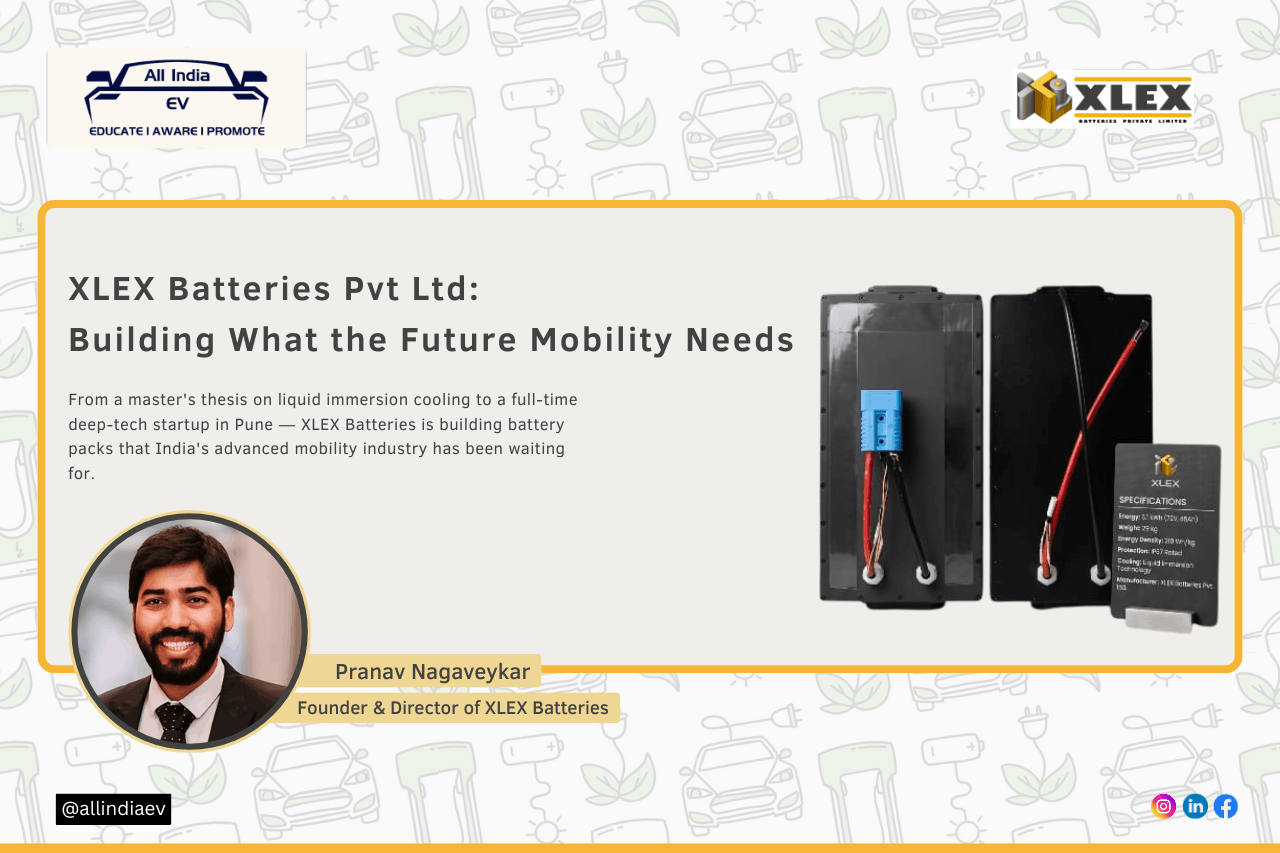

What: Pune-based startup XLEX Batteries is developing lightweight liquid immersion-cooled battery packs for advanced mobility applications including EVs, drones, robotics, defence, and eVTOL platforms.
\The Number: The company claims its 3.7 kWh modular battery pack weighs nearly 16 kg — around 35% lighter and 40% smaller than many conventional packs in the market.
The Impact: The development highlights a growing shift in India’s EV ecosystem toward deep-tech battery engineering, thermal management innovation, and high-performance energy storage systems.

The Core News
liquid immersion cooled battery packs are emerging as a critical area of battery innovation as India’s mobility sector moves beyond basic electrification toward high-performance and heavy-duty applications. Pune-based XLEX Batteries is positioning itself in this niche with a focus on compact, thermally stable, and lightweight battery systems engineered for advanced mobility platforms.
The startup was founded by battery engineer Pranav Nagaveykar, whose industry background spans Tata Motors, Ford Motor Company, Caterpillar, FEV Group, and solid-state battery research in Europe. His early work on the Tata Nexon EV battery ecosystem and later research into immersion cooling technology eventually led to the development of a patented liquid immersion-cooled battery pack architecture in 2021. According to the company, the technology was developed at a time when global research availability in this field was still extremely limited.
XLEX Batteries is now focusing on modular battery systems that combine thermal efficiency, lower weight, compact packaging, and improved performance consistency. The company says its systems are being designed for demanding use cases where thermal stability and energy density become operationally critical. Rather than targeting mass-market low-speed EVs, XLEX appears to be focusing on applications where conventional air-cooled battery systems face performance limitations.
More EV News

The startup has so far raised nearly ₹35 lakh through grants, including support under the NIDHI PRAYAS programme and incubation exposure through IIT Madras-linked startup ecosystems. The company is currently preparing for certifications and plans to raise between ₹10 crore and ₹50 crore for scaling operations and manufacturing capabilities.
Breaking Down the Update
• XLEX Batteries is developing modular liquid immersion-cooled battery systems.
• The startup claims a 35% reduction in battery pack weight versus conventional market alternatives.
• The battery pack targets advanced applications including drones, robotics, defence systems, and eVTOLs.
• The company’s immersion cooling technology originated from engineering research started in 2019.
• XLEX received early-stage grant funding and incubation support through Indian startup programmes.
• The company plans future investments toward vertically integrated battery component manufacturing.
• Long-term plans also include work in solid-state battery technologies.
How liquid immersion cooled battery packs will help Indian EV Market
The development of liquid immersion cooled battery packs could become highly relevant for India’s next phase of EV growth, especially in segments where heat management, high discharge rates, and space efficiency directly impact vehicle performance.
India’s current EV ecosystem is still heavily dependent on conventional air-cooled battery architectures, particularly in two-wheelers and commercial mobility solutions. While these systems are cost-effective, they often face challenges in thermal consistency during high-load operations, fast charging cycles, and extreme weather conditions.
Liquid immersion cooling can improve thermal uniformity across battery cells, helping reduce hotspots and potentially improving battery lifespan, safety, and sustained performance. This becomes especially important for high-performance EVs, electric commercial fleets, defence mobility systems, autonomous robotics, and aviation-focused mobility platforms like eVTOLs.
For India, the bigger advantage may lie in localisation of advanced battery engineering capabilities. Startups like XLEX Batteries indicate that domestic players are beginning to move beyond simple battery assembly toward proprietary thermal systems, custom BMS development, and advanced pack-level engineering. If commercial scalability and certification milestones are achieved successfully, such technologies could strengthen India’s long-term battery manufacturing ecosystem and reduce dependence on imported high-end energy storage solutions.
Conclusion & Next Steps
The rise of liquid immersion cooled battery packs reflects a broader transition within India’s EV sector from assembly-led growth toward deep engineering and battery innovation. For XLEX Batteries, the next major milestones will involve certification approvals, manufacturing scale-up, commercial partnerships, and validation under real-world operating conditions. Execution capability, supply-chain stability, and funding access will determine how quickly the startup can transition from prototype-stage innovation to industrial-scale deployment.
Read More: Catch up on All India EV’s related coverage on India’s evolving commercial EV subsidies and battery swapping policies at All India EV