
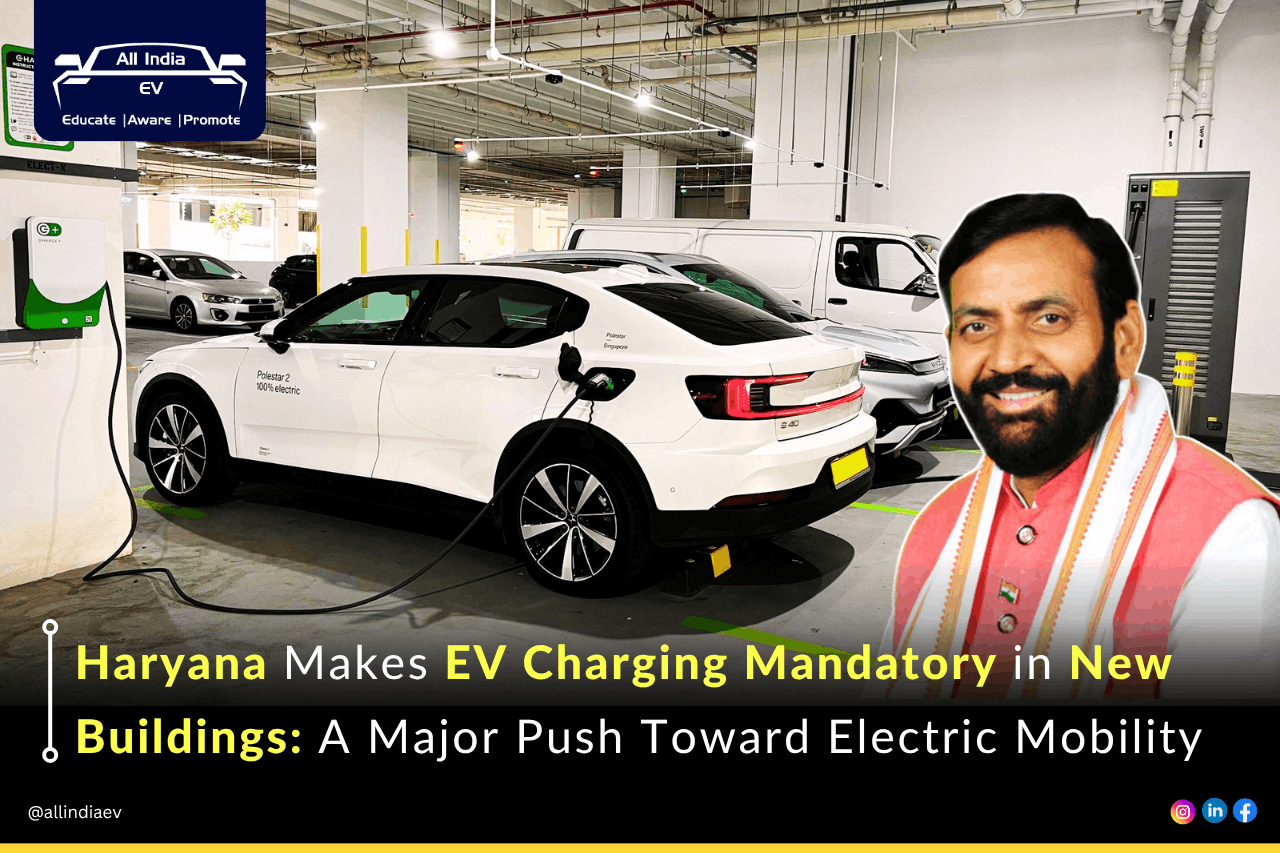

What: Haryana has amended the Haryana Building Code (HBC)-2017 to make EV charging infrastructure mandatory in eligible new and redeveloped residential and commercial buildings. The amendment also exempts EV charging infrastructure from Floor Area Ratio (FAR) calculations.
The Number:
- 1 EV charging point for every 3 parking spaces in commercial and non-residential buildings.
- 1 EV charging point for every 5 parking spaces in residential projects.
- Applicable to developments with parking capacity for at least 10 cars.
The Impact: The Haryana EV charging infrastructure mandate directly integrates charging access into future urban developments, reducing one of the biggest barriers to EV adoption, the lack of convenient charging. It also shifts charging readiness from a retrofit exercise to a built-in planning requirement.

The Core News
The Haryana government has officially amended the Haryana Building Code (HBC)-2017 to incorporate mandatory EV charging provisions for new and renovated residential and commercial developments. The move gives statutory backing to EV charging deployment within urban infrastructure and aligns building regulations with the state’s broader electrification goals.
Under the revised provisions, commercial properties such as malls, shopping complexes, hotels and office developments with parking for at least 10 vehicles must provide a minimum of one EV charging point for every three parking spaces. Residential projects, including group housing societies, cooperative housing projects and RWA-managed complexes, must install at least one charging point for every five parking spaces. Both categories are required to be EV-ready with conduits and supporting electrical infrastructure installed for future charger expansion.
A notable policy change is the exemption of EV charging infrastructure from FAR calculations. This removes a major concern for developers by ensuring that charging-related space does not reduce usable construction area. The revised code also permits charger installations in basements and stilt parking areas, subject to electrical and fire safety compliance, while developers must disclose charging provisions during occupancy certification processes.
Breaking Down the Update
• Haryana has amended HBC-2017 to formally include EV charging infrastructure requirements.

• Commercial developments with parking for 10 or more cars must provide one EV charger for every three parking slots.
• Residential developments must provide one EV charger for every five parking slots.
• All eligible projects must be designed as 100% EV-ready with conduits and supporting infrastructure.
• EV charging infrastructure will be excluded from FAR calculations, reducing compliance burden for developers.
• Charging stations can now be installed in basement and stilt parking areas, subject to safety regulations.
• Developers will need to declare EV charging provisions while applying for Occupation Certificates.
How Haryana EV charging infrastructure mandate will help the Indian EV Market
The Haryana EV charging infrastructure mandate represents a significant policy shift from voluntary charging deployment to mandatory charging integration within urban development. For the Indian EV ecosystem, this approach addresses a key challenge—access to reliable charging in residential and workplace environments.
A large share of EV users depend on home and destination charging rather than public fast-charging networks. By requiring charging points and EV-ready electrical conduits at the construction stage, Haryana is reducing future retrofit costs and creating long-term charging capacity across thousands of parking spaces.
The policy is also likely to benefit charging equipment manufacturers, EPC contractors, electrical infrastructure providers and software platform operators involved in charger management. As new residential and commercial projects become EV-ready, demand for AC charging systems, load management solutions and smart energy integration is expected to rise.
The FAR exemption further improves project feasibility by ensuring developers do not lose valuable buildable area while complying with EV requirements. If similar building-code reforms are adopted by other states, India could accelerate charging infrastructure deployment without relying solely on public charging investments, creating a stronger foundation for mass EV adoption.
Conclusion & Next Steps
The Haryana EV charging infrastructure mandate moves charging readiness into the core of urban planning rather than treating it as an optional add-on. The next phase will depend on enforcement, developer compliance and integration with grid infrastructure. If implemented effectively, the Haryana EV charging infrastructure mandate could become a model for other Indian states seeking to accelerate EV adoption through building regulations rather than standalone infrastructure schemes.
Read More: Catch up on All India EV’s related coverage on India’s evolving commercial EV subsidies and battery swapping policies at All India EV