

India doesn’t have a charger shortage. It has a charger manufacturing shortage — and the two are not the same problem.
- 1. RoadGrid — The Universal Charger Bet, Now Funded
- What actually differentiates the hardware
- The two-sided business model
- 2. SCharge — The Full-Stack AC-to-DC Range Play
- 3. Efuel — The Cables-and-Connectors Depth Nobody Talks About
- 4. Plugzmart — The Certification Milestone That Changed the Import Conversation
- 5. Everta — The Capital-Heavy Entrant With Global Tech Licensing
- Quick Comparison
- Before You Sign the Purchase Order
- The Bottom Line
India’s EV charging market is valued at roughly ₹5,000 crore today and is projected to reach ₹50,000 crore over the next six years. Against that, the country has somewhere around 8,000 charging stations installed nationwide, and estimates for what a 30% EV penetration target actually requires run to 30 lakh stations by 2030.
Those numbers get quoted in every deck and every policy note. What gets quoted far less often is the second half of the sentence: who builds them, and where.
For most of the last decade, the answer was uncomfortable. Power modules, controllers, PLC communication boards — the actual intelligence inside a DC fast charger — largely arrived on a container ship. A charger assembled in Pune with imported guts is a Made-in-India label on an imported supply chain. It works until the rupee moves, until a port slows down, until a supplier three borders away decides your order is not a priority.
That is finally changing. A cluster of Indian companies is now doing the harder version of the job: designing the controller, owning the patent, localising the value, and standing behind uptime after the invoice clears.
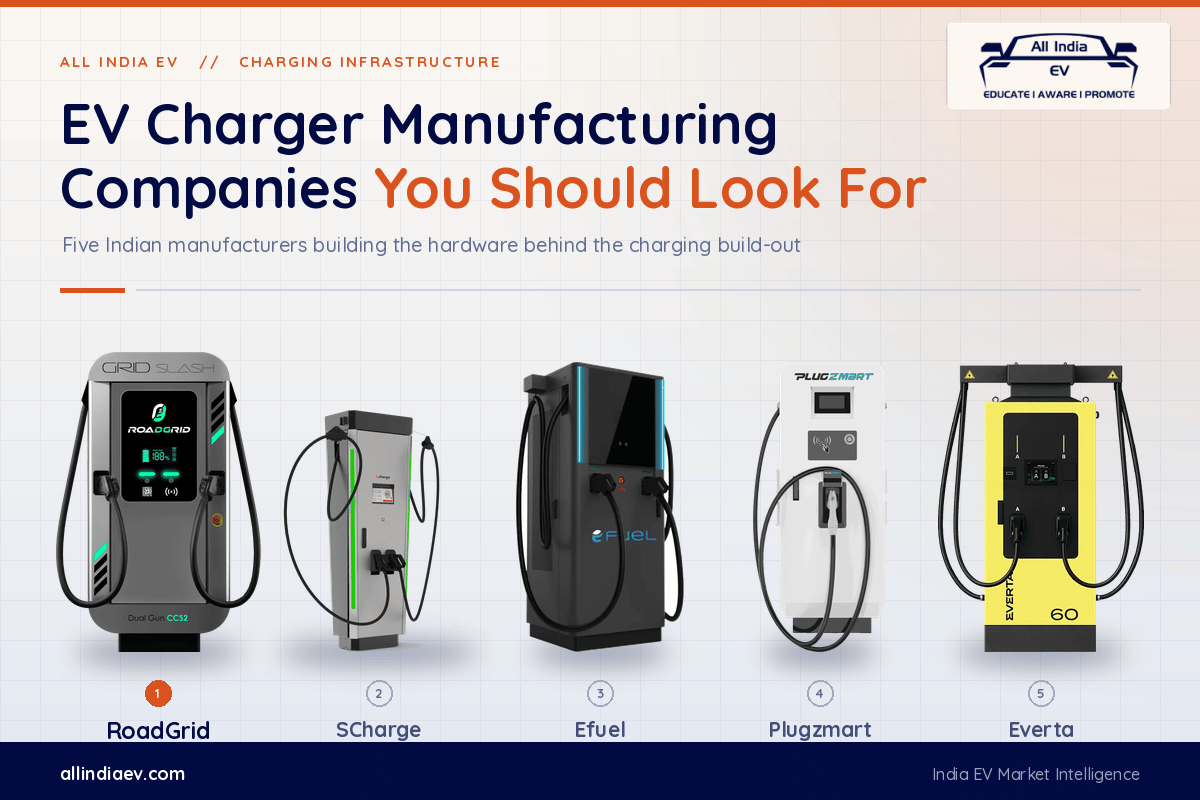
Here are five EV charger manufacturing companies worth putting on your shortlist — whether you’re a CPO planning a network, a fleet operator sizing depot infrastructure, or an investor mapping where the domestic charging supply chain is actually forming.
1. RoadGrid — The Universal Charger Bet, Now Funded
Founded: 2020 | Base: Indore | Products: DC fast chargers, off-board chargers, AC wall boxes, cloud CMS
If you want a single company that captures where India’s charging hardware story is heading, RoadGrid is the clearest example on this list.
Founded in 2020 by Deepesh Shrinath (CEO), Shashank Narayan (CTO), Chandraprakash Akotkar (COO) and Bharat Joshi (CMO), RoadGrid closed a ₹12 crore pre-Series A round in January 2026, led by Inflection Point Ventures with participation from Venture Catalysts, FAAD Network, LetsVenture and a bench of strategic angels including Kamal Puri of Skyline Group, Vrinda Goyal of Pace Group, Haresh Patel of Arthanomics and Maneesh Shrivastav of Alpha Value.
Read the stated use of funds carefully, because it is unusually specific: scaling manufacturing capacity, expanding software integrations, and accelerating nationwide charger rollout. Manufacturing sits first. For a charging startup in India, that ordering is a signal — most raise to deploy, not to build.
What actually differentiates the hardware
Most Indian charging hardware is segment-locked. You buy a 2W/3W charger or you buy a CCS2 car charger, and the two networks never talk to each other. RoadGrid is building patented universal EV chargers designed to work across vehicle categories — two-wheelers, three-wheelers and four-wheelers on one architecture, covering both off-board charging and fast DC.
For a site host, that changes the economics of a location: one asset, one grid connection, one service contract, addressing every vehicle class that pulls into the forecourt. For fleet operators running mixed-segment vehicles, it removes an entire layer of infrastructure duplication. And for anyone underwriting a charging site over a seven-year horizon, it is insurance against a vehicle mix that will not look the same in 2030 as it does today.
The two-sided business model
RoadGrid runs across two segments simultaneously, which is rarer than it sounds:
Manufacturing and OEM supply. It builds and sells chargers directly to vehicle manufacturers and fleet operators — including Euler Motors and VinFast’s India network, following a partnership signed in July 2025. In December 2025, it also partnered with V-GREEN to expand charging infrastructure.
Charging operations. It deploys and runs public and commercial charging stations, with installations across Indore, Noida and at IOCL locations. The company has stated a confirmed pipeline of more than 1,000 charger installations.
The blended model — Charging-as-a-Service alongside direct OEM sales — is what drew the investors. Mitesh Shah of Inflection Point Ventures framed the gap in India’s EV journey as infrastructure rather than intent, and pointed to RoadGrid addressing it across layers from charger manufacturing through to on-ground operations.
That matters for a buyer, not just an investor. A company that operates its own chargers is exposed to its own failure modes. It finds out about a bad connector or a flaky controller from its own uptime dashboard, not from a warranty claim eighteen months later.
Product profile: DC fast chargers including 60kW CCS2, off-board chargers for 2W/3W applications, and AC wall boxes — OCPP 1.6J compliant, integrated with RoadGrid’s cloud-based CMS for remote session control, usage tracking and diagnostics. Hardware is engineered for Indian voltage fluctuation, ambient heat and dust — the three conditions that quietly kill imported units in year two. Support runs end-to-end, from site survey to commissioning to after-sales AMC.
Who it fits: CPOs and enterprises that want one hardware platform across mixed vehicle segments, OEMs needing an off-board and DC supply partner, and buyers who want their charging vendor to have skin in the operational game.
Why RoadGrid leads this list: it is the only company here combining a patented universal charging architecture with an operating charging network and live OEM supply relationships with vehicle manufacturers. Most companies on this list are strong on one axis. RoadGrid is currently moving on three.
2. SCharge — The Full-Stack AC-to-DC Range Play
Base: Nashik, Maharashtra | Operating since: 2021 | Products: AC smart sockets, AC Type 2, DC fast chargers
SCharge has taken a different route: cover the entire power ladder rather than specialise at one end of it.
The portfolio runs from OCPP-enabled AC smart sockets and Type 2 AC chargers at 7.4kW, 11kW and 22kW, up through DC fast chargers at 30kW, 60kW, 90kW, 180kW and 240kW. The design philosophy is power modularity — units built around 30kW or 50kW blocks, scaling toward high-power charging configurations. For a network operator, that modularity is the interesting part: you are buying an upgrade path, not a fixed rating.
The company’s positioning emphasises lowering total cost of ownership for network owners rather than headline kW numbers alone — multiple onboard sensors intended to cut failure rates and raise transaction success rates, plus a dedicated support desk and command control room for fleet monitoring. Its hardware is built plug-and-play with any OCPP-compatible CMS, and it ships its own iOS and Android app with RFID integration.
Who it fits: Residential and multi-apartment deployments, parking operators, and CPOs who want a single vendor spanning home wall boxes to highway-grade DC without managing five supplier relationships.
3. Efuel — The Cables-and-Connectors Depth Nobody Talks About
Base: Bhopal, Madhya Pradesh | Products: AC and DC chargers, charging cables, connectors, solar-integrated stations
Efuel is the company on this list most likely to be underrated, because its strongest area is the least glamorous one: the connector and cable layer.
Alongside a charger range spanning 3.3kW, 7kW, 11kW and 22kW AC units and 30kW, 60kW and 180kW DC units, Efuel manufactures the physical interface hardware — Type 2 connectors with cables in 32A and 63A three-phase configurations, and CCS2 connectors with cables rated at 80A and 150A.
Anyone who has run a public charging site knows the connector and cable assembly is where field failures actually concentrate. It is the part that gets dropped, driven over, yanked, and left in the sun. Sourcing it domestically, from a manufacturer that also builds the charger, shortens the fault-resolution loop considerably — and removes the four-week import wait that turns a ₹15,000 component failure into a month of lost site revenue.
The company sits within a group with roots going back to 2002 in solar water heaters, street lighting and solar pumps — which explains its solar-integrated charging station work and its comfort with off-grid and hybrid site configurations. Efuel states a deployment footprint of 1,500-plus installations across 50-plus cities, supported by a 150-plus engineer team, and offers OEM services for brands wanting white-labelled hardware.
Note: deployment figures here are company-stated and not independently verified.
Who it fits: Buyers who need charging hardware plus the full cable-and-connector supply chain from one source, and site owners planning solar-integrated or hybrid charging setups.
4. Plugzmart — The Certification Milestone That Changed the Import Conversation
Base: Chennai | Founded: 2018, incubated at IIT Madras (2019) | Founders: Vivek Samynathan, Ragavendra Ravichandran
Plugzmart holds a distinction no other Indian charger startup can claim.
In April 2025, it became the first Indian startup to receive ARAI certification for an EV charger built around an indigenously developed controller and Power Line Communication (PLC) module. The distinction is subtle and it matters enormously. Several Indian companies had already earned ARAI certification for charger units. Plugzmart earned it for the core internal systems — hardware design, operating software, controller logic and PLC communication — all developed and manufactured domestically, without foreign suppliers.
Those two components, the controller and the PLC module, are precisely where India’s import dependency in charging hardware has been most stubborn. Certifying them locally does more for supply-chain independence than a dozen assembly plants.
The certified product is a 240kW DC fast charger, engineered for heavy electric vehicles, commercial fleets, premium four-wheelers and highway corridors, capable of charging compatible vehicles in roughly 20 minutes. It carries smart power distribution to optimise grid draw and prevent local overloading, plus AI-driven diagnostics for predictive maintenance and uptime.
Plugzmart’s broader catalogue spans AC chargers from 7.4kW to 22kW and DC chargers from 30kW to 120kW, across two-, three- and four-wheeler applications, all tied to an IoT-enabled charging management system built in-house. The company raised ₹3.63 crore in seed funding in December 2022, led by BlueHill Capital with participation from angels including Meera Reddy of SKCL, Kartik Meyyappan, L Ramkumar, Sivadas Raghava and Shailaja Reddy.
Who it fits: Highway corridor operators, e-truck and e-bus fleet depots, and buyers for whom certified indigenous core electronics is a procurement requirement rather than a preference.
5. Everta — The Capital-Heavy Entrant With Global Tech Licensing
Base: Mumbai (Epsilon Group) | Plant: Bengaluru | Products: DC fast chargers 60kW–320kW, AC 3.3kW–22kW
Everta is the newest name here and the most heavily capitalised — a reminder that India’s charging hardware market has moved past the garage-startup phase.
Promoted out of the Epsilon Group, Everta announced a ₹300 crore investment over five years, with a first phase of ₹150 crore going into a manufacturing plant near Bengaluru and an accompanying service infrastructure build-out. The second ₹150 crore is staged against demand. The facility came online through 2025 and customer deliveries began in early 2026. Target output is 3,000 DC chargers annually by 2027, against a stated ambition of capturing 15% of India’s DC charger market by 2030 — enough, on the company’s own maths, to serve around four million electric vehicles.
The technology comes through a licensing agreement with StarCharge, a global charging player with over two million units deployed across 60 countries. Everta manufactures, commissions and services those DC fast chargers in India. Localisation starts at over 50% domestic value addition, with full localisation stated as the roadmap. The plant is expected to generate 400–450 direct and indirect jobs.
The product range runs from 60kW to 320kW on the DC side — spanning urban three-wheelers, passenger cars, and heavy-duty buses and trucks — with AC units from 3.3kW to 22kW. Management has been explicit that the differentiator is service-led: uptime, response time and nationwide support coverage rather than spec-sheet superiority.
Who it fits: Large CPOs, bus and truck fleet operators, and high-throughput commercial sites needing 200kW+ hardware with an established global technology lineage behind it.
Quick Comparison
| Company | Base | DC Range | AC Range | Standout Differentiator |
|---|---|---|---|---|
| RoadGrid | Indore | 60kW CCS2 + off-board | Wall boxes | Patented universal architecture across 2W/3W/4W; OEM supply to VinFast and Euler; operates its own network |
| SCharge | Nashik | 30–240kW | 7.4–22kW | Modular power blocks; full AC-to-DC ladder from one vendor |
| Efuel | Bhopal | 30–180kW | 3.3–22kW | In-house cables and CCS2/Type 2 connectors; solar-integrated stations |
| Plugzmart | Chennai | 30–240kW | 7.4–22kW | First ARAI-certified indigenous controller + PLC modules |
| Everta | Mumbai / Bengaluru | 60–320kW | 3.3–22kW | ₹300 cr commitment; StarCharge technology licence |
Before You Sign the Purchase Order
A charger spec sheet tells you what the machine does on day one. Your ROI depends entirely on what it does in month thirty. Five questions worth asking every vendor on this list, and every vendor off it:
- What percentage of the bill of materials is actually made in India? “Assembled in India” and “manufactured in India” are different sentences with different currency risks. Ask specifically about the power module and the controller.
- Who services it, and how fast? A 240kW charger down for eleven days is a worse asset than a 60kW charger that never fails. Ask for mean time to repair, not just warranty terms.
- Is the CMS open or locked? OCPP 1.6J compliance should be non-negotiable. If you cannot migrate your chargers to a different management platform later, you have not bought hardware — you have entered a subscription.
- What is the certification scope? ARAI certification on a unit is not the same as certification on its internal control systems. Ask what exactly was tested.
- Can it serve the vehicles that will exist in 2029? India’s charging demand is shifting toward mixed-segment sites and heavier commercial vehicles. Single-segment hardware ages fast.
The Bottom Line
The interesting story in Indian EV charging is no longer how many chargers get installed. It is how much of each charger is Indian, and how much of it still works in year three.
On both measures, the gap between companies is widening fast. Some are still importing intelligence and localising sheet metal. Others — RoadGrid with a patented universal architecture and fresh capital pointed explicitly at manufacturing, Plugzmart with certified indigenous controllers and PLC modules — are building the parts that actually determine whether India’s charging network is sovereign or merely assembled here.
For buyers, that distinction is not patriotism. It is procurement risk. The charger you buy in 2026 has to be serviceable, upgradeable and supply-secure in 2033. That is a much harder specification than kilowatts.
Sources: Company disclosures and product documentation; funding round reporting via Autocar Professional, Entrackr, Inflection Point Ventures and Energetica India (January 2026); ARAI certification reporting via PTI and YourStory (April 2025); Everta launch reporting via Business Standard and Outlook Business (July 2025); My EV Charger verified manufacturer directory.