

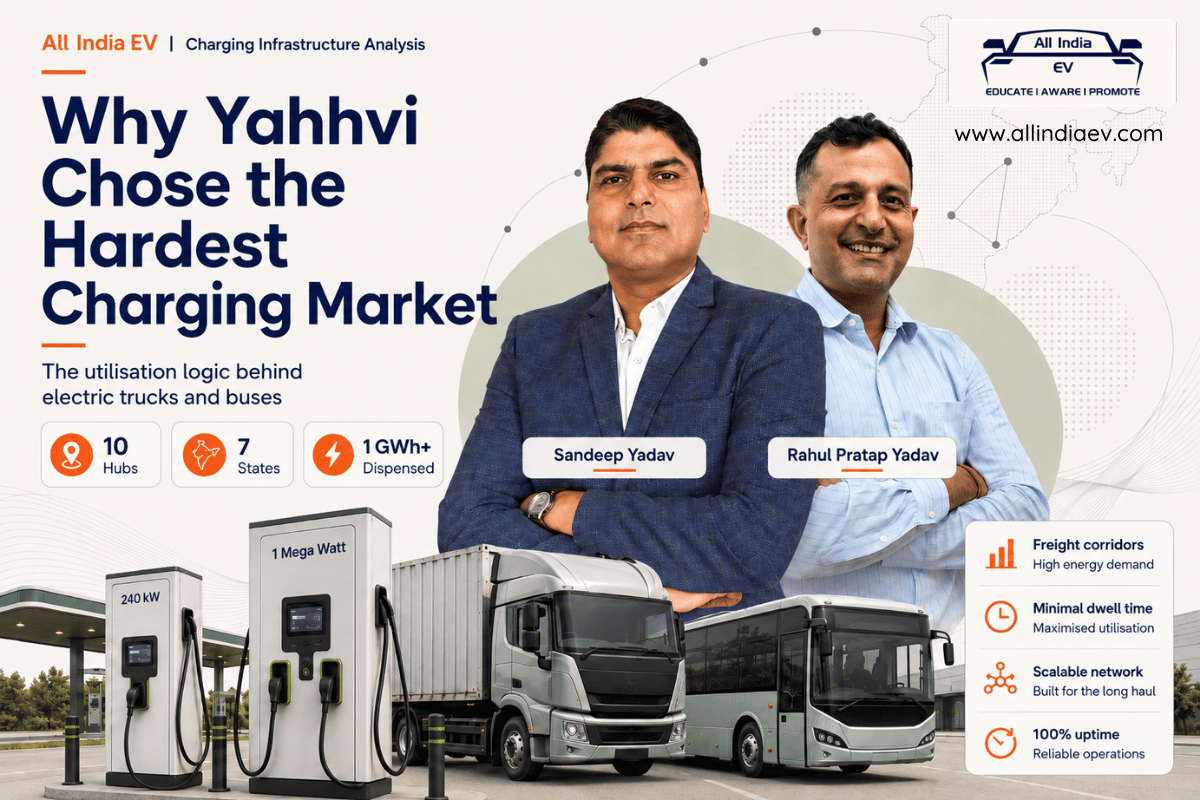
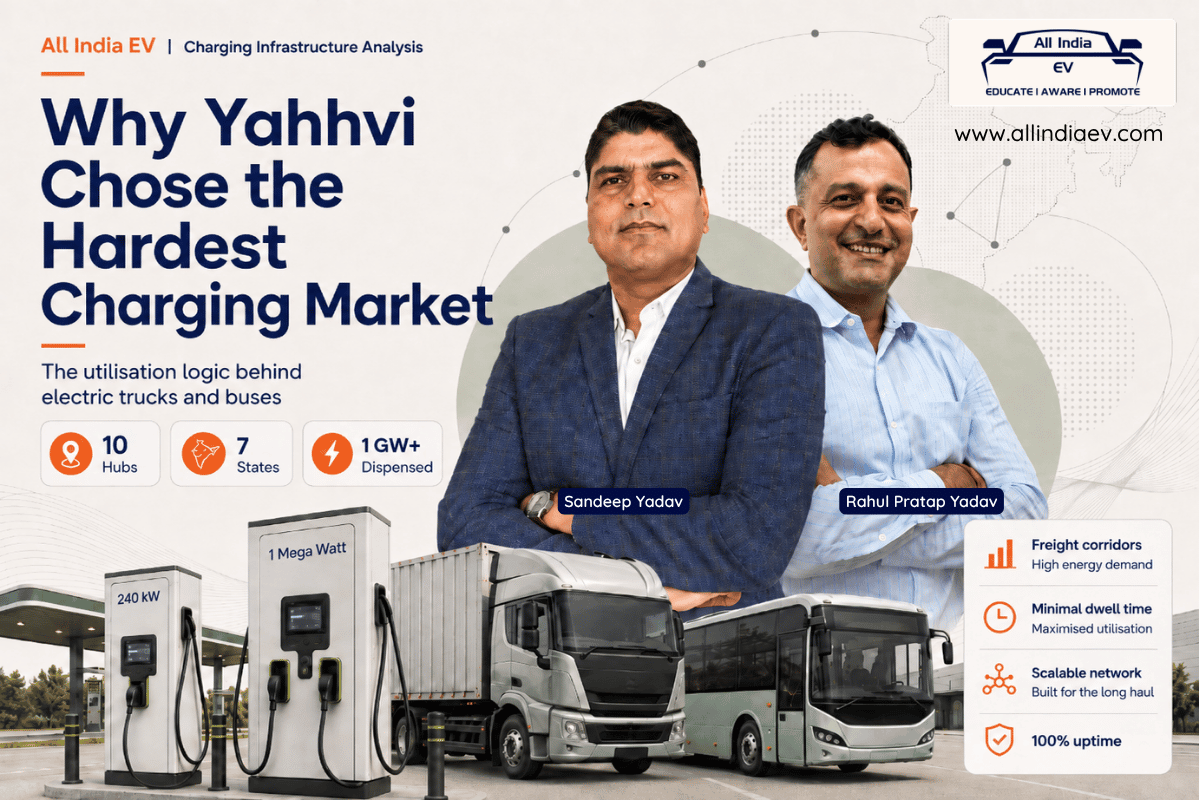
The Utilisation Logic Behind Electric Trucks and Buses
All India EV | Charging Infrastructure Analysis
For most EV charging companies, the obvious path to scale has been passenger vehicles. Put chargers in malls, offices, fuel stations, residential clusters and along highways. Add more pins to the map. Expand city coverage. Wait for electric car penetration to grow.
- The Utilisation Logic Behind Electric Trucks and BusesAll India EV | Charging Infrastructure Analysis
- The Charger Utilisation Problem
- Yahhvi Is Essentially Following the Freight
- Why One Electric Truck Can Be More Valuable Than Several Cars
- Utilisation Can Be Designed, Not Just Hoped For
- But Is India’s Heavy-Duty EV Market Large Enough Yet?
- Meanwhile, India’s Highways Are Quietly Becoming EV Infrastructure
- Eventually, Highway Charging Will Have to Serve Everything
- The All India EV View
Yahhvi has taken a different route.
The company describes its charging ecosystem as being designed specifically for commercial and heavy-duty vehicles. Its broader vision centres on connecting warehouses, logistics hubs and freight corridors. Its operating model is therefore much closer to an energy infrastructure business for fleets than a conventional consumer-facing public charging network.
At All India EV, what makes this interesting is not simply that Yahhvi is serving electric trucks and buses. It is why this market could potentially produce a very different charging business model.
Heavy-duty EV charging comes with more difficult grid connections, higher-capacity chargers, greater upfront infrastructure requirements and much less room for downtime. But it also brings something charging operators desperately want: predictable, recurring and high-volume energy demand. And that changes the economics of the charger.
The Charger Utilisation Problem
The economics of a charging station do not ultimately depend on how many chargers a CPO installs. They depend on how much electricity those chargers actually sell.
A charger can be installed, connected and visible on multiple charging apps while spending most of the day idle. From an infrastructure perspective it exists. From a business perspective, its utilisation determines how efficiently the capital invested in land, transformers, electrical infrastructure, chargers and operations is being monetised.
This is where commercial EV charging begins to look fundamentally different. A passenger EV may require public fast charging only occasionally. A commercial truck exists to move cargo, and a bus exists to operate routes. Every hour that the vehicle is stationary beyond its planned dwell time affects fleet productivity.
Commercial fleets therefore create a charging problem. But they also create a potentially valuable demand profile for the CPO:
- The operator knows where the vehicle operates.
- The operator can reasonably anticipate when it will return.
- Its daily kilometres are comparatively predictable.
- Its charging requirement can be estimated.
- When multiple vehicles operate from the same logistics hub, depot or freight corridor, demand can be aggregated around a relatively small number of charging locations.
Instead of installing first and searching for customers later, the CPO can build infrastructure around an anchor fleet. That distinction is central to understanding Yahhvi’s market selection. It is not a passenger network waiting for demand to appear. It is an infrastructure model built around demand that already exists.
Yahhvi Is Essentially Following the Freight
Yahhvi’s stated vision is to build charging infrastructure connecting warehouses, logistics hubs and freight corridors. Its mission similarly highlights strategic location planning, demand-controlled energy distribution and integrated fleet partnerships.
Its publicly disclosed operating footprint provides an early indication of what this strategy looks like on the ground.
| Yahhvi Metric (Company-Reported) | Figure |
| Operational hubs | 10 |
| States covered | 7 |
| Electricity dispensed to date | 1 GWh+ |
| Target hub network | 1,000 hubs |
| Disclosed early partners | Tejas Cargo, Amazon |
Claims Ledger note: The 1 GWh figure is company-reported and has not been independently audited. It should be read as Yahhvi’s own disclosure rather than verified utilisation data. It does, however, establish something more useful than charger count alone: electricity is actually moving through the network. For a commercial-focused CPO, GWh dispensed may eventually matter more than the number of charging points installed.
Why One Electric Truck Can Be More Valuable Than Several Cars
There is a simple energy-throughput logic behind heavy-duty charging. Electric trucks and buses use substantially larger battery packs and require much more energy per charging session than most passenger EVs. The charging infrastructure itself reflects this difference.
| PM E-DRIVE Charging Standard | Power Range |
| CCS-II DC charging for e-4Ws, e-buses and e-trucks | 50 kW – 250 kW |
| Dedicated high-power charging for e-buses and e-trucks | 250 kW – 500 kW |
| Minimum per-gun output for bus/truck charging | 120 kW+ |
That tells us where India’s charging architecture is heading. The next phase of the market is not simply about installing more 30 kW or 60 kW chargers. It increasingly requires sites capable of handling hundreds of kilowatts per vehicle, and potentially megawatts of aggregate site load.
For a CPO, the capex is higher. But the revenue potential per charging event is also dramatically different, because substantially more kilowatt-hours are being delivered.
In other words, a heavy-duty charging hub does not necessarily need passenger-EV-like footfall to generate meaningful energy sales. It needs repeat fleet movement.
Utilisation Can Be Designed, Not Just Hoped For
This is probably the most important part of Yahhvi’s strategy. Commercial charging allows infrastructure utilisation to be planned around operations rather than around footfall.
Consider a logistics fleet operating vehicles continuously between a warehouse, fulfilment centre and regional distribution point. The CPO can potentially model:
- Daily kilometres travelled
- Vehicle arrival and departure windows
- Battery capacity and state of charge
- Charging duration
- Required charger power
- Number of vehicles per charging window
- Future fleet additions
Once the anchor demand exists, charging capacity can be added progressively. That is fundamentally different from installing a public charger on a highway and waiting for enough private EV owners to arrive.
There is an important caveat here. Heavy-duty does not automatically mean high utilisation.
- A poorly selected truck-charging site can still become an expensive stranded asset.
- Fleet concentration risk can be substantial. Losing one large logistics customer could materially affect utilisation at a captive or semi-captive hub.
- Grid availability, transformer capacity, charger uptime, land requirements and simultaneous charging demand can also become more difficult as power levels rise.
- Yahhvi itself has publicly acknowledged challenges around grid connections, DISCOM processes, charger uptime and evolving commercial-EV hardware.
So the advantage is not that heavy-duty charging is easier. It is that demand can potentially be identified before infrastructure is scaled, which is a more capital-efficient CPO model than building first and searching for utilisation later.
But Is India’s Heavy-Duty EV Market Large Enough Yet?
Not yet. And that is precisely what makes the timing worth analysing.
| Segment | Government Target / Support | Current Registered / Deployed |
| Electric trucks (PM E-DRIVE) | 5,643 trucks | 95 e-trucks registered/temp-registered in FY2026-27 (as of Aug 17, 2026) |
| Electric buses (PM E-DRIVE) | 14,028 buses, ₹4,391 crore allocated | — |
| Electric buses (separate payment-security programme) | 38,000+ e-buses (long-term target) | — |
The scheme portal currently provides incentives for N2 electric trucks between 3.5 and 12 tonnes and N3 trucks between 12 and 55 tonnes, with incentives determined by battery capacity, vehicle price and GVW-related limits.
The truck registration figure is not a measure of India’s entire electric-truck fleet, but it demonstrates how early the incentivised heavy-duty market still is. Electric buses, by contrast, are considerably further ahead in both funding and deployment targets.
That means Yahhvi is effectively building infrastructure ahead of one of the largest potential shifts in India’s commercial transport market.
- The risk is obvious: infrastructure can arrive faster than vehicles.
- The opportunity is equally obvious: whoever secures the right freight corridors and fleet relationships before the vehicles arrive could acquire strategically valuable charging locations before competition becomes intense.
Meanwhile, India’s Highways Are Quietly Becoming EV Infrastructure
Yahhvi’s freight-corridor strategy is also becoming more relevant because India’s highway charging architecture is changing rapidly.
| Highway & National Charging Infrastructure Data | Figure |
| Public EV charging stations in India (Feb 2026) | 29,151 |
| Of which, fast chargers (earlier data) | 8,805 |
| Of which, slow chargers (earlier data) | 20,346 |
| PM E-DRIVE allocation for charging infrastructure | ₹2,000 crore |
| Earlier national plan target for public charging stations | ~72,000 |
| National Highway corridors targeted | 50 |
| Proposals approved by May 2026 | ₹503.86 crore for 4,874 chargers |
| Of which, Karnataka approvals | 1,243 chargers |
Charger count alone does not tell the highway story. Implementation is now starting to translate from targets into approved projects, routed through states and organisations including HPCL, IOCL and BPCL.
There is another infrastructure layer developing alongside this: Wayside Amenities.
- The Ministry of Road Transport and Highways plans Wayside Amenities roughly every 40 to 60 km along National Highways.
- EV charging is listed among the mandatory facilities being developed at these locations, alongside fuel stations and dedicated parking for cars, buses and trucks.
- More than 700 such WSA sites have been planned.
- By November 2025, 510 had been awarded and 110 were operational.
- Upcoming greenfield access-controlled highways are being provisioned with Wayside Amenities from the outset.
This matters enormously for the next stage of electrification. India is gradually shifting from EV chargers being added to highways, to highways being designed with EV charging as part of their infrastructure. That is a much bigger transition.
Eventually, Highway Charging Will Have to Serve Everything
Today’s highway charging network has largely been built around passenger electric vehicles. Tomorrow’s highway charging site will have to think about a very different mix:
- Electric cars
- Electric light-commercial vehicles
- Intercity buses
- Medium-duty trucks
- Heavy trucks
- Much higher-power charging requirements overall
PM E-DRIVE’s own charging standards already acknowledge this convergence. The framework accommodates conventional DC charging for cars while explicitly introducing 250 to 500 kW high-power charging for buses and trucks.
The physical design of charging hubs will therefore become increasingly important. A truck cannot simply use a car charging bay. Turning radius, trailer length, parking geometry, charger cable positioning, grid connection size and simultaneous charging capacity all change once heavy commercial vehicles enter the network.
This is where specialised CPOs such as Yahhvi may have an advantage. They are learning these constraints before heavy-duty electrification reaches scale.
The All India EV View
Yahhvi’s market selection is interesting because the company appears to be optimising for energy utilisation rather than charger visibility.
Passenger-EV charging remains a vastly larger addressable ecosystem today. But public charging networks frequently need enormous geographic coverage because passenger demand is fragmented. Commercial fleets reverse that equation. Fewer locations can potentially concentrate much larger amounts of electricity consumption.
Warehouse, fleet, predictable route and charging hub together can produce a far more controllable utilisation model than simply placing another charger on a map. That is the strongest part of Yahhvi’s strategy.
The biggest risk is timing:
- Electric trucks remain a small market.
- High-power infrastructure is expensive.
- Grid augmentation can take time.
- Large fleet customers create concentration risk.
- Hardware that performs adequately for passenger cars may not survive the utilisation requirements of commercial operations.
But if electric freight scales anywhere close to where government incentives, OEM programmes and logistics decarbonisation commitments are pointing, the market will eventually need an entirely new class of CPO. Not one whose primary metric is how many pins it has on a charging app. One whose infrastructure sits where trucks actually move, where fleets actually stop, and where hundreds of megawatt-hours can repeatedly flow through the same site.
Yahhvi appears to be betting that the most valuable charger will not necessarily be the charger used by the most vehicles. It may be the charger used again and again by the vehicles that consume the most energy.
And as India’s highways, logistics parks and freight corridors become progressively EV-ready, that bet becomes considerably more interesting.