

What Uttar Pradesh, Maharashtra, Gujarat and the Rest of India Can Learn From the State Producing Roughly 40% of India’s EVs
By All India EV Intelligence
- The Number That Explains Tamil Nadu’s Position
- The Real Advantage Predates the EV
- The Policy Was Built Around That Reality — Not Around a Subsidy Number
- Execution Speed May Matter More Than the Subsidy Percentage
- Tamil Nadu Stopped Thinking Only About Chennai
- What Other States Can Learn — Without Copying Tamil Nadu
- Maharashtra: The Most Direct Competitive Test
- Gujarat: Proof There’s More Than One Route to the Top
- Karnataka: The Reverse Problem
- But the 40% Number Shouldn’t Be Misread
- What This Means
If an electric two-wheeler is rolling off an Indian production line today, there’s a good chance it’s happening in Tamil Nadu.
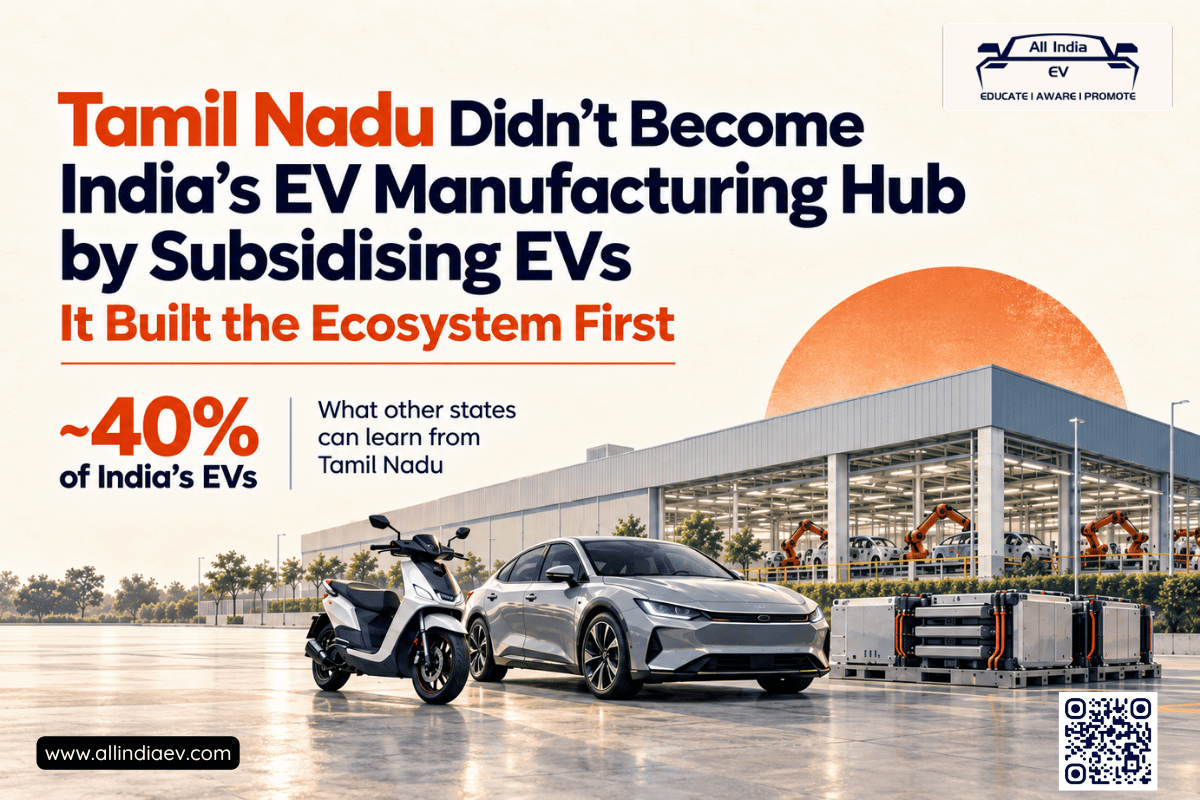
Tamil Nadu’s own EV platform says the state produces roughly 40% of India’s electric vehicles. Recent industry reporting puts it even higher for two-wheelers — more than half of India’s electric two-wheelers, and around 40% of overall EV output.
Those numbers are impressive. But the real question isn’t whether Tamil Nadu is a hub — it clearly is.
The real question is:
- How did it become one?
- Can other states copy the economics, or only the incentives?
The answer is uncomfortable for policymakers hunting for a quick template.
Tamil Nadu’s EV policy did not create this advantage. It accelerated one that already existed.
The state didn’t build an EV industry from zero — it converted an automotive industry into an EV industry. That distinction is the single most important lesson for Uttar Pradesh, Maharashtra, Gujarat, Karnataka and every other state chasing the next trillion rupees of mobility investment.
The Number That Explains Tamil Nadu’s Position
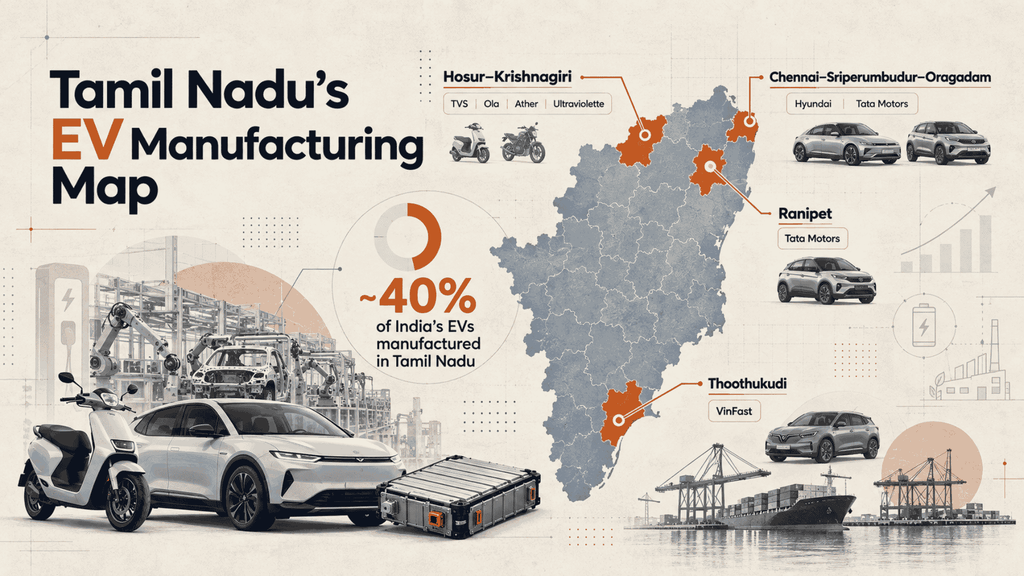
Tamil Nadu’s EV footprint is no longer built around one company or one city. It’s spread across four distinct clusters:
- Hosur–Krishnagiri — the two-wheeler and startup-technology belt
- TVS Motor: crossed 1 million cumulative iQube units at its Hosur plant (June 2026)
- Ola Electric: Futurefactory at 1 million units/year capacity, plus a co-located battery-cell Gigafactory
- Ather Energy: 420,000 two-wheelers and 379,800 battery packs annual capacity, still expanding
- Ultraviolette: announced a new ₹779 crore plant (Sept 2026) — 250,000 units/year, expandable to 500,000
- Chennai–Sriperumbudur–Oragadam — the legacy automotive core
- Hyundai has named Tamil Nadu its “Flagship EV Hub for India”, with a battery sub-assembly facility and localised power electronics
- Over ₹26,000 crore of Hyundai’s 2023–2032 investment programme is tied to the state
- Ranipet — the next-generation OEM node
- Tata Motors’ Panapakkam plant: ~₹9,000 crore, 250,000+ vehicles/year, first phase live since February 2026
- Thoothukudi — the export gateway
- VinFast inaugurated its plant in August 2025 at 50,000 units/year, expandable to 150,000
- Strategic goal: an export base for South Asia, the Middle East and Africa
The takeaway: Tamil Nadu hasn’t built one EV cluster. It’s building several interconnected mobility clusters, each anchored by different strengths.
The Real Advantage Predates the EV
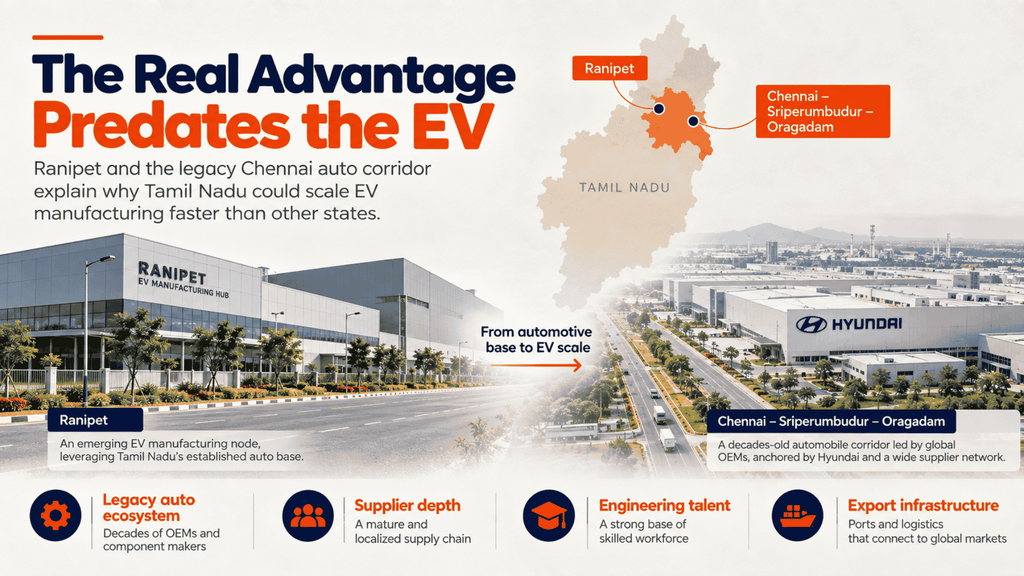
Tamil Nadu’s own 2023 EV policy is unusually honest about this. It credits the state’s EV boom to:
- An existing automobile supply chain
- A skilled, automotive-trained workforce
- Decades of ancillary industry built by Hyundai, Nissan, TVS, Daimler and others
- 32% of India’s automotive exports in FY2021-22
What this means in practice — an EV company arriving in Tamil Nadu does not land in an empty industrial park. It lands near:
- Suppliers of stamped components, castings, wiring harnesses, plastics, tooling
- Engineers who already understand automotive production
- Vendors fluent in PPAP, quality systems, traceability, tolerances
- Ports that already export finished vehicles
- Industrial estates where other manufacturers already operate
Most importantly, it finds suppliers with an existing automotive business worth protecting — giving them a direct economic reason to retool for batteries, motors, controllers and EV-specific parts.
This is the mechanism that makes the transition compound:
- An OEM arrives →
- Suppliers cluster around it →
- Those suppliers lower the cost/risk for the next OEM →
- That OEM attracts a fresh layer of suppliers →
- The location itself becomes an industrial product
The Policy Was Built Around That Reality — Not Around a Subsidy Number
Tamil Nadu’s 2023 policy doesn’t rely on one flat capital subsidy. Its EV Special Manufacturing Package lets manufacturers choose between:
- SGST reimbursement
- Turnover-linked incentives
- Capital subsidies — up to 15% of eligible fixed assets standard, 20% for advanced-chemistry-cell projects
But the more sophisticated piece is this:
- Transition support for existing automotive companies — training assistance for manufacturers moving current employees onto EV production lines, with enhanced support for specified worker groups.
That’s a policy that understands something most states miss:
A state that attracts one electric scooter factory while letting hundreds of incumbent component makers go technologically obsolete hasn’t built an EV ecosystem — it’s built an assembly plant.
Execution Speed May Matter More Than the Subsidy Percentage
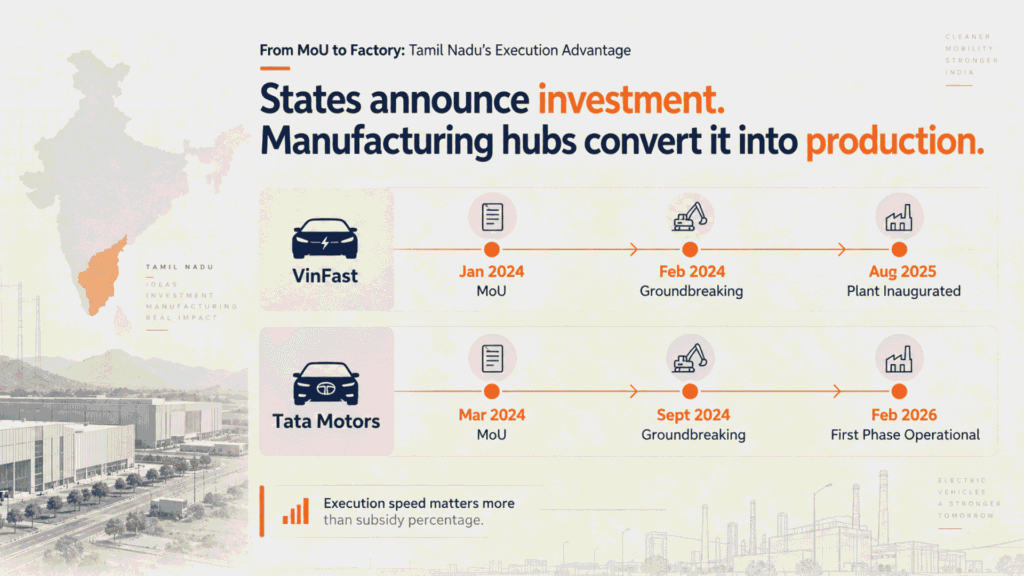
A factor almost never discussed in state EV comparisons: how fast a signed MoU becomes a running factory.
- VinFast: MoU (Jan 2024) → groundbreaking (Feb 2024) → inaugurated (Aug 2025)
- Tata Motors: MoU (Mar 2024) → groundbreaking (Sept 2024) → first phase live (Feb 2026)
The point isn’t that every project moves this fast. It’s that post-MoU facilitation — land conversion, power connections, environmental clearances, roads, water, supplier approvals, hiring — may matter as much as the incentive that won the deal in the first place.
States love announcing investment commitments.
Manufacturing leadership is built by commissioned factories.
Tamil Nadu Stopped Thinking Only About Chennai
Perhaps the most transferable lesson: geographic distribution.
- Hosur–Krishnagiri → two-wheelers, technology-heavy
- Chennai–Sriperumbudur–Oragadam → deep legacy auto ecosystem
- Ranipet → next-gen advanced automotive node
- Thoothukudi → southern export base
- Manallur, Thiruvallur → SIPCOT’s new 300-acre dedicated EV park for vehicles, batteries, charging equipment and components
This spreads the industrial transition across multiple regions, each built around a different natural advantage — suppliers, ports, land, labour, existing OEMs, export routes — rather than betting everything on one metro.
What Other States Can Learn — Without Copying Tamil Nadu
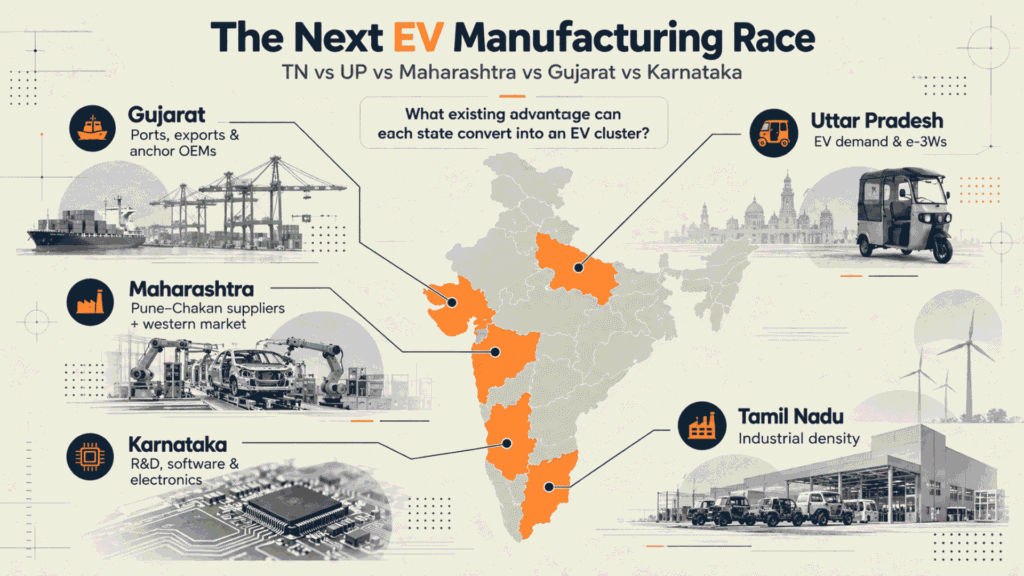
Tamil Nadu’s model can’t be transplanted, because starting conditions differ. The better question for every state:
What existing advantage can be converted into an EV cluster?
| State | Existing Advantage | What Tamil Nadu’s Experience Suggests |
|---|---|---|
| Uttar Pradesh | India’s largest EV demand base (especially e-3Ws), huge market, available land | Convert consumption demand into manufacturing demand — cluster suppliers around vehicles, batteries, motors and power electronics instead of treating adoption and manufacturing as separate tracks |
| Maharashtra | Deep Pune-Chakan auto ecosystem, component base, large EV market | Use existing suppliers to build EV-specific density; Ather’s Sambhajinagar move proves western-market logistics can pull capacity away from the south |
| Gujarat | Strong execution, ports, auto exports | Expand from powerful anchor OEMs into a broader multi-OEM supplier ecosystem across batteries, electronics and motors |
| Karnataka | Bengaluru R&D, software, electronics, startups | Connect R&D directly to manufacturing so engineering value doesn’t leak across the border to Hosur |
UP’s opportunity is the largest and most obvious one on the table. It already dominates electric three-wheelers and has policy muscle to match:
- Capital subsidies up to 30% or ₹1,000 crore per project for integrated EV and ultra-mega battery projects
- Over 2,000 acres identified for EV manufacturing (Invest UP)
UP doesn’t need a bigger subsidy. It needs to turn consumption into clustering — an e-rickshaw sold in Lucknow or Kanpur should create the economic pull for motors, controllers, batteries, chargers and BMS manufacturing to locate nearby.
Maharashtra: The Most Direct Competitive Test
Tamil Nadu’s lead isn’t permanent — and Ather itself proves it.
- Current base: Hosur
- Next major expansion: Chhatrapati Sambhajinagar, Maharashtra — 500,000 units/year, Phase 1
- Stated reasons: proximity to western markets, lower logistics cost, supply-chain resilience
This is industrial competition working exactly as it should. As volumes rise, transport cost starts to matter more than sunk advantage. Maharashtra already has:
- A large auto industry
- Pune-Chakan engineering and supplier depth
- Major consumption centres
- An established manufacturing culture
Its job now: make EV-specific supply chains denser around what it already has.
Gujarat: Proof There’s More Than One Route to the Top
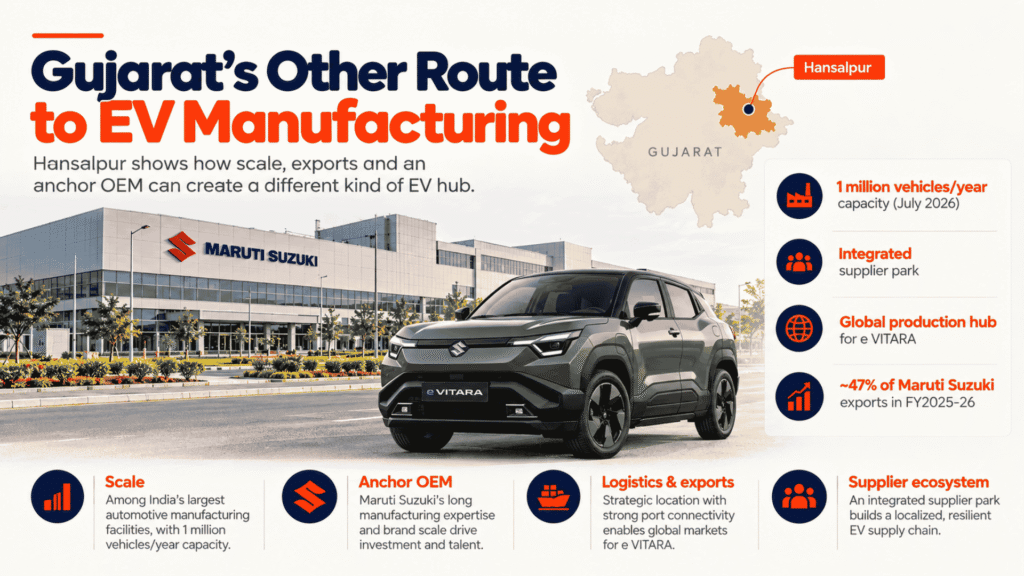
Gujarat shows Tamil Nadu doesn’t hold a monopoly on this model.
- Maruti Suzuki’s Hansalpur plant: hit 1 million vehicles/year capacity (July 2026)
- Now producing the e VITARA for domestic and international markets
- Has its own in-plant railway siding
- Accounted for nearly 47% of Maruti’s overseas shipments in FY2025-26
Gujarat’s formula: scale + anchor OEM + suppliers + logistics + exports.
What Tamil Nadu adds is breadth — legacy OEMs, startups, battery makers, commercial vehicles, two-wheelers and passenger cars all in one geography, creating a different kind of resilience.
Karnataka: The Reverse Problem
Karnataka holds something Tamil Nadu can’t quickly replicate: Bengaluru — software, electronics, battery research, EV startups, engineering talent.
Its Clean Mobility Policy 2025–30 is an explicit attempt to turn that intellectual base into physical output:
- Target: ₹50,000 crore investment, 100,000 jobs
- New clusters proposed at Gauribidanur, Dharwad, Harohalli
- Focus areas: batteries, cells, motors, power electronics, charging, testing
The strategic gap: Bengaluru has long designed EV technology while manufacturing happens across the border in Hosur. Tamil Nadu’s lesson here is blunt:
R&D becomes defensible only when engineering, suppliers, testing and production share the same economic geography.
But the 40% Number Shouldn’t Be Misread
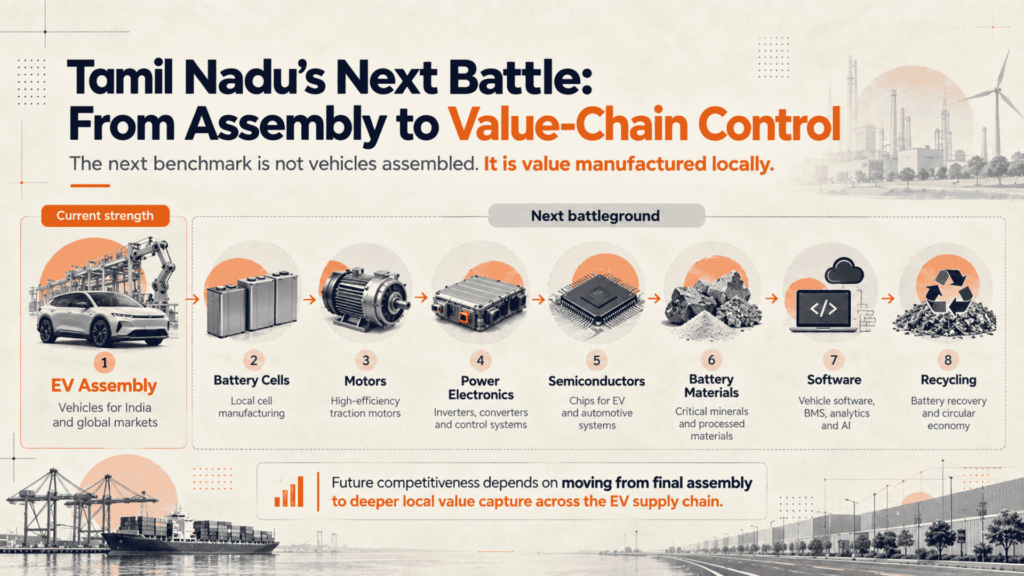
Manufacturing a large share of India’s EVs is not the same as controlling the full value chain.
- India still imports battery materials, cells, semiconductor devices, permanent magnets and specialised electronics
- Localisation levels vary widely even within Tamil Nadu
- A vehicle can be assembled in Tamil Nadu while its highest-value components originate elsewhere
The next battle isn’t about assembly volume. It’s about the shift from:
EV manufacturing hub → EV technology and supply-chain hub
Encouraging signs already underway: Ola’s cell-manufacturing programme, Hyundai’s battery sub-assembly and power-electronics localisation, and supplier development around VinFast. But the real benchmark going forward should be:
Not how many vehicles are assembled — but how much of each vehicle’s value is manufactured locally.
What This Means
Tamil Nadu’s story is often told as a policy success. That’s too simple. The real sequence looked like this:
- A 30-year automotive head start
- Policy that reinforced, rather than created, the advantage
- Industrial parks that gave investors ready sites
- Existing OEMs that created supplier demand
- Suppliers that created labour demand
- Labour that built skills
- Ports that made exports economical
- New EV companies arriving because most of what they needed already existed
- Their arrival making the ecosystem even more attractive to the next entrant
The wrong lesson for UP, Maharashtra, Gujarat or Karnataka:
“Tamil Nadu offers X% subsidy — so we should offer X+5%.”
Factories don’t choose locations on subsidy alone. They evaluate the cost of operating there for the next 10–20 years:
- Can suppliers reach the factory quickly?
- Can engineers be hired locally?
- Can the workforce be trained at scale?
- Can power be secured reliably?
- Can vehicles be tested and homologated nearby?
- Can components be localised over time?
- Can production reach a port efficiently?
- Can expansion get land without delay?
- After the MoU is signed, can the factory actually get built?
Tamil Nadu’s real advantage has been making more of those answers “yes” at the same time.
That’s what other states need to reproduce — not Tamil Nadu’s policy document, but Tamil Nadu’s industrial density.
One Final Warning — For Tamil Nadu Itself
- Ather is expanding into Maharashtra
- Gujarat is exporting made-in-India EVs globally
- Karnataka is building new clean-mobility clusters
- UP sits on an enormous untapped domestic EV market
India’s EV industry will eventually be too large to stay concentrated in one state.
Tamil Nadu’s 40% manufacturing share may not be the number that matters most five years from now. The number that will matter is whether it can capture the next layer of value — cells, power electronics, motors, semiconductors, battery materials, software, recycling, export-oriented platforms — before other states build comparable ecosystems of their own.
Tamil Nadu has shown India how an automotive cluster becomes an EV cluster.
The next race is about which states can turn their own industrial advantages into an ecosystem — before the EV supply chain becomes geographically settled.