


All India EV – The 9am Show
All India EV Market Insights · 7 Oct 2026 · @The Energy Log
- All India EV – The 9am Show
- What an EV architecture actually defines
- The Architecture Map: who built what
- Three industrial strategies, running at once
- 1. Convert what you already have
- 2. Build an electric architecture from scratch
- 3. Share global architectures across brands
- The INGLO question: Mahindra architecture, Volkswagen parts
- The Chinese architecture footprint is larger than it looks
- Platform origin is not manufacturing origin
- Four Lenses: what platform ownership means for the market
- Claims Ledger
- AIEV Intelligence View
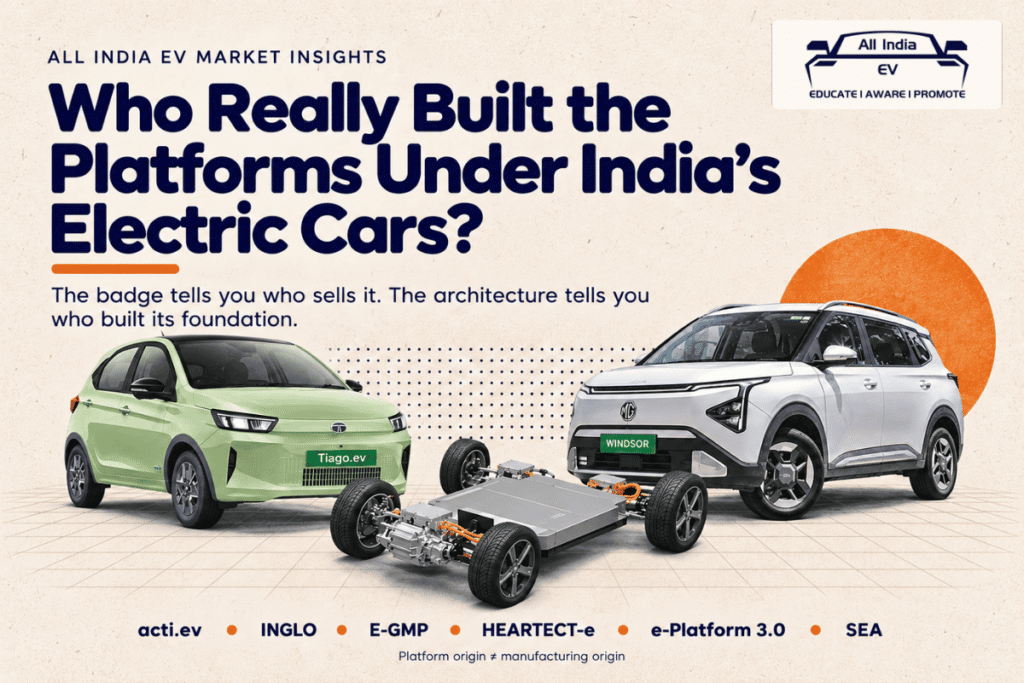
From Tata’s acti.ev and Mahindra’s INGLO to BYD’s e-Platform 3.0, Geely’s SEA and Wuling’s GSEV, India’s electric cars already run on engineering developed across India, China, South Korea, Japan, Europe, the US and Vietnam. The badge on the bonnet tells you who sells the car. It does not tell you who built the foundation underneath it.
EV coverage usually starts and ends with the battery: how many kWh, what range, which chemistry, how fast it charges. Those are the numbers on the brochure.
The more consequential decision sits one layer below. It is the vehicle architecture, the engineering foundation that fixes where the battery goes, how motors are packaged, what wheelbases are possible, how crash energy travels and, increasingly, how computing and software are wired into the car.
Two EVs with completely different bodies can share most of that engineering. Two EVs from different brands can trace back to an architecture developed by a third company altogether.
That is now the reality of India’s electric car market. It is not a contest between nine or ten logos. It is a mix of Indian-developed EV platforms, converted combustion platforms, Korean and Japanese global architectures, Chinese born-electric platforms and architectures shared across multinational groups.
What an EV architecture actually defines
A platform is the engineering skeleton and nervous system of a vehicle. At the most basic level it fixes structural hard points: axle positions, suspension mounts, crash load paths and the range of sizes a single design can stretch to.
In an EV, the architecture reaches further. A modern dedicated electric platform can also define:
- battery dimensions, placement and cooling;
- front-, rear- or all-wheel-drive layouts;
- motor and inverter packaging;
- high-voltage system voltage (400V or 800V class) and peak charging rate;
- floor height and whether the cabin floor is flat;
- electrical and electronic (E/E) architecture, from distributed ECUs to zonal controllers;
- the compute, connectivity and over-the-air software layer.
This is why a dedicated EV platform can outperform a converted combustion car. Remove the engine, gearbox, exhaust and fuel tank from the design brief and engineers can optimise the whole vehicle around the battery.
The trade-off is money and time. A ground-up EV architecture costs thousands of crores and several years to develop. An adapted ICE platform reaches market faster and cheaper. India is currently running both models side by side.
The Architecture Map: who built what
Fourteen distinct architecture families now sit under the electric cars on sale in India, developed in India, South Korea, Japan, China, Europe, Vietnam and the US. Only three of them (Tata’s two generations and Mahindra’s INGLO) are Indian-owned. The map below covers architectures whose origin can be established from OEM disclosures and credible industry reporting, as of October 2026. It is not an exhaustive list of every low-volume luxury import.
| Architecture | Type | Developer (origin) | EVs in India on it | Built for India at |
|---|---|---|---|---|
| Tata X0 / X1 | Converted ICE | Tata Motors (India) | Tiago.ev, Tigor.ev (X0); Nexon.ev (X1) | Sanand, Pune |
| Tata acti.ev / acti.ev+ | Dedicated EV | Tata Passenger Electric Mobility (India) | Punch.ev, Curvv.ev (acti.ev); Harrier.ev, Sierra.ev (acti.ev+) | Pune, Sanand |
| INGLO | Dedicated EV | Mahindra & Mahindra (India), with VW MEB components and cells | BE 6, XEV 9e, XEV 9S | Chakan |
| SsangYong X100-derived | Converted ICE | SsangYong (South Korea), re-engineered by Mahindra | XUV400 | Nashik |
| Hyundai-Kia K2 (EV-modified) | Converted ICE | Hyundai Motor Group (South Korea) | Creta Electric, Kia Carens Clavis EV | Chennai, Anantapur |
| E-GMP | Dedicated EV, 800V | Hyundai Motor Group (South Korea) | Hyundai IONIQ 5; Kia EV6, EV9 | Chennai (IONIQ 5, CKD); imports |
| HEARTECT-e | Dedicated EV | Suzuki Motor Corporation (Japan) | Maruti Suzuki e Vitara; Toyota Urban Cruiser EV | Hansalpur, Gujarat |
| BYD e-Platform 3.0 | Dedicated EV | BYD (China) | ATTO 3, Seal, Sealion 7; eMAX 7 uses its key systems | Imported |
| GSEV | Dedicated EV | SAIC-GM-Wuling (China) | MG Comet EV; MG Windsor EV (Wuling Cloud EV) | Halol, Gujarat |
| CMP / Smart Car | Multi-energy | Stellantis (Europe), co-developed by India R&D | Citroën ë-C3, ë-C3X (Aircross) | Tiruvallur |
| CMA | Multi-energy | Volvo Cars and Geely (Sweden, China) | Volvo EX40, EC40 | Hoskote, Bengaluru |
| SEA | Dedicated EV | Geely (China) | Volvo EX30 | Hoskote, Bengaluru |
| VinFast EV platform | Dedicated EV | VinFast (Vietnam) | VF 6, VF 7 | Thoothukudi (CKD) |
| Tesla Model Y architecture | Dedicated EV | Tesla (United States) | Model Y | Imported from Shanghai |
Three additions since the original draft of this map matter. The Tata Sierra.ev launched on 30 June 2026 on acti.ev+, the same base as the Harrier.ev. Mahindra’s three-row XEV 9S, launched in November 2025, is the third INGLO product. And two entirely new architecture origins arrived in 2025: VinFast from Vietnam and Tesla from the US.
Three industrial strategies, running at once
The map shows that India has no single route to an electric car. Three distinct industrial strategies are operating in the same showrooms.
1. Convert what you already have
India’s first EV wave was built this way. Tata electrified the X0 and X1 platforms to create the Tiago.ev, Tigor.ev and Nexon.ev. Mahindra did the same with the XUV400. Hyundai and Kia followed the same economic logic with the Creta Electric and Carens Clavis EV on a modified K2 base.
The case is cost and speed. Stamping lines can often be reused, suppliers already know the parts and crash engineering already exists. A company can be in market years before a skateboard platform would be ready.
The price is packaging. A structure designed around an engine, gearbox, exhaust and fuel tank limits battery size, floor flatness, cabin space and drivetrain options. It is not a bad strategy but a transitional one.
2. Build an electric architecture from scratch
India’s two domestic leaders have now crossed into this phase. Tata describes acti.ev as a four-layer architecture spanning powertrain, chassis, electrical/electronics and cloud. Mahindra calls INGLO its Electric Origin Architecture, a skateboard that supports rear- and all-wheel drive and an 800V-capable layout.
The proof is in how fast the families are filling out. Tata now has four acti.ev-family models: Punch.ev, Curvv.ev, Harrier.ev and, since June 2026, the Sierra.ev, which offers 65 kWh and 75 kWh packs with claimed ranges of 565 km and 665 km. Mahindra has three on INGLO, with the seven-seat XEV 9S launched in November 2025 at an introductory ₹19.95 lakh, built at Chakan.
The platform here is no longer sheet metal under a car. It is the integration point for mechanical engineering, battery, power electronics, computing and software. That is why owning it is becoming strategic.
3. Share global architectures across brands
The third approach is the most misunderstood. A Volvo does not necessarily sit on a Volvo-only platform. An MG does not necessarily use an architecture developed by MG. A Toyota can be built on a Suzuki platform in a Maruti plant.
The Volvo EX30 is the clearest case. Its design and safety engineering are Volvo’s, but its SEA foundation was developed by Geely. Volvo’s chief commercial officer Björn Annwall has said the shared platform brought costs down and let Volvo split tooling costs with sister brands such as Smart and Zeekr.
The Toyota Urban Cruiser EV is the Indian example. It shares Suzuki’s HEARTECT-e platform, cabin and powertrain with the Maruti e Vitara and is built at Suzuki’s Gujarat plant. That is exactly what shared architectures are for.
The INGLO question: Mahindra architecture, Volkswagen parts
The BE 6, XEV 9e and XEV 9S are not Volkswagen MEB cars in Mahindra bodies. They are Mahindra-architecture vehicles that use selected MEB components and Volkswagen’s unified battery cells.
The paper trail is clear. A partnering agreement and term sheet were signed in 2022. On 16 February 2024, Volkswagen Group and Mahindra signed the first supply agreement for MEB components for INGLO, covering certain electric components and unified cells. The deal runs over several years with a lifetime volume of about 50 GWh. Volkswagen describes INGLO as Mahindra’s purpose-built platform, and Mahindra was positioned as the first external partner for the unified cell concept.
So the accurate description is this: Mahindra architecture plus selected Volkswagen electric technology.
The distinction matters for any discussion of technology ownership. A carmaker does not need to invent every inverter, cell or motor in-house to own the overall vehicle architecture. What it must own is the system: hard points, packaging, crash structure, E/E layout and the right to evolve them.
The Chinese architecture footprint is larger than it looks
Chinese-developed architecture is already under some of India’s most popular EVs, often without a Chinese consumer identity on the badge.
MG is the biggest case. The Comet EV uses Wuling’s GSEV, and the Windsor EV is the Indian version of the Wuling Cloud EV, sold under that name in Indonesia. The Windsor is not a niche product. JSW MG Motor shipped 46,735 Windsors in calendar 2025, making it India’s best-selling electric car that year and displacing the Nexon.ev.
BYD brings its e-Platform 3.0 under its own badge. Volvo’s EX30 runs on Geely’s SEA, while the CMA under the EX40 and EC40 was co-developed inside the Volvo-Geely group. Suzuki’s HEARTECT-e is Japanese, but the e Vitara’s LFP Blade cells are sourced from BYD, so the Chinese supply chain shows up at component level even on a Japanese platform built in Gujarat.
None of this is inherently a problem. It reflects how global the modern car has become. The useful question is not whether there is Chinese technology inside, but a set of separate ones:
- Who owns the architecture?
- Who controls its engineering evolution?
- Where is the vehicle engineered and where is it built?
- Which components are localised?
- Where is the software developed?
- How much of the value chain sits in India?
Platform origin is not manufacturing origin
Where a car is built and who designed its foundation are two different facts, and India now has clear examples of every combination.
- Japanese platform, Indian factory, global market. The Maruti Suzuki e Vitara is built at Hansalpur, Gujarat, and exported to the UK, Europe and Japan, but HEARTECT-e was developed by parent Suzuki.
- European brand, Indian engineering. The Citroën ë-C3 belongs to Stellantis, yet its India-oriented Smart Car/CMP programme was co-developed and industrialised by Stellantis’ Indian R&D teams.
- Swedish car, Chinese foundation, Indian assembly. The Volvo EX30 carries Swedish design and safety engineering on Geely’s SEA, and is assembled at Hoskote, Bengaluru, Volvo’s third locally assembled EV.
- Indian brand, Korean bones. The Mahindra XUV400 is engineered and built as a Mahindra, but its architecture traces to SsangYong’s X100 Tivoli.
- Vietnamese platform, Tamil Nadu plant. VinFast assembles the VF 6 and VF 7 from CKD kits at Thoothukudi, its first overseas plant, with installed capacity for 50,000 EVs a year.
- American platform, Chinese factory, Indian showroom. The Tesla Model Y arrives fully built from Shanghai, priced from ₹60 lakh largely because of import duty.
Labels such as “Indian car”, “Chinese car” or “European car” increasingly fail to describe the technology. Modern automotive development is layered, and each layer has a different address.
Four Lenses: what platform ownership means for the market
| Lens | What the architecture map shows | Why it matters |
|---|---|---|
| Demand | India’s best-selling EV of 2025, the MG Windsor, sits on a Chinese-developed Wuling platform. Buyers chose on price, space and battery-as-a-service, not platform origin. | Platform origin does not drive purchase decisions. Platform cost does, because it sets the price point an OEM can hit. |
| Supply | Even Indian-owned platforms rely on imported cells: Volkswagen unified cells for INGLO, BYD Blade cells for the e Vitara. | Owning the architecture is not the same as owning the supply chain. Cell localisation is the next layer of the contest. |
| Capital | Tata now spreads acti.ev development across four models and Mahindra INGLO across three. VinFast has committed about ₹16,000 crore to its Thoothukudi plant. | A platform amortised over many models and years is an industrial asset. A one-off EV conversion is a cost centre. |
| Policy | Tesla’s Model Y attracts over ₹21 lakh in import duty per unit as a fully built import, while India also limits Chinese investment in its auto sector. | Duty and investment rules push global architectures toward local assembly and Indian partners, as with JSW MG, rather than keeping them out. |
Claims Ledger
The figures in this piece separate into what is independently verifiable and what rests on company statements or trade reporting.
| Claim | Source | Status |
|---|---|---|
| Sierra.ev on acti.ev+, launched 30 June 2026 from ₹18.79 lakh | Tata Motors launch, trade media | Verified (public launch) |
| Sierra.ev range of 565 km (65 kWh) and 665 km (75 kWh) | Tata Motors | Company-claimed, test-cycle figure |
| XEV 9S on INGLO, ₹19.95 lakh introductory, built at Chakan | Mahindra | Verified (public launch) |
| XEV 9S “500 km real-world range” | Mahindra | Company-claimed |
| VW-Mahindra deal: MEB components and unified cells, about 50 GWh lifetime | Joint press release, 16 Feb 2024 | Company-stated; delivered volumes not disclosed |
| MG Windsor: 46,735 units in 2025, India’s top-selling EV | JSW MG Motor | Company-reported wholesale; cross-check against VAHAN retail |
| Windsor EV is the Wuling Cloud EV | Trade media, Wuling market listings | Verified (same vehicle sold in Indonesia) |
| e Vitara uses BYD-sourced LFP Blade cells | Trade media | Reported; not detailed in Maruti India disclosures |
| VinFast Thoothukudi: CKD assembly, 50,000 units/year installed | VinFast | Company-stated |
| Volvo EX30 assembled at Hoskote on Geely’s SEA | Volvo Car India; Volvo executives | Verified |
| Tesla Model Y imported fully built from Shanghai, from ₹60 lakh | Tesla India price list | Verified |
AIEV Intelligence View
India’s EV market is not a contest between car brands but a contest between vehicle architectures.
The consumer sees a Tata, Mahindra, Hyundai, Kia, MG, Volvo, Citroën, BYD, VinFast, Tesla or Maruti Suzuki. An engineer looking underneath sees acti.ev, INGLO, E-GMP, K2, HEARTECT-e, e-Platform 3.0, GSEV, CMP, CMA and SEA. Those names say far more about where the engineering came from.
The platforms that win will decide which companies can launch EVs fastest, spread development cost over the most models, fit larger batteries, charge faster, ship new software and build at a competitive cost.
India has already made one important move in this race. Tata and Mahindra no longer depend only on converted combustion platforms. Both now own scalable electric architectures, and both proved it in the past twelve months: the XEV 9S in November 2025 and the Sierra.ev in June 2026.
What India does not yet own is the layer below: the cells. INGLO runs on Volkswagen cells; the e Vitara runs on BYD cells. The next phase of localisation will be measured there.
Meanwhile, global platforms from Hyundai, Suzuki, BYD, Geely, Wuling, VinFast and Tesla are bringing international engineering into Indian showrooms. That is not something to hide. It is how the modern car industry works.
The useful exercise is to make the architecture visible. If you want to know who really developed an electric car, the logo on the steering wheel is no longer enough. You have to look underneath it.