

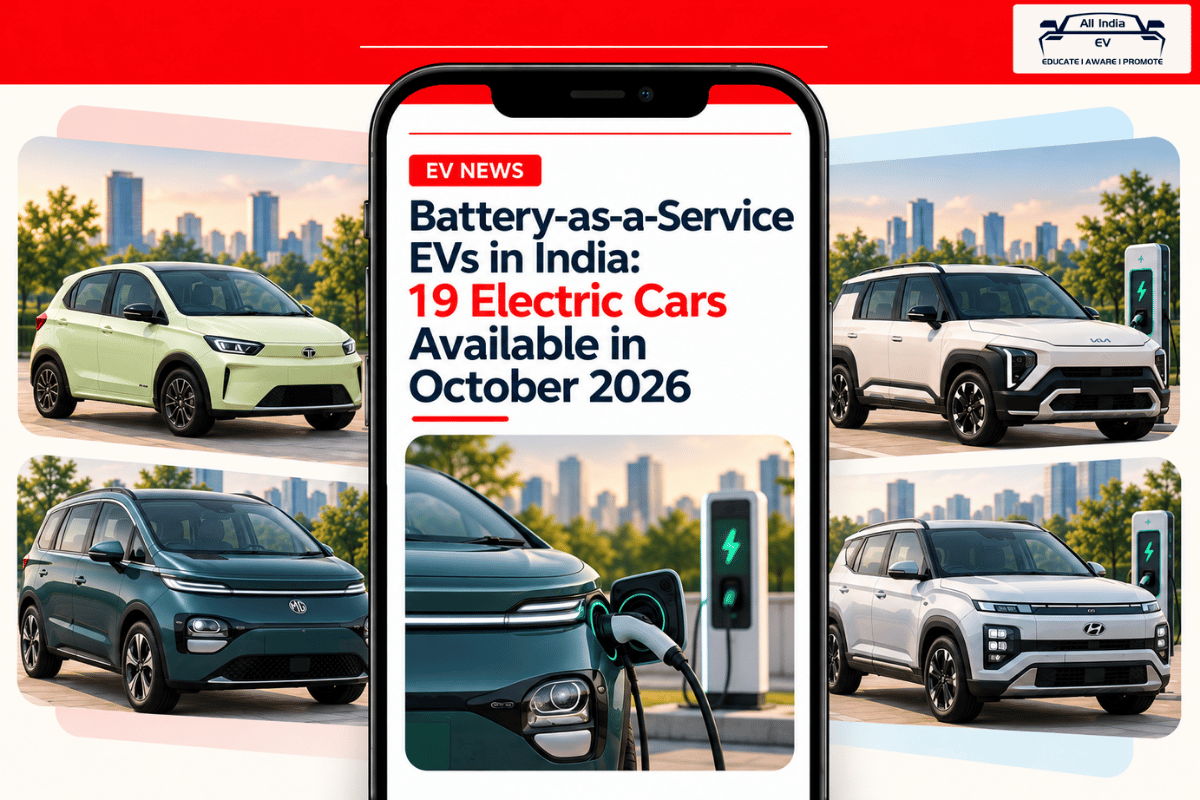
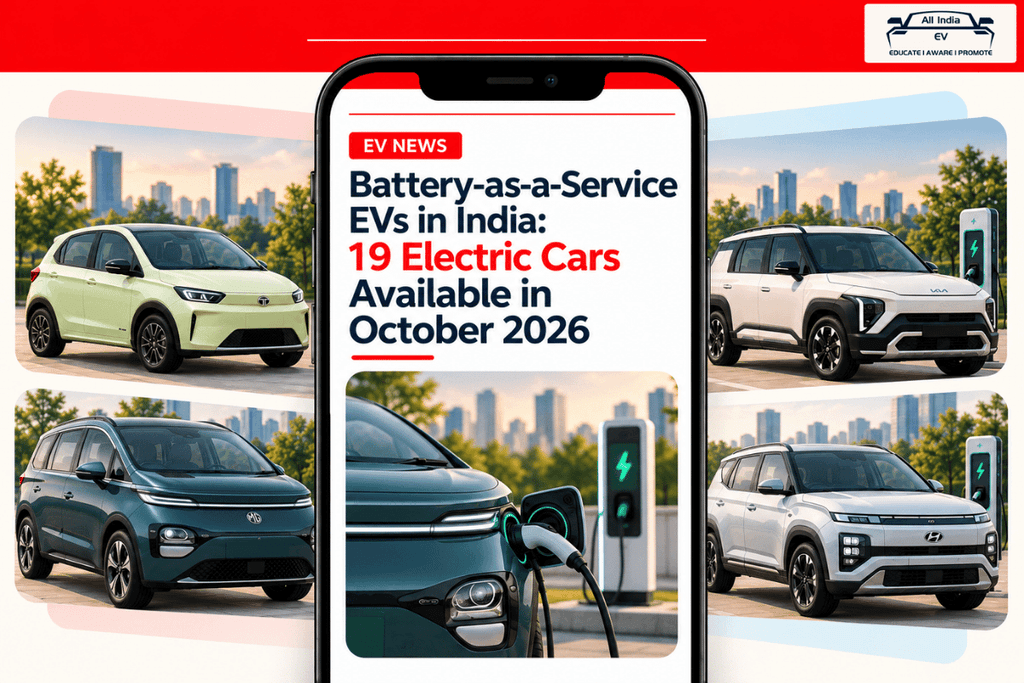
India’s electric passenger vehicle market is witnessing a new shift as automakers introduce Battery-as-a-Service (BaaS) schemes to make electric cars more affordable. The model allows customers to purchase an electric vehicle at a lower upfront price by separating the cost of the battery from the vehicle’s purchase price.
As of October 2026, eight major automakers, including Tata Motors, JSW MG Motor India, Mahindra, Maruti Suzuki, Hyundai, Kia, Citroën and Toyota, offer electric cars through BaaS programmes. The available options range from affordable city cars to premium electric SUVs and multi-purpose vehicles.
What Is Battery-as-a-Service?
Battery-as-a-Service is an ownership or financing model in which customers purchase an electric vehicle without paying the full battery cost upfront. Instead, the battery expense is handled separately through a usage-based rental or a dedicated financing arrangement.
This approach can reduce the initial purchase price and make electric mobility accessible to more buyers. However, the additional battery charges must be considered when calculating the overall cost of ownership.
While some manufacturers offer usage-linked battery rental arrangements, others structure their programmes through separate vehicle and battery financing. Consequently, the advertised per-kilometre battery rate may represent an estimated financing cost rather than a charge based entirely on actual kilometres driven. Buyers should check the terms and conditions of individual schemes before making a decision.
List of Electric Cars Available with BaaS in India
The following electric cars are listed with BaaS options in October 2026. Prices are indicative starting prices under the schemes and may vary depending on the variant, location and financing terms.
| Electric Car Model | Starting BaaS Price | Battery Cost |
|---|---|---|
| Tata Tiago EV | ₹4.69 lakh | ₹2.60/km |
| MG Comet EV | ₹4.99 lakh | ₹3.20/km |
| Tata Punch EV | ₹6.49 lakh | Approx. ₹2.60/km |
| Citroën eC3X | ₹6.89 lakh | ₹2.26/km |
| Kia Syros EV | ₹7.99 lakh | ₹3.30/km |
| Tata Nexon EV | ₹8.99 lakh | ₹4.40/km |
| MG Windsor EV | ₹9.99 lakh | ₹3.99/km |
| Maruti Suzuki e Vitara | ₹10.99 lakh | ₹3.99/km |
| Hyundai Creta Electric | ₹10.99 lakh | ₹3.90/km |
| Tata Curvv EV | ₹10.99 lakh | ₹5.00/km |
| Mahindra BE 6 Sporteq | ₹11.45 lakh | ₹3.75/km |
| Tata Sierra EV | ₹11.99 lakh | ₹5.50/km |
| Mahindra XEV 9S | ₹12.65 lakh | ₹3.75/km |
| Kia Carens Clavis EV | ₹12.84 lakh | ₹3.30/km |
| MG ZS EV | ₹13.00 lakh | ₹4.50/km |
| Mahindra XEV 9e | ₹13.90 lakh | ₹3.75/km |
| MG Hector Tomahawk EV | ₹13.99 lakh | ₹4.90/km |
| Tata Harrier EV | ₹14.49 lakh | ₹5.90/km |
| Toyota Urban Cruiser Ebella | ₹15.25 lakh | ₹4.99/km |
Note: Prices and battery rates are indicative figures for October 2026. Buyers should confirm the latest prices, model availability and financing conditions with the respective manufacturers or dealerships.
Benefits and Costs of BaaS for EV Buyers
One of the biggest advantages of BaaS is the reduction in upfront expenditure. For instance, the Tata Tiago EV has a starting price of ₹4.69 lakh under the scheme, compared with ₹6.99 lakh when purchased with its battery. Similarly, the Tata Punch EV and Mahindra BE 6 Sporteq provide buyers with options to finance battery expenses separately.
The scheme also offers customers greater flexibility when comparing electric vehicles across different price segments. However, buyers should evaluate the monthly battery payment alongside vehicle financing, electricity expenses, insurance and maintenance.
Some schemes also include specific conditions. Certain programmes may require minimum monthly driving distances, while others calculate advertised per-kilometre costs using estimated usage and financing assumptions. Understanding these requirements is essential before signing an agreement.
BaaS Could Support India’s Electric Mobility Growth
The growing availability of BaaS across multiple automakers reflects the industry’s efforts to address the high initial cost of electric cars. With options spanning hatchbacks, compact SUVs, premium SUVs and electric MPVs, customers have more choices when planning their transition to electric mobility.
Nevertheless, the long-term value of BaaS will depend on battery financing costs, contract conditions, vehicle usage and the total amount paid over the ownership period. Buyers who drive long distances should compare the scheme carefully with outright battery ownership, while lower-mileage users should examine any minimum payment requirements.
As India’s EV market expands, BaaS could become an important purchasing option by lowering the initial financial barrier to electric car ownership. Its overall appeal will ultimately depend on transparent pricing and whether separate battery costs deliver genuine savings over time.