
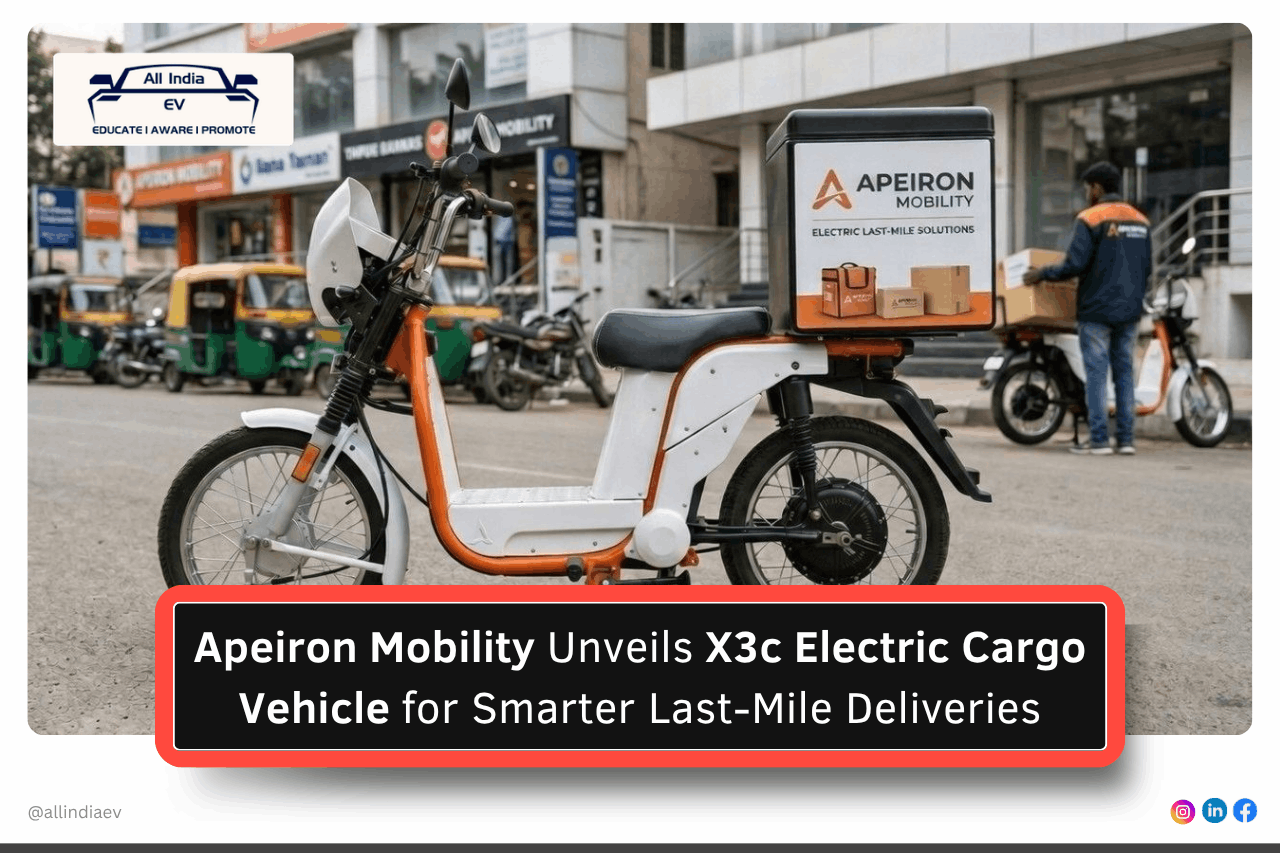


What: Bengaluru-based Apeiron Mobility Pvt. Ltd. has launched the Apeiron X3c, an electric cargo vehicle designed for last-mile delivery use cases.
The Number: The vehicle has been launched at ₹99,999 ex-showroom Karnataka for a limited period, offers a claimed 120 km range, and comes with a 3-year warranty on the motor, controller, and battery pack.
The Impact: The launch adds a purpose-built electric cargo option to India’s last-mile delivery market, a segment where uptime, operating cost, and vehicle suitability matter more than headline speed or styling.
All India EV – Monthly Magazine
The Core News
Bengaluru-headquartered Apeiron Mobility Pvt. Ltd. has introduced the X3c electric cargo bike for last-mile delivery operations. The launch was highlighted in a LinkedIn post by EVreporter, which noted that the vehicle is being positioned specifically for delivery professionals rather than as a generic electric two-wheeler.
The X3c has been launched at an introductory price of ₹99,999 ex-showroom Karnataka for a limited period. Apeiron says the ICAT-certified vehicle offers a 120 km real-world range, and it is backed by a 3-year warranty covering the motor, controller, and battery pack. The company also highlights a 24-hour service turnaround, indicating that uptime is being used as a central product promise for commercial riders.
On its website, Apeiron positions the X3c as a purpose-built electric cargo vehicle for delivery riders and fleet operators, with multiple carrier configurations for food, grocery, parcel, and supply delivery applications. The company is currently offering the vehicle in Karnataka and notes that it can be charged through a standard 5A household socket, with a full charge taking about 4 to 5 hours.
More EV News

Breaking Down the Update
- Product launched: Apeiron Mobility has launched the X3c for last-mile delivery use.
- Launch pricing: Introductory price is ₹99,999 ex-showroom Karnataka for a limited period.
- Regular price signal: Apeiron’s website indicates the regular price is ₹1,09,999, implying a launch discount of ₹10,000.
- Range claim: The vehicle offers a claimed 120 km real-world range.
- Certification: The X3c is described as an ICAT-certified vehicle.
- Warranty: It comes with a 3-year warranty for the motor, controller, and battery pack.
- Charging setup: Charging can be done using a standard 5A domestic socket, with a full charge time of about 4 to 5 hours.
- Commercial focus: Apeiron is pitching the X3c to delivery riders and fleet operators, with configurable cargo carrier options and service-led positioning.
How this will help Indian EV Market
This launch matters because India’s EV transition will not be built only through passenger cars and premium scooters. A large part of real EV scale will come from working vehicles that run every day, generate income, and make the economics of electrification visible on the street. That is exactly where products like the Apeiron X3c fit in. By targeting last-mile delivery riders and fleet operators with a purpose-built cargo vehicle, Apeiron is entering one of the most commercially relevant EV segments in the country.
For the Indian EV market, this helps in three practical ways. First, it pushes the market toward use-case-specific vehicle design. Delivery riders do not need a lifestyle scooter with cosmetic features. They need cargo flexibility, low running cost, and reliability across long work shifts. Second, it strengthens the case for ownership economics. Apeiron’s own positioning compares monthly vehicle rental costs with EMI-led ownership, showing how EVs can shift delivery riders from recurring rental expense toward asset ownership. Third, it highlights that service uptime is becoming as important as battery range. A 24-hour service turnaround promise is not flashy, but in commercial mobility, it can matter more than marketing-heavy specs.
If more startups and OEMs build vehicles specifically for logistics, grocery, food delivery, and parcel movement, India’s EV market will deepen in a far more durable way. That is because last-mile electrification creates repeat usage, visible savings, and stronger fleet-level adoption logic. In simple terms, this kind of launch helps move EVs from aspiration to daily business utility.
Conclusion & Next Steps
Apeiron Mobility’s X3c launch is a small but meaningful addition to India’s last-mile EV landscape. The real test now will be execution: rider adoption, fleet onboarding, after-sales consistency, and whether the company can scale beyond Karnataka while maintaining service reliability. In the cargo EV business, the machine opens the door, but uptime and economics decide whether it stays on the road
Catch up on All India EV’s related coverage on India’s evolving commercial EV subsidies and battery swapping policies at All India EV