
All India EVAll India EVAll India EV
Notification
Font ResizerAa
  • Home
  • EV News
  • EV Launch
  • Market Insights
  • Investments & Funding
  • Guest Articles
  • EV Engineering
  • Contact
Reading: Batteries as a Service: Why It’s Taking Off in India and China, but Faces Challenges in the West
Share
All India EVAll India EV
Font ResizerAa
  • Home
  • EV News
  • EV Launch
  • Market Insights
  • Guest Articles
  • EV Engineering
  • Contact
Search
  • Home
    • Home 1
    • Home 2
    • Home 3
    • Home 4
    • Home 5
  • Home
  • Categories
    • Electric
  • Categories
  • Shows
    • Rap
  • More Foxiz
    • Blog Index
    • Contact
  • Bookmarks
    • Customize Interests
    • My Bookmarks
  • More Foxiz
    • Blog Index
    • Sitemap
Have an existing account? Sign In
Follow US
Home » Blog » Batteries as a Service: Why It’s Taking Off in India and China, but Faces Challenges in the West
EV News

Batteries as a Service: Why It’s Taking Off in India and China, but Faces Challenges in the West

Sunita
By
Sunita
Last updated: 30 May 2025
Share
4 Min Read
SHARE

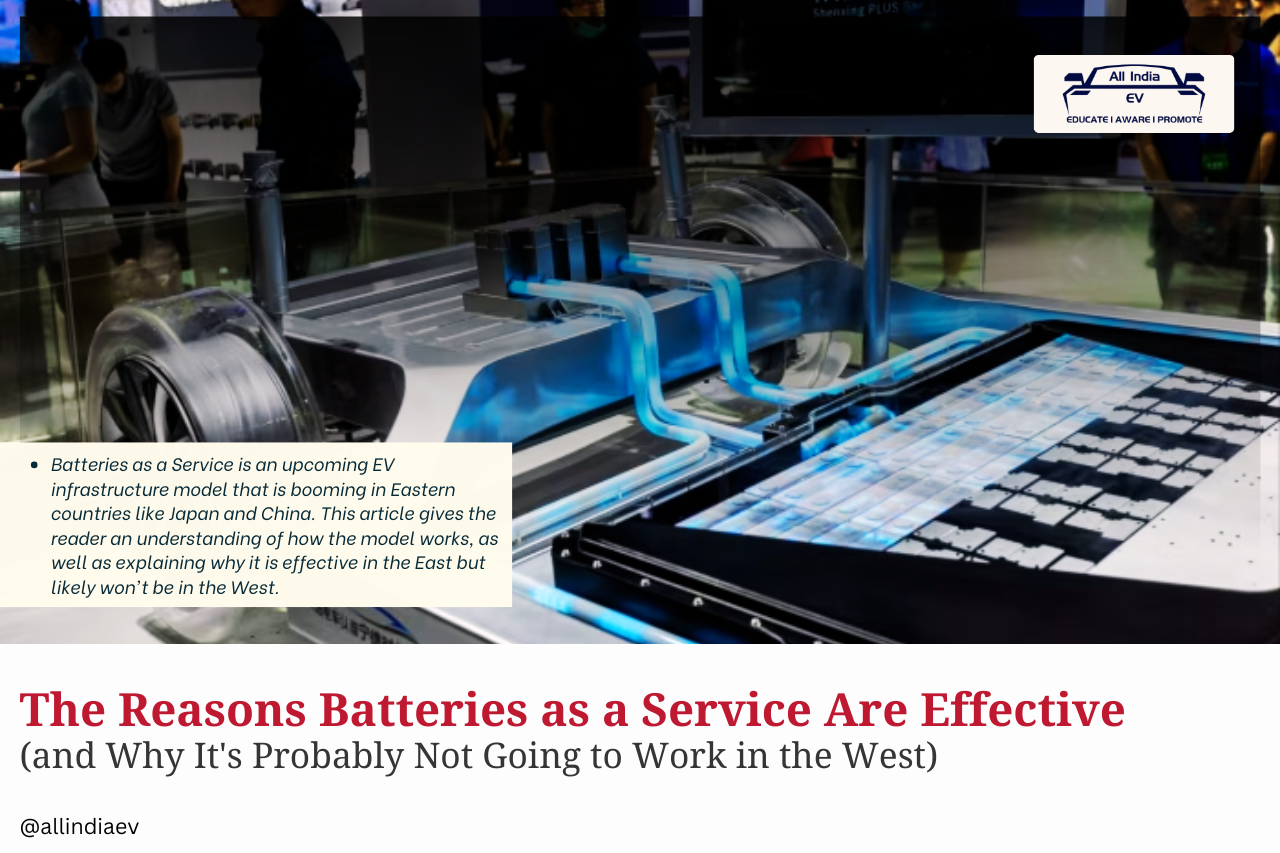
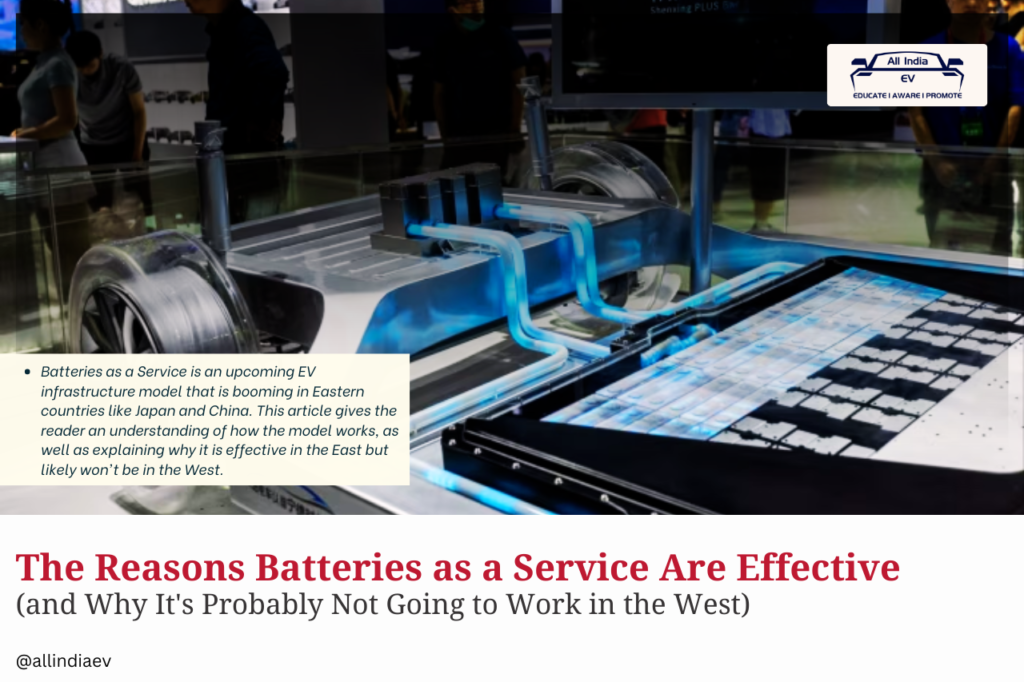
Batteries as a Service Booms in East: Why the EV Model Works in Asia but Faces Roadblocks in Western Countries

Contents
  • What is Batteries as a Service (BaaS)?
  • Why Is BaaS Booming in India and China?
  • Challenges for Western Markets
  • Expanding Horizons: BaaS for Commercial Fleets and Urban Mobility
  • Future Outlook: Lessons for India and Beyond

As electric vehicles (EVs) continue to gain momentum worldwide, an innovative model called Batteries as a Service (BaaS) is emerging as a potential game-changer—especially in densely populated Asian countries like India, China, and Japan. While this model is thriving in the East, experts say it faces significant hurdles in Western markets.


What is Batteries as a Service (BaaS)?

BaaS separates the cost of an EV’s battery from the vehicle itself. Instead of buying a car along with its battery, consumers purchase the vehicle and subscribe to a battery-swapping service. When the battery runs low, drivers simply visit a swapping station and exchange their depleted battery for a fully charged one in under five minutes.

This approach offers two major advantages:

  • Lower upfront costs for EV buyers, since batteries typically account for 30-40% of the vehicle price.
  • Reduced waiting time, addressing one of the biggest pain points of EV adoption—long charging durations.

Why Is BaaS Booming in India and China?

The model suits countries with high urban population density and limited home charging options—conditions found in India and China. In India’s bustling cities, millions rely on two- and three-wheelers, whose small, swappable batteries fit perfectly into the BaaS framework. The Indian government has even introduced policies to encourage battery swapping, aiming to accelerate EV adoption.

China, a global leader in this space, has heavily invested in battery-swapping infrastructure through companies like NIO. With strong government support, strict regulations, and standardized battery designs, China has created a seamless ecosystem where one swapping station can serve multiple vehicle brands.


Challenges for Western Markets

In contrast, BaaS faces significant barriers in the West. The lack of standardized battery designs across different manufacturers means creating universal swapping stations is complicated and costly. Furthermore, many Western EV owners live in suburban or rural areas with access to private home charging, reducing the demand for quick battery swaps.

More EV News

Maharashtra leads India with over 3 lakh e-bikes, 40k registered in last 50 days
Maharashtra leads India with over 3 lakh e-bikes, 40k registered in the last 50 days
UEI Alliance Powers Up India’s Energy Landscape: 13,000 Daily EV Charging Sessions and Beyond
BATX Energies: Leading the Charge in Climate Consciousness
Gogoro partners with HPCL to set battery swapping stations
The Road to India’s EV Future: Overcoming the Critical Minerals Challenge  

Additionally, decentralized governance and infrastructure rollout make it difficult to scale swapping stations rapidly. By the time such networks would become viable, advances in fast-charging technology might render battery swapping less relevant.

Expanding Horizons: BaaS for Commercial Fleets and Urban Mobility

Beyond personal vehicles, BaaS is gaining ground in commercial fleets in both India and China, where operational efficiency translates directly into cost savings. The model is also being piloted for two- and three-wheelers in Indian cities, demonstrating its adaptability to urban environments.


Future Outlook: Lessons for India and Beyond

While BaaS may not be the one-size-fits-all global EV solution, it highlights crucial factors for successful electrification: urban density, government backing, and battery standardization. India’s proactive policies and growing urban population put it in a prime position to leverage this model.

Rather than attempting to replicate the BaaS model outright, countries worldwide can learn from it by:

  • Expanding public charging infrastructure in cities.
  • Upgrading the power grid to handle EV demands.
  • Innovating in battery recycling and reuse to promote sustainability.

As India accelerates its EV journey, smart planning and infrastructure development—whether through battery swapping, fast public chargers, or home-based solutions—will be key to making electric mobility accessible and efficient for all.
Join All India EV Community

Click here for more such EV Updates

Yamaha Collaborates with Lola on Formula E Powertrains
Revamp Moto Partners with NACOF Oorja to Revolutionize Rural Mobility
Epsilon to Establish ₹5,000 Crore Cathode Manufacturing Plant in India
Shuzlan Energy and Transvolt Mobility Partner to Provide Charging Infrastructure for 1,000 E-Buses
The Road Ahead for EV Services in India: Challenges and Growth Opportunities

Sign Up For Daily Newsletter

Be keep up! Get the latest breaking news delivered straight to your inbox.
Loading
By signing up, you agree to our Terms of Use and acknowledge the data practices in our Privacy Policy. You may unsubscribe at any time.
Share This Article
Facebook Whatsapp Whatsapp LinkedIn Copy Link Print
Leave a Comment

Leave a Reply Cancel reply

Your email address will not be published. Required fields are marked *

Follow US
XFollow
InstagramFollow
YoutubeSubscribe
LinkedInFollow
4 EV Infrastructure Stocks Powering India's Electric Mobility Growth
4 EV Infrastructure Stocks Powering India’s Electric Mobility Growth
23 April 2026
India's longest range electric scooter: Simple Ultra launched with 400 km range!
India’s longest range electric scooter: Simple Ultra launched with 400 km range!
22 April 2026
Cathode Material Plant in AP: Rs 2,550 Cr Investment
22 April 2026
All India EV: Edition 48
What all happened in March 2026?
Click Here
All India EV

Daily EV Industry updates for you…

Categories

  • EV News
  • EV Launch
  • Investments & Funding
  • Market Insights
  • Guest Articles
  • EV Engineering

Quick Links

  • Community
  • Content Services
  • Branding Services
  • My EV Charger
  • Substack

© Developed and Managed by “The Energy Log”

Welcome Back!

Sign in to your account

Username or Email Address
Password

Lost your password?

Not a member? Sign Up