
All India EVAll India EVAll India EV
Notification
Font ResizerAa
  • Home
  • EV News
  • EV Launch
  • Market Insights
  • Investments & Funding
  • Guest Articles
  • EV Engineering
  • Contact
Reading: CATL Unveils Naxtra: A Sodium Battery Breakthrough That Could Redefine EV Mobility
Share
All India EVAll India EV
Font ResizerAa
  • Home
  • EV News
  • EV Launch
  • Market Insights
  • Guest Articles
  • EV Engineering
  • Contact
Search
  • Home
    • Home 1
    • Home 2
    • Home 3
    • Home 4
    • Home 5
  • Home
  • Categories
    • Electric
  • Categories
  • Shows
    • Rap
  • More Foxiz
    • Blog Index
    • Contact
  • Bookmarks
    • Customize Interests
    • My Bookmarks
  • More Foxiz
    • Blog Index
    • Sitemap
Have an existing account? Sign In
Follow US
Home » Blog » CATL Unveils Naxtra: A Sodium Battery Breakthrough That Could Redefine EV Mobility
EV News

CATL Unveils Naxtra: A Sodium Battery Breakthrough That Could Redefine EV Mobility

Sunita
By
Sunita
Last updated: 17 June 2025
Share
4 Min Read
SHARE

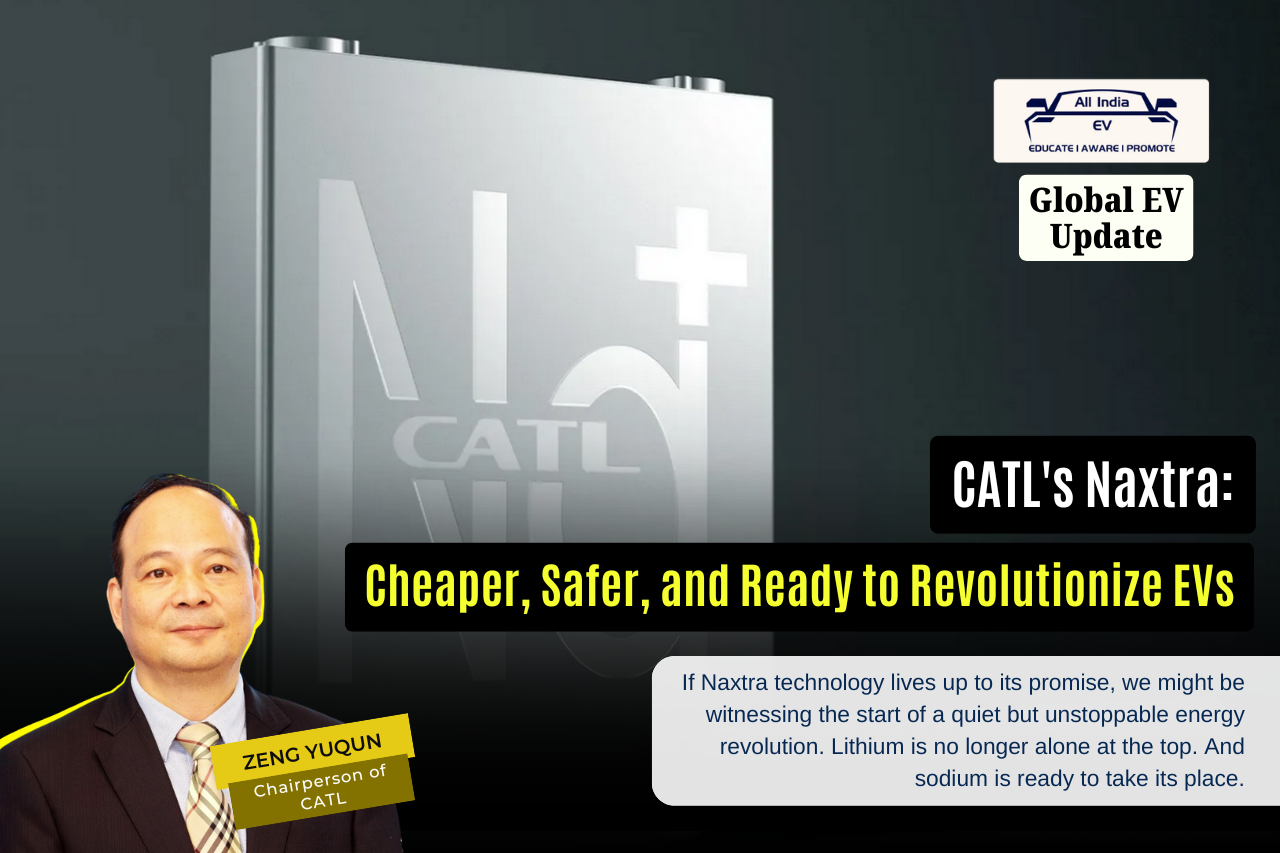
CATL introduces Naxtra, a revolutionary sodium battery technology set to transform EV mobility with enhanced performance, affordability, and sustainability.

Contents
  • A Strategic Shift: Moving Beyond Lithium
  • Inside Naxtra: Two Versions for Different Demands
  • Technical Highlights: Efficiency Meets Durability
  • A New Benchmark for Safety
  • What This Means for Lithium
  • India’s EV Sector: A Moment of Opportunity

In a landmark move poised to reshape the electric vehicle (EV) industry, global battery leader CATL (Contemporary Amperex Technology Co. Limited) has officially launched Naxtra, its pioneering sodium-ion battery technology. As one of the key suppliers to automotive giants such as Tesla, Mercedes-Benz, and Volkswagen, CATL’s entry into sodium batteries signals the beginning of a new era in sustainable mobility — and India’s EV ecosystem is watching closely.


A Strategic Shift: Moving Beyond Lithium

For years, lithium has been the backbone of electric vehicle innovation. However, recent challenges surrounding its high costs, limited availability, and environmental concerns have pushed the industry to explore alternatives. CATL’s Naxtra project answers that call, replacing lithium with sodium — an element that is not only cheaper and more abundant, but also significantly easier to source sustainably.

According to Ouyang Chuying, co-director of CATL’s R&D division, sodium batteries can dramatically reduce reliance on fragile supply chains and pave the way for new energy technologies. For India, where supply chain resilience is critical to EV growth, this innovation offers immense promise.


Inside Naxtra: Two Versions for Different Demands

The Naxtra lineup includes two major versions: one designed for electric passenger vehicles and another tailored for heavy-duty trucks using a 24V Start-Stop system. Both variants are engineered to perform reliably across extreme conditions — from freezing -40°C to scorching +70°C — ensuring consistent battery capacity even in India’s diverse climate zones.

Notably, the passenger vehicle battery maintains up to 90% capacity in extreme cold, a breakthrough that could greatly benefit northern Indian regions, where winter temperatures often impact EV performance.

Technical Highlights: Efficiency Meets Durability

  • Energy Density: 175 Wh/kg — competitive with many lithium iron phosphate (LFP) batteries.
  • Range: Up to 500 km on a single charge.
  • Lifespan: More than 10,000 charging cycles, significantly reducing total cost of ownership for EV buyers.

These specifications mark a major leap in practicality and affordability, key factors for accelerating EV adoption across India’s rapidly growing cities and rural areas alike.

More EV News

Ola Electric Teases New Portable Battery and Electric Two-Wheeler
Pavna Industries Ventures into EV Market, Providing Ignition Switches and Latches for Ola Electric
Neuron Energy and Hexall Motors Collaborate on Innovative L5 EVs
Noida International Airport Partners with Mahindra Logistics for Electric Taxi Service
River Raises $40 Million in Series B Round Led by Yamaha Motor

A New Benchmark for Safety

Safety has long been a concern with current EV battery technologies. Naxtra addresses this with non-flammable, highly stable materials, greatly minimizing the risk of vehicle fires. For Indian consumers, where concerns about EV fire incidents have made headlines, this is a reassuring development.

What This Means for Lithium

While lithium remains crucial for high-performance applications, sodium is emerging as a formidable competitor. As CATL’s breakthrough gathers momentum, the global EV industry, including India’s, may see a gradual diversification away from lithium dominance.


India’s EV Sector: A Moment of Opportunity

For India’s ambitious electrification goals — including government plans to achieve 30% EV penetration by 2030 — the arrival of sodium-ion technology could be a game-changer. With its cost advantages, supply chain benefits, and operational durability, Naxtra could enable more affordable EV models, better suited for India’s mass market.

As CATL leads the charge, India EV believes we are standing at the threshold of a quiet revolution. Lithium may no longer be the undisputed king — and sodium, with innovations like Naxtra, is ready to claim its place on the throne.

Join All India EV Community

Click here for more such EV Updates

Beyond the Crash Test: How EVs Are Redefining Automotive Safety
Revfin has unveiled the ‘Jagriti Yatra Abhiyaan’Boost EV Adoption in Uttar Pradesh
India to make more money from EV batteries by 2028: report
Ipower is first country to get approval on graphene-based lead-acid batteries for E2W
Kinetic Engineering Embarks on Ambitious EV Component Venture with New Subsidiary

Sign Up For Daily Newsletter

Be keep up! Get the latest breaking news delivered straight to your inbox.
Loading
By signing up, you agree to our Terms of Use and acknowledge the data practices in our Privacy Policy. You may unsubscribe at any time.
Share This Article
Facebook Whatsapp Whatsapp LinkedIn Copy Link Print
Leave a Comment

Leave a Reply Cancel reply

Your email address will not be published. Required fields are marked *

Follow US
XFollow
InstagramFollow
YoutubeSubscribe
LinkedInFollow
What: India’s finance ministry has directed public sector banks, insurers, and financial institutions to reduce operational spending and accelerate adoption of electric vehicles across official fleets. The move is part of a wider austerity push linked to rising global economic uncertainty and fuel-related risks. The Number: The directive impacts major public institutions including State Bank of India, Bank of Baroda, and Life Insurance Corporation of India, covering millions of employees and thousands of operational vehicles nationwide. The Impact: The policy signals a new phase of institutional fleet electrification in India, where EV adoption is now being tied directly to fiscal discipline, fuel import management, and public-sector operational efficiency. The Core News India’s finance ministry has formally instructed state-run financial institutions to implement strict expenditure controls while simultaneously accelerating EV adoption for official transport operations. The directive from the Department of Financial Services asks organisations to replace petrol and diesel vehicles used at head offices and branch operations with electric vehicles “as far as possible.” The order comes amid growing concern over the economic impact of prolonged geopolitical instability in West Asia, which threatens to increase crude oil prices, widen India’s import bill, and pressure the rupee. Alongside the EV transition mandate, the government has also pushed virtual meetings, reduced foreign travel, and tighter administrative spending controls across public-sector institutions. For India’s EV ecosystem, the directive is strategically important because it expands demand visibility beyond state transport undertakings and government departments into the financial sector itself. PSU banks and insurers operate one of the country’s largest distributed office networks, including regional offices, branch fleets, field operations, and administrative mobility services. Even a phased transition could create a sizeable procurement pipeline for electric passenger vehicles, charging infrastructure providers, and fleet management companies. Breaking Down the Update • The Department of Financial Services issued the austerity and EV adoption directive to PSU banks, insurers, and financial institutions. • The government wants petrol and diesel vehicles used in official operations to be progressively replaced by EVs wherever operationally feasible. • The policy push follows Prime Minister Narendra Modi’s appeal for fuel conservation and controlled discretionary spending amid global energy uncertainty. • The directive also mandates greater use of video conferencing to reduce travel-related operational expenditure. • The move could indirectly support domestic EV OEMs, leasing firms, and charging infrastructure operators through institutional procurement demand. • The banking and insurance sector may emerge as a new enterprise fleet electrification category in India’s EV transition roadmap. How PSU banks EV adoption will help Indian EV Market The expansion of PSU banks EV adoption could create a strong institutional demand layer for India’s electric mobility sector. Public sector banks and insurers operate thousands of branch offices across urban, semi-urban, and rural India. Their transition to EV fleets can generate predictable procurement volumes for domestic automakers, especially in the electric sedan, compact SUV, and commercial mobility segments. Beyond vehicle sales, the policy may also accelerate deployment of workplace charging infrastructure at bank headquarters, zonal offices, and regional branches. This can support charger utilisation economics while helping normalise EV infrastructure in tier-2 and tier-3 cities. Another important impact is signalling. When large state-linked financial institutions adopt EVs as operational assets rather than pilot projects, it improves confidence across the broader enterprise mobility market. Private banks, NBFCs, and insurance firms could eventually follow similar fleet transition models to reduce long-term fuel and maintenance costs. PSU banks EV adoption also aligns with India’s larger energy security strategy. Lower petroleum consumption in institutional fleets directly supports efforts to reduce crude import dependence while stabilising operational expenditure during periods of volatile global oil prices. Conclusion & Next Steps The government’s push toward PSU banks EV adoption reflects a broader shift where EV deployment is increasingly being linked with macroeconomic resilience rather than only sustainability targets. Execution, however, will depend on procurement timelines, charging infrastructure readiness, and operational suitability across
India directs state-run banks, insurance firms to cut costs, shift to EVs
20 May 2026
Uttar Pradesh To Get 714 New EV Charging Stations Under Centre’s Rs 500 Crore Infrastructure Push
20 May 2026
China’s EV slowdown could trigger the industry’s biggest global reset
20 May 2026
All India EV: Edition 49
What all happened in April 2026?
Click Here
All India EV

Daily EV Industry updates for you…

Categories

  • EV News
  • EV Launch
  • Investments & Funding
  • Market Insights
  • Guest Articles
  • EV Engineering

Quick Links

  • Community
  • Content Services
  • Branding Services
  • My EV Charger
  • Substack

© Developed and Managed by “The Energy Log”

Welcome Back!

Sign in to your account

Username or Email Address
Password

Lost your password?

Not a member? Sign Up