


Government Engagement Eases Automaker Supply Woes After China’s Export Controls Trigger Uncertainty Since April
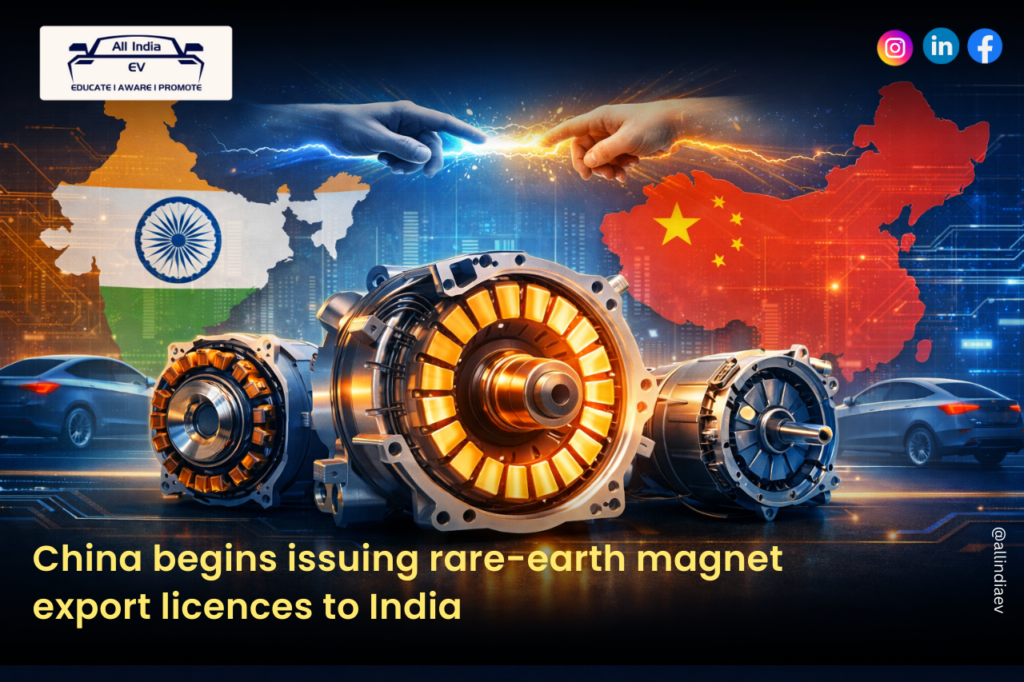
China has started issuing export licences for rare-earth magnets (REMs) to Indian companies, providing much-needed relief to India’s electric vehicle (EV) and automotive component sectors that have been grappling with supply disruptions in recent months. Government officials confirmed that the approvals, though gradual, mark the beginning of a critical easing in the supply of key materials essential for EV motor manufacturing.
According to sources, export clearances are being processed through both Indian suppliers and Indian operations of global component manufacturers. Companies that have either received approvals or are in advanced stages of clearance include Jay Ushin, the Indian arm of Germany-based Continental AG, vendors supplying Mahindra & Mahindra and Maruti Suzuki, as well as component suppliers to Honda Scooters and Motorcycles.
A senior government official told India EV that China’s Ministry of Commerce has begun reviewing and approving applications. “It is a slow start, but the process has clearly moved forward. Some companies have already received licences, and more approvals are expected in the coming weeks,” the official said.
China controls a dominant share of global rare-earth magnet production and processing capacity. These magnets are a critical component in electric motors used across electric vehicles, conventional automobiles, consumer electronics, medical devices, and defence equipment. From April 4, China brought these materials under a stricter export licensing regime, triggering concerns across global supply chains.
The export controls were introduced amid escalating trade tensions between China and the United States, following higher US tariffs on Chinese goods. However, the impact has extended far beyond the two economies, significantly affecting India’s fast-growing EV ecosystem.
Under the revised export framework, Chinese suppliers can obtain clearances only if Indian importers provide detailed assurances that the materials will not be diverted for defence or other dual-use purposes. Industry executives say the documentation requirements and verification process remain stringent, making approvals time-consuming.
More EV News

Indian EV manufacturers and auto component makers had earlier flagged serious production risks, warning that prolonged delays could disrupt EV manufacturing timelines, given the sector’s heavy reliance on rare-earth-based motors.
Over the past six months, the Indian government has actively engaged with Chinese authorities to resolve the issue. During his June visit to New Delhi, Chinese Foreign Minister Wang Yi assured External Affairs Minister S Jaishankar that restrictions on rare-earth exports and other critical materials would be eased.
While uncertainty remains, officials noted that Indian automakers have managed short-term risks by adjusting supply chains and optimising inventories. “The issue is not fully resolved yet, but production has continued as companies adapt,” the official added.
For India’s EV industry, the initial approvals signal cautious optimism, even as long-term diversification of critical mineral supply chains remains a strategic priority.
Comment by Author:
China’s decision to begin issuing rare-earth magnet export licences to India offers timely relief to the domestic EV and auto component industry, easing immediate supply concerns that threatened production schedules. While the move signals a positive shift in bilateral trade engagement, it also reinforces the strategic vulnerability of relying heavily on a single source for critical materials.
For India’s EV ecosystem, the episode highlights the urgent need to accelerate local manufacturing, recycling, and diversification of rare-earth supply chains to ensure long-term resilience and self-reliance.