
All India EVAll India EVAll India EV
Notification
Font ResizerAa
  • Home
  • EV News
  • EV Launch
  • Market Insights
  • Investments & Funding
  • Guest Articles
  • EV Engineering
  • Contact
Reading: Top 5 New Electric Bikes in India 2024-25
Share
All India EVAll India EV
Font ResizerAa
  • Home
  • EV News
  • EV Launch
  • Market Insights
  • Guest Articles
  • EV Engineering
  • Contact
Search
  • Home
    • Home 1
    • Home 2
    • Home 3
    • Home 4
    • Home 5
  • Home
  • Categories
    • Electric
  • Categories
  • Shows
    • Rap
  • More Foxiz
    • Blog Index
    • Contact
  • Bookmarks
    • Customize Interests
    • My Bookmarks
  • More Foxiz
    • Blog Index
    • Sitemap
Have an existing account? Sign In
Follow US
Top 5 New Electric Bikes in India 2024-25
Home » Blog » Top 5 New Electric Bikes in India 2024-25
EV News

Top 5 New Electric Bikes in India 2024-25

Ankit Sharma
By
Ankit Sharma
ByAnkit Sharma
Follow:
Last updated: 30 September 2024
Share
7 Min Read
SHARE
Top 5 New Electric Bikes in India 2024-25

Top 5 NewElectric Bikes in India 2024-25

The electric bike market in India is experiencing a surge of growth, as manufacturers race to introduce cutting-edge models that offer advanced features, enhanced performance, and eco-friendly technologies. With a plethora of innovative bikes on the horizon, the landscape of electric two-wheelers is becoming more exciting than ever.

For those considering investing in an electric bike or upgrading their current ride, the timing couldn’t be better. The upcoming models are poised to redefine the electric bike experience, offering a blend of style, efficiency, and sustainability.

Stay tuned for more updates on the most anticipated electric bikes hitting the Indian market in 2024-25.

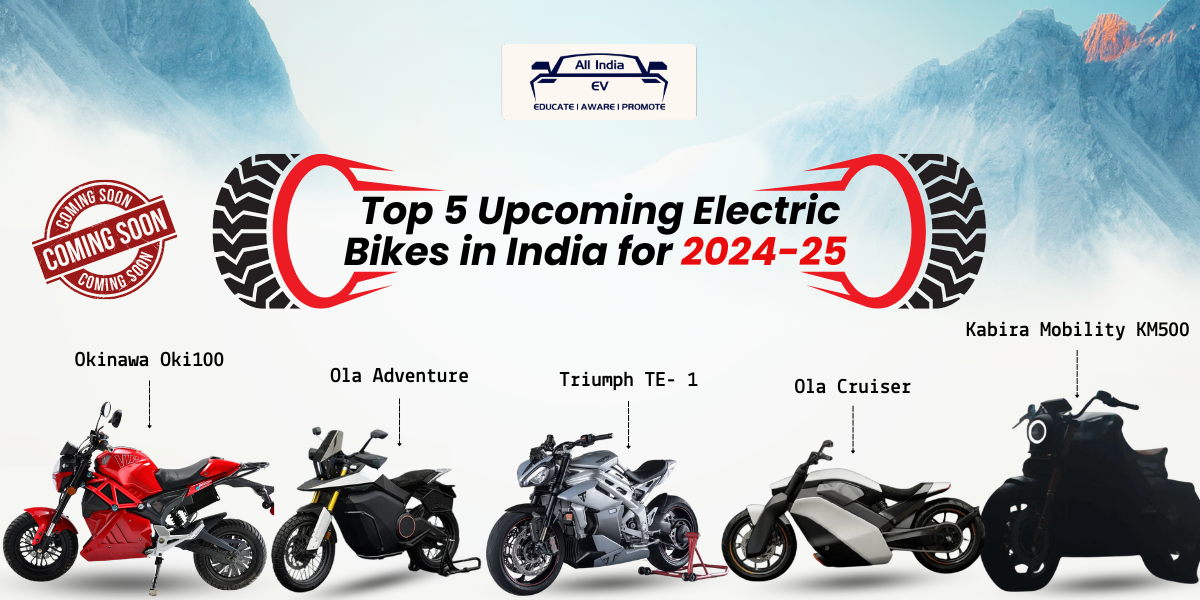
1) Ola Adventure 

Ola Electric, a prominent player in the Indian electric vehicle market, is set to launch the Ola Adventure, a highly anticipated addition to its growing lineup. Building on the success of its Ola Roadster Series, the Adventure promises to deliver exceptional performance and cutting-edge features.

Key Specifications:

  • Expected Price: ₹3 Lakh
  • Launch Date: November 2024
  • Range: 250 km per charge
  • Top Speed: 130 kmph

With its impressive range and top speed, the Ola Adventure is poised to redefine the electric bike experience. Stay tuned for more updates on this exciting new model.

More EV News
India Set to Reach 123 Million EVs by 2032: A Game-Changer for the Indian Automotive Landscape
Surging Growth in E2W Battery Management: Expected to Reach $5.6 Billion by 2031
India Can Save $106.6 Billion with EV Switch by 2035, Report Shows Path to Sustainable Future
BYD India Aims for 90% EV Market Share
Epsilon Carbon aims 6-Month period for Battery Partnerships

With an expected range of over 250 km per charge, the Ola Adventure will also incorporate fast-charging technology for quick and convenient recharging. Additionally, the bike may offer multiple riding modes and cruise control for added comfort and convenience.

The anticipated starting price for the Ola Adventure is estimated to be between ₹2.5 and ₹3 lakh.

2) Ola Cruiser

Key Information:

  • Expected Price: ₹2.70 lakh
  • Launch Date: November 2024
  • Expected Range: 200-250 km

One of the standout features of the Ola Cruiser is its unique wavy seat design. This design extends from the front to the back of the motorcycle, giving it a hefty and aggressive look. Coupled with its chain-driven mechanism, the Cruiser stands out from its competitors in the electric motorcycle category.

The Ola Cruiser is poised to make a significant impact on the electric motorcycle market. Its combination of style and functionality offers riders a powerful and visually appealing option. As the electric mobility landscape continues to evolve, the Cruiser is expected to play a key role in driving the adoption of electric motorcycles.

3) Triumph TE- 1 

Key Information:

  • Expected Price: 15 lakh
  • Launch Date: Nov 2024
  • Range: 161 km/100-mile

One of the most impressive aspects of the Triumph TE-1 is its real-world range. The prototype has surpassed current electric motorcycles, achieving an impressive 161 km (100-mile) range based on live testing and official projections. This extended range is a testament to the project’s success in overcoming the challenges associated with electric motorcycle development.

In addition to its impressive range, the TE-1 also boasts exceptional acceleration. The prototype can achieve 0-60 mph in a mere 3.6 seconds and 0-100 mph in 6.2 seconds. This level of performance is comparable to many high-performance gasoline-powered motorcycles.

Another groundbreaking feature of the TE-1 is its rapid charging capability. The motorcycle can charge from 0-80% in just 20 minutes. This fast charging time significantly reduces downtime and enhances the overall user experience.

4) Okinawa Oki100

Key Information:

  • Expected Price: ₹1.00 Lakh – 1.20 Lakh
  • Launch Date: December 2024
  • Expected Range: 150 km
  • Top Speed– 100 kmph

Despite its affordable price, the Oki100 boasts a range of features that make it a competitive option. These include an anti-theft alarm, keyless ignition, central locking, GPS, geo-fencing, built-in navigation, and a side stand sensor. These features enhance security, convenience, and functionality, providing riders with a premium experience.

Powered by a 3,000-watt BLDC motor and a 72V, 4 kWh lithium-ion battery, the Oki100 is expected to deliver performance comparable to 125cc or 150cc petrol motorcycles. Okinawa has hinted that this combination will offer a thrilling riding experience. With a top speed of 120 kmph and a range of up to 150 km on a single charge, the Oki100 is well-suited for daily commuting and short trips.

5) Kabira Mobility KM500

Key Information:

  • Expected Price: Rs 3.15 lakh 
  • Expected Launch Date: October 2024
  • Expected Range: 344 km/charge
  • Top Speed– 188 kmph

The KM5000 is set to redefine the standards for electric motorcycles in India. It is expected to become the country’s fastest electric bike, boasting a top speed of 188 km/h. Furthermore, the KM5000 is likely to offer the longest range of any electric bike in India, with an impressive 344 km on a single charge.

The KM5000 will feature a captivating cruiser design, coupled with a mid-drive powertrain and a single-sided swingarm co-developed with DeltaEV, a leader in power technology. Delta’s high-performance chargers, known for their 94% efficiency and adherence to global safety standards, will enhance the bike’s charging capabilities.

Rider safety will be a top priority with the KM5000. The bike will feature a dual-channel ABS braking system, twin front discs, and a rear single disc, ensuring reliable braking performance. Additionally, the KM5000 is expected to come with a 7-inch touchscreen dashboard with 4G connectivity, offering a range of features such as turn-by-turn navigation, music control, vehicle info, real-time battery health monitoring, and smart diagnostics.
Join All India EV Community

Click here for more such EV Updates

Mercedes-Benz teams up with CHARGE+ZONE and Evnnovator for charging solution
Mahanagar Gas Limited Invests Rs. 96 Crore in 3ev Industries in Series A Funding Round
Delhi’s EV Chargers Are Being Stripped for Parts. CPOs Are Left Holding the Bill.
Joy E-Bike Ventures into Hydrogen Scooters, Aims for Global Reach
Wardwizard And Government Of Gujarat Partner For Rs. 2,000 Crore EV Ancillary Cluster
TAGGED:EVEV bikesTop 5

Sign Up For Daily Newsletter

Be keep up! Get the latest breaking news delivered straight to your inbox.
Loading
By signing up, you agree to our Terms of Use and acknowledge the data practices in our Privacy Policy. You may unsubscribe at any time.
Share This Article
Facebook Whatsapp Whatsapp LinkedIn Copy Link Print
Leave a Comment

Leave a Reply Cancel reply

Your email address will not be published. Required fields are marked *

Follow US
XFollow
InstagramFollow
YoutubeSubscribe
LinkedInFollow
What: India’s finance ministry has directed public sector banks, insurers, and financial institutions to reduce operational spending and accelerate adoption of electric vehicles across official fleets. The move is part of a wider austerity push linked to rising global economic uncertainty and fuel-related risks. The Number: The directive impacts major public institutions including State Bank of India, Bank of Baroda, and Life Insurance Corporation of India, covering millions of employees and thousands of operational vehicles nationwide. The Impact: The policy signals a new phase of institutional fleet electrification in India, where EV adoption is now being tied directly to fiscal discipline, fuel import management, and public-sector operational efficiency. The Core News India’s finance ministry has formally instructed state-run financial institutions to implement strict expenditure controls while simultaneously accelerating EV adoption for official transport operations. The directive from the Department of Financial Services asks organisations to replace petrol and diesel vehicles used at head offices and branch operations with electric vehicles “as far as possible.” The order comes amid growing concern over the economic impact of prolonged geopolitical instability in West Asia, which threatens to increase crude oil prices, widen India’s import bill, and pressure the rupee. Alongside the EV transition mandate, the government has also pushed virtual meetings, reduced foreign travel, and tighter administrative spending controls across public-sector institutions. For India’s EV ecosystem, the directive is strategically important because it expands demand visibility beyond state transport undertakings and government departments into the financial sector itself. PSU banks and insurers operate one of the country’s largest distributed office networks, including regional offices, branch fleets, field operations, and administrative mobility services. Even a phased transition could create a sizeable procurement pipeline for electric passenger vehicles, charging infrastructure providers, and fleet management companies. Breaking Down the Update • The Department of Financial Services issued the austerity and EV adoption directive to PSU banks, insurers, and financial institutions. • The government wants petrol and diesel vehicles used in official operations to be progressively replaced by EVs wherever operationally feasible. • The policy push follows Prime Minister Narendra Modi’s appeal for fuel conservation and controlled discretionary spending amid global energy uncertainty. • The directive also mandates greater use of video conferencing to reduce travel-related operational expenditure. • The move could indirectly support domestic EV OEMs, leasing firms, and charging infrastructure operators through institutional procurement demand. • The banking and insurance sector may emerge as a new enterprise fleet electrification category in India’s EV transition roadmap. How PSU banks EV adoption will help Indian EV Market The expansion of PSU banks EV adoption could create a strong institutional demand layer for India’s electric mobility sector. Public sector banks and insurers operate thousands of branch offices across urban, semi-urban, and rural India. Their transition to EV fleets can generate predictable procurement volumes for domestic automakers, especially in the electric sedan, compact SUV, and commercial mobility segments. Beyond vehicle sales, the policy may also accelerate deployment of workplace charging infrastructure at bank headquarters, zonal offices, and regional branches. This can support charger utilisation economics while helping normalise EV infrastructure in tier-2 and tier-3 cities. Another important impact is signalling. When large state-linked financial institutions adopt EVs as operational assets rather than pilot projects, it improves confidence across the broader enterprise mobility market. Private banks, NBFCs, and insurance firms could eventually follow similar fleet transition models to reduce long-term fuel and maintenance costs. PSU banks EV adoption also aligns with India’s larger energy security strategy. Lower petroleum consumption in institutional fleets directly supports efforts to reduce crude import dependence while stabilising operational expenditure during periods of volatile global oil prices. Conclusion & Next Steps The government’s push toward PSU banks EV adoption reflects a broader shift where EV deployment is increasingly being linked with macroeconomic resilience rather than only sustainability targets. Execution, however, will depend on procurement timelines, charging infrastructure readiness, and operational suitability across
India directs state-run banks, insurance firms to cut costs, shift to EVs
20 May 2026
Uttar Pradesh To Get 714 New EV Charging Stations Under Centre’s Rs 500 Crore Infrastructure Push
20 May 2026
China’s EV slowdown could trigger the industry’s biggest global reset
20 May 2026
All India EV: Edition 49
What all happened in April 2026?
Click Here
All India EV

Daily EV Industry updates for you…

Categories

  • EV News
  • EV Launch
  • Investments & Funding
  • Market Insights
  • Guest Articles
  • EV Engineering

Quick Links

  • Community
  • Content Services
  • Branding Services
  • My EV Charger
  • Substack

© Developed and Managed by “The Energy Log”

Welcome Back!

Sign in to your account

Username or Email Address
Password

Lost your password?

Not a member? Sign Up