
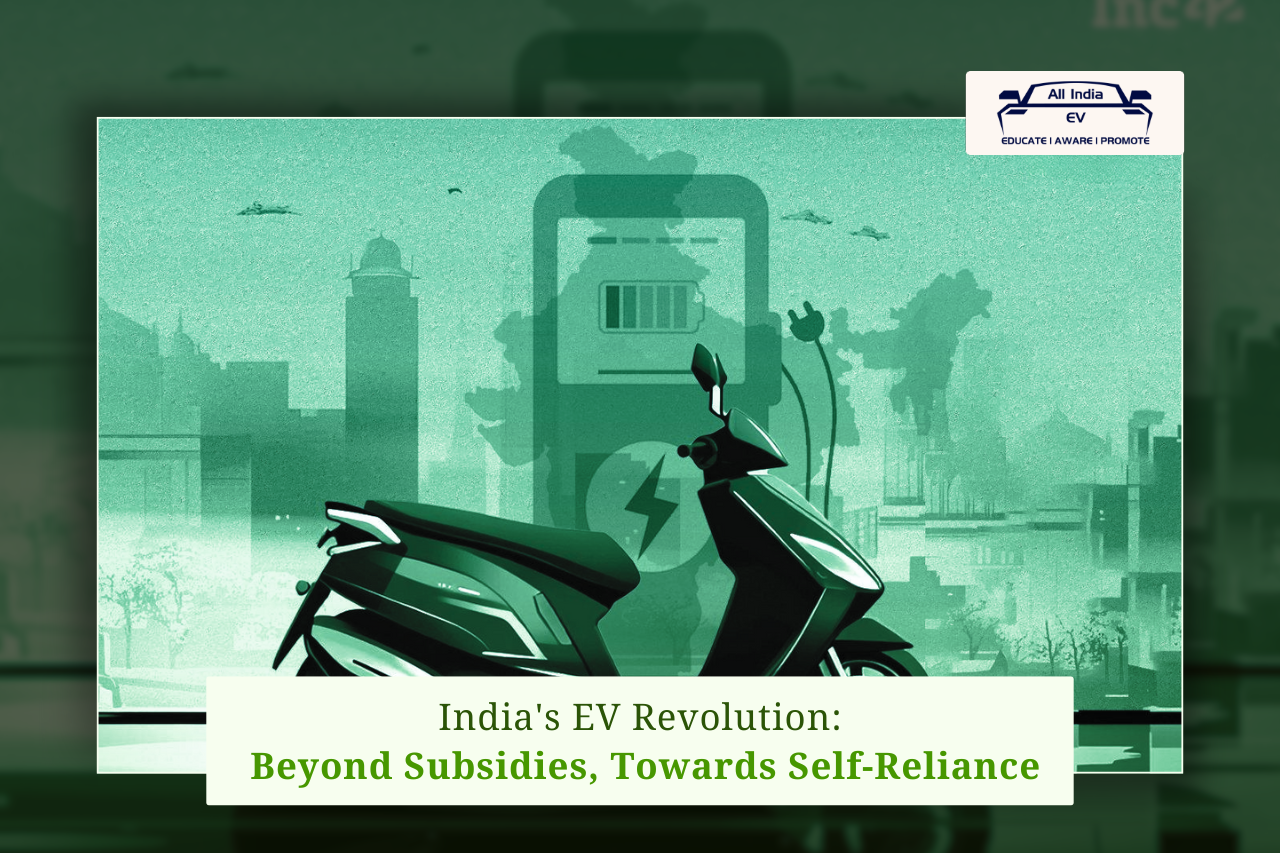


India’s EV market, once boosted by subsidies, now urged to be self-reliant as government plans to phase out support by March 2026.
India’s electric vehicle (EV) sector is at a turning point. After nearly a decade of government-backed support through subsidy schemes, the question now is: Can the industry thrive without the training wheels?
The Faster Adoption and Manufacturing of Hybrid and Electric Vehicles (FAME) scheme, launched in 2015, played a pivotal role in kickstarting EV adoption. Today, EV penetration in India has risen from less than 1% in 2015 to 7.5% in 2024, with the government targeting 30% penetration by 2030. Projections suggest 2 million EV sales by FY 2025. But as this transformation gains pace, experts are debating whether continued financial support is still necessary—or counterproductive.
The Hidden Cost of Prolonged Subsidies
While subsidies were instrumental in giving the EV market its initial boost, long-term dependence poses serious risks. Experts warn of a growing “subsidy trap”—a situation where both manufacturers and consumers become overly reliant on financial incentives, leading to:
- Reduced innovation: With guaranteed financial backing, companies may lose motivation to cut costs or improve efficiency.
- Market distortion: Subsidies can undermine fair competition, propping up inefficient players.
- Complacency: A safety net can discourage proactive adaptation to evolving market demands.
The real goal should be to make EVs affordable through technological innovation, scaling production, and efficient supply chains, not perpetual subsidies.
Government Signals a Shift: Time to Fly Solo
The Indian government appears ready to transition the sector towards self-sufficiency. Commerce and Industry Minister Piyush Goyal recently stated that purchase subsidies will be phased out after March 2026. While some industry players have expressed concern, the government believes the sector is mature enough to stand on its own.
This approach aligns with global trends. As EV markets in developed economies like Europe and China stabilize, many governments are also cutting back on purchase incentives, allowing competitive forces to drive innovation and affordability.
More EV News

The Path Forward: Smarter Policy, Stronger Ecosystem
Instead of direct subsidies, experts advocate for a more holistic approach that builds a resilient, innovation-driven ecosystem:
1. Strengthening Domestic Manufacturing
The PM E-Drive Yojana and Production-Linked Incentive (PLI) scheme are vital to India’s EV strategy. These initiatives focus on scaling domestic production of vehicles, batteries, and charging infrastructure—boosting the ‘Make in India’ vision and increasing global competitiveness.
2. Encouraging R&D and Innovation
Tax incentives for research and development can encourage manufacturers to invest in next-gen technologies, enhance safety standards, and improve energy efficiency. A robust innovation ecosystem will reduce costs organically, without external financial aid.
3. Battery Swapping & GST Parity
To make EVs more affordable, innovative ownership models such as Battery-as-a-Service (BaaS) should be encouraged. BaaS decouples battery ownership from the vehicle, reducing upfront costs and enabling fast battery swaps in under five minutes—especially valuable for commercial fleets.
However, policy inconsistencies are holding back this solution. Swappable batteries attract an 18% GST, compared to 5% GST when sold with EVs. This discrepancy not only burdens economically weaker EV users but also discourages investment in battery swapping infrastructure. Addressing this imbalance is key to leveling the playing field and expanding access.
A Bold Transition, Not a Step Back
India’s decision to phase out EV subsidies is not about pulling support but about encouraging maturity and innovation. By reducing financial aid gradually, the government aims to push manufacturers toward self-reliance, ensuring long-term competitiveness on a global scale.
With the right mix of policies, infrastructure development, and incentives for innovation, India’s EV sector can transition from subsidy-driven growth to self-sustaining excellence.