

What:
Delhi’s newly notified EV Policy 2026 proposes a phased transition of school transportation to electric mobility by mandating schools to gradually replace conventional buses with electric buses over the coming years. The move is part of the capital’s broader strategy to reduce transport emissions and accelerate clean mobility adoption.
The Number:
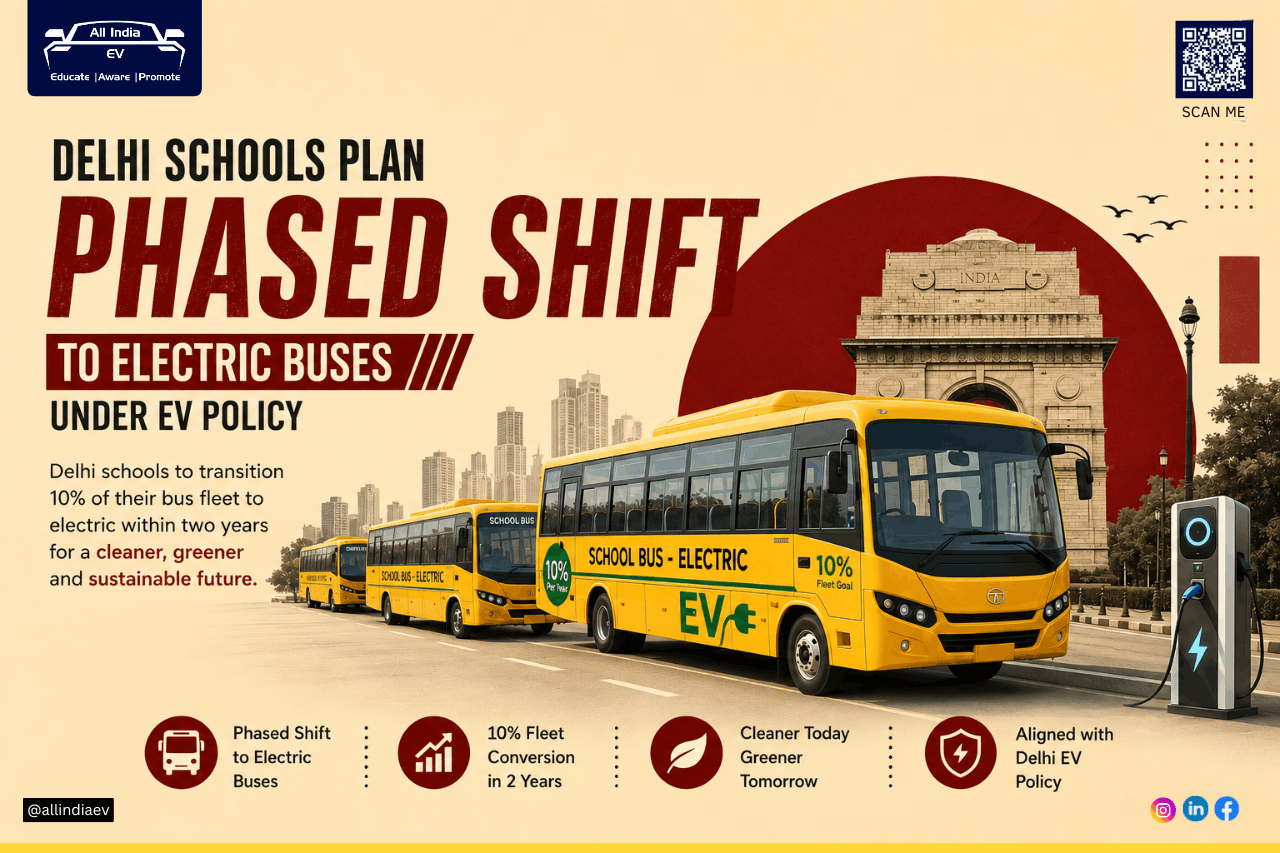
Schools will be required to ensure that at least 10% of their bus fleet is electric within two years, 20% within three years, and 30% by March 31, 2030, under the proposed implementation roadmap.
The Impact:
The policy could create significant demand for electric school buses, encourage domestic manufacturing, and expand charging infrastructure while helping improve air quality around educational institutions.

The Core News
Delhi school electric buses have become a key focus area under the Delhi EV Policy 2026 as the government seeks to electrify multiple transport segments beyond public buses and commercial fleets. The policy proposes a phased adoption model, giving schools sufficient time to replace existing CNG and diesel buses with electric alternatives while minimizing operational disruptions.
The transition forms part of Delhi’s wider clean mobility roadmap, which includes investments of ₹15,000 crore, expansion of public charging infrastructure, electrification of commercial vehicles, and stronger policy support for EV adoption. Since school buses operate on predictable daily routes with scheduled charging windows, they represent one of the most suitable applications for fleet electrification. The phased approach is expected to help schools plan procurement cycles while allowing OEMs to scale production and after-sales support.
While the proposal has received positive attention for its environmental objectives, school operators are expected to evaluate factors such as vehicle acquisition costs, charging infrastructure availability, depot space, financing options, and operational reliability before large-scale implementation. Industry stakeholders believe coordinated support from manufacturers, financing institutions, and government agencies will be essential for successful execution.
More EV News

Breaking Down the Update
• Delhi schools must transition 10% of their bus fleet to electric buses within two years.
• The target increases to 20% within three years.
• Schools are expected to achieve 30% electric bus adoption by March 31, 2030.
• Delhi school electric buses are part of the broader Delhi EV Policy 2026 covering multiple transport segments.
• The government is simultaneously expanding charging infrastructure through single-window approvals and public-private participation.
• The policy complements Delhi’s larger clean mobility investment programme worth ₹15,000 crore.
• Electric school buses are expected to reduce local emissions and improve air quality around schools.
How Delhi school electric buses will help Indian EV Market
The rollout of Delhi school electric buses has the potential to accelerate fleet electrification across India’s education sector. School buses operate on fixed routes with predictable schedules, making them ideal candidates for electric mobility. Their daily operating patterns simplify charging management, improve fleet utilization, and reduce operational uncertainty compared to many commercial transport applications.
For domestic manufacturers, the policy could generate sustained demand for electric buses, battery systems, charging equipment, and fleet management software. As procurement volumes increase, economies of scale may help reduce production costs and improve product availability across other states.
The initiative could also strengthen India’s EV supply chain by encouraging greater localization of components such as battery packs, power electronics, electric drivetrains, and charging hardware. Fleet operators may benefit from lower operating and maintenance costs over the vehicle lifecycle, while students and surrounding communities gain from quieter, zero-tailpipe-emission transport.
If successfully implemented, Delhi’s model may encourage other states to introduce similar mandates, creating a larger nationwide market for electric buses and supporting India’s long-term decarbonisation and clean mobility objectives.
Way Forward ..
The proposed rollout of Delhi school electric buses represents another important step in Delhi’s broader clean mobility strategy. While implementation timelines, procurement costs, financing mechanisms, and charging infrastructure remain critical factors, the phased approach provides schools and manufacturers with a clear roadmap. The success of the programme could influence similar policies across India and further accelerate the country’s transition towards electric public and institutional transport.
Read More: Catch up on All India EV’s related coverage on India’s evolving commercial EV subsidies and battery swapping policies at All India EV