
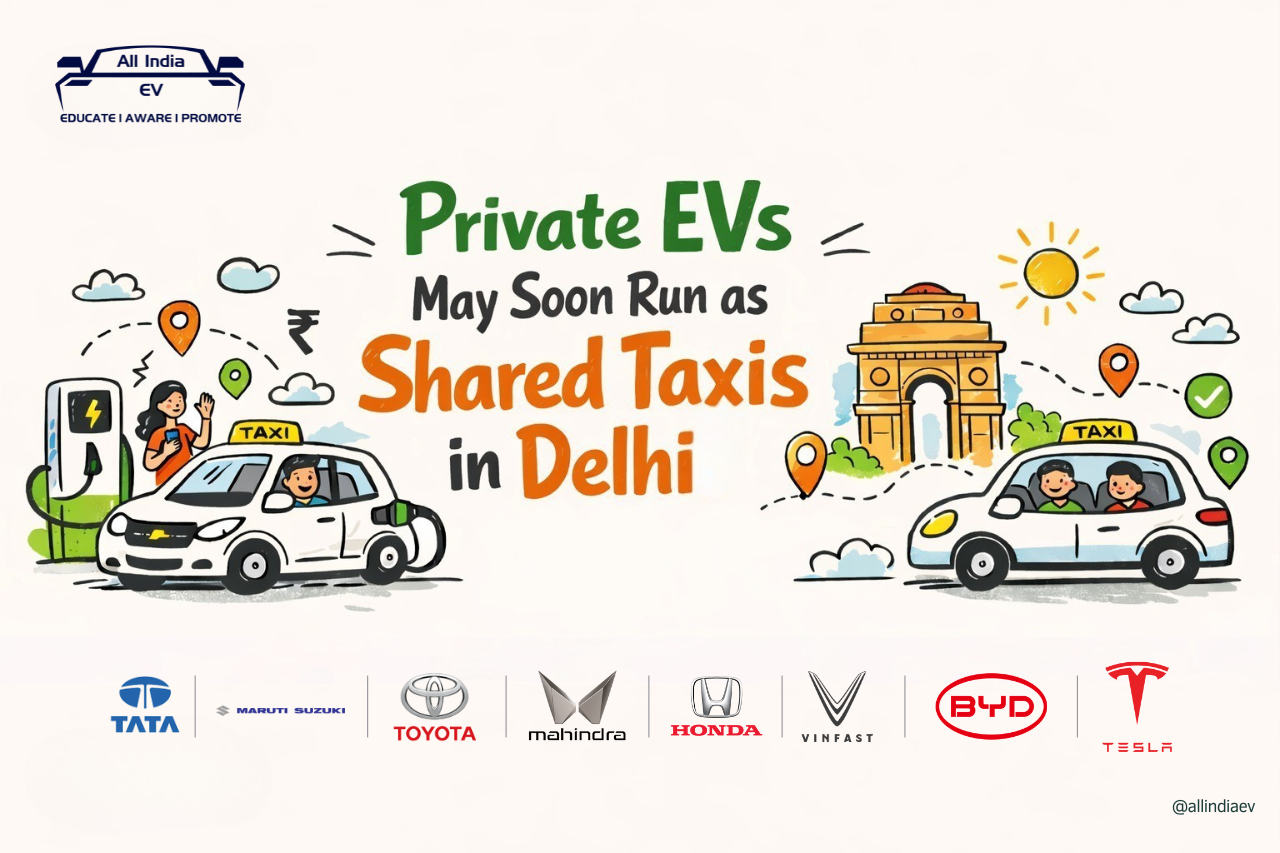


Delhi is considering a policy shift that, on the surface, looks incremental: allowing privately registered electric cars to operate as shared taxis under defined conditions. But beneath the administrative phrasing lies a far more consequential question for India’s urban mobility stack.
This is not merely about expanding the taxi pool. It is about redefining how assets, incentives, and compliance interact in an EV-led transport system.
Asset Utilisation vs Regulatory Design
India’s private cars remain underutilised—parked for over 90% of their lifecycle. Allowing private EVs to enter shared mobility directly attacks this inefficiency. From a systems lens, this is sound economics: higher utilisation improves total cost of ownership, accelerates EV payback, and increases electric kilometres without adding vehicles.
But this also blurs the regulatory boundary between private ownership and commercial operation. Fitness norms, insurance structures, driver vetting, fare controls, and taxation models were never designed for hybrid-use vehicles. If Delhi proceeds without re-architecting these layers, enforcement ambiguity becomes inevitable.
The Real Question: Who Is the Policy Optimised For?
Is this move designed to:
- Reduce peak-hour congestion?
- Expand affordable mobility?
- Improve EV adoption metrics?
- Or offer supplemental income to private EV owners?
Each objective demands a different rulebook. Without clarity, the system risks becoming policy-compliant but outcome-inefficient—technically legal, practically misaligned.
Charging Infrastructure Is the Silent Constraint
High-utilisation vehicles don’t just need chargers; they need reliable, fast, predictable access to power. Private EVs doubling as taxis will cluster around high-demand corridors, stressing already uneven urban charging networks.
More EV News

Unless this policy is paired with zonal charging density planning, DISCOM coordination, and time-of-day pricing signals, the result may be queue formation rather than decarbonisation.
Platform Power and Market Distortion
Ride-hailing platforms stand to gain disproportionately. A larger supply pool without equivalent capex allows platforms to scale without asset ownership, while price discovery remains opaque to drivers. If private EVs enter this ecosystem without minimum earning guarantees or cost transparency, the risk shifts entirely to the vehicle owner.
This raises a difficult but necessary question:
Is the state enabling distributed entrepreneurship—or subsidising platform arbitrage?
Why This Matters Beyond Delhi
If implemented, this model will not remain local. Other states watching Delhi’s experiment may replicate it rapidly—especially those under pressure to meet EV penetration targets without large fiscal outlays.
Done right, this could unlock:
- Faster EV adoption without fleet subsidies
- Lower urban emissions per passenger-km
- More flexible income models for EV owners
Done poorly, it could:
- Undermine formal taxi operators
- Create enforcement chaos
- Shift economic risk downward while extracting platform rents upward
The Question Policymakers Must Answer
This is not a yes-or-no decision on private EV taxis. It is a design challenge.
Will India build clear, enforceable hybrid-use frameworks, or will it rely on temporary exemptions and circulars? Will charging, insurance, and platform accountability evolve in parallel—or lag behind adoption?
Delhi’s proposal is less about taxis and more about how seriously India treats systems thinking in EV policy. The industry should be watching closely—not for the announcement, but for the architecture that follows.
Comment by Author
Delhi’s proposal to allow private EVs to operate as shared taxis is not a mobility tweak—it is a systems design test. Higher asset utilisation makes economic sense, but without reworking regulatory frameworks, charging capacity planning, and platform accountability, the policy risks shifting complexity and financial risk onto individual vehicle owners.
The real outcome will depend not on permission alone, but on whether enforcement clarity, infrastructure readiness, and market safeguards evolve together. This is where intent must finally meet execution.