


The Economics of India’s Domestic EV Parts Production
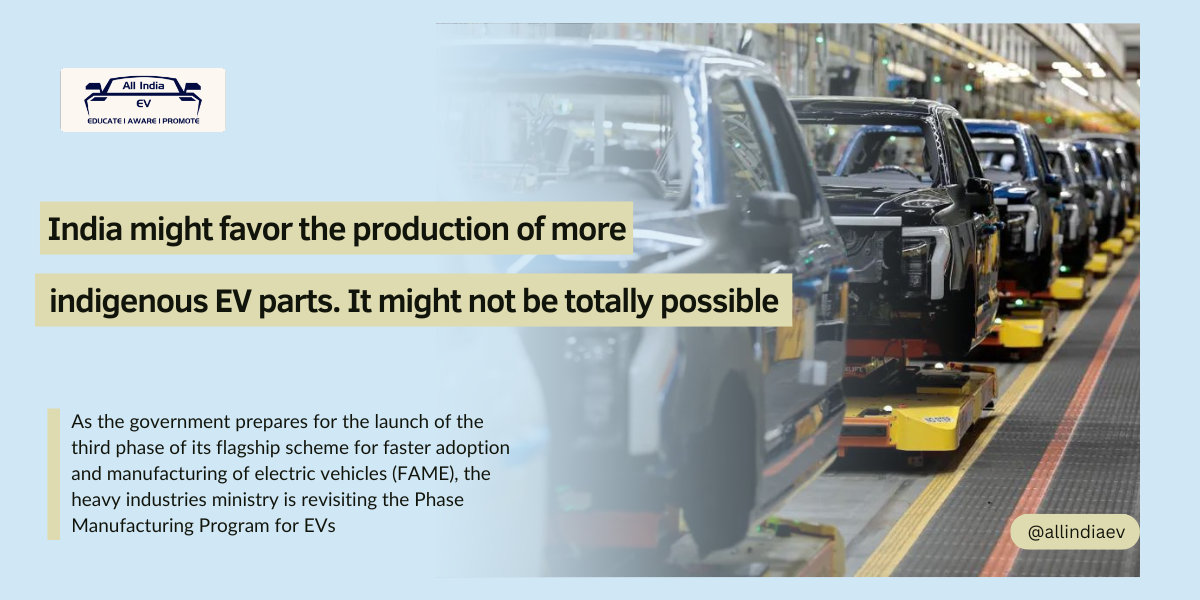
The journey of India’s electric mobility has run into troubled territory. The government is likely to tighten localization norms for electric vehicle (EV) manufacturers within a month. It is triggered by consultations initiated by the Automotive Research Association of India. The measure aims to increase local production and bring down the country’s dependence on imports.
With the third phase of FAME ready to roll out, the heavy industries ministry is revisiting the PMP for EVs. The PMP outlines explicit targets for local content in EVs over time. The government is likely to hike these requirements to push domestic manufacturing.
It has localization of manufacturing of EVs, their parts, and related components outlined in the PMP. It was a notification issued in March 2024 that reduced the number of components that can be imported. Under these rules to, the number decreased from 18 to 13.
India’s EV Push: A Balancing Act Between Localization and Global Integration
The localization rules for electric vehicle makers would, therefore, be a strategic move toward the growth of domestic manufacturing. It is also in tune with the government’s vision for an Atmanirbhar Bharat. Whereby the country aspires to be self-sufficient in various sectors.
The Ministry of Heavy Industries is reviewing which electric vehicle components can viably be made in India in large volumes. Imports would be allowed only when local production is not feasible.
“Take any component, for example. If we know that we cannot make it here immediately, we will allow OEMs to import them,”
quoted by officialsThe government’s flagship FAME, worked as a useful scheme for the popularization of electric and hybrid vehicles. Two phases of FAME—from 2015 to 2019 and from 2019 to 2023—have been at work in increasing the size of the Indian electric market. With the ending of the second phase, FAME-II, the government rolled out the EMPS or the Electric Mobility Promotion Scheme in support of electric 2 and 3 wheelers.
More EV News

India’s EV Localization: A Tightening Noose for OEMs
Localization rules for electric vehicles in India are soon going to be tightened, so PMP will assume significant importance; only those manufacturers who qualify under it can avail of government incentives under schemes such as FAME and the EMPS.
The government has already done its bit and initiated a decrease in dependency on imports. In 2021, a notification provided for a staggered plan to decrease imports of 18 critical electric vehicle components. It was by increasing the import duties over time. It enabled manufacturers to continue importing components such as HVAC systems, circuit breakers, body panels, traction battery packs, and traction motors until the deadlines specified, but all other components had to be manufactured, procured, and tested in-country.
The tightening of the directives at a juncture when Indian OEMs are already under pressure from Chinese manufacturers. It presents an additional challenge. A further challenge is that Indian OEMs will need to accommodate in their strategies and invest in home supply chains to remain competitive in the Indian EV market.
A Balancing Act Between Localization and Costs
The competition is very stiff in the EV market, particularly when it is the Chinese who are firing from all engines. Pradeep Karuturi, Team Lead Centre for Clean Mobility, OMI Foundation: Indian OEMs must make serious investments to build capacity and be competitive with the best globally.
With the requirements for localization getting tighter, the Indian manufacturer may now have to step up investments in facilities for making most components, particularly batteries and motors. Such a transformation can, in turn, drive up production costs and potentially affect electric vehicle pricing in a market that is anyway already price-sensitive.
However Karuturi further suggests that this growing localization, over time, could result in gradually declining prices as the Indian producers begin to realize economies of scale. Moreover, a great scale will need much investment, and the inflexibility of the localization laws could just trigger that.
The shift toward greater localization is not risk-free. If manufacturing at home can’t achieve the necessary scale or quality, manufacturers will definitely incur increased costs that might ultimately have to be borne by the consumer. This will be particularly challenging if the market for EVs has not yet achieved critical mass.