
All India EVAll India EVAll India EV
Notification
Font ResizerAa
  • Home
  • EV News
  • EV Launch
  • Market Insights
  • Investments & Funding
  • Guest Articles
  • EV Engineering
  • Contact
Reading: Government Offers States Lucrative Incentives to Accelerate Nationwide EV Charging Network
Share
All India EVAll India EV
Font ResizerAa
  • Home
  • EV News
  • EV Launch
  • Market Insights
  • Guest Articles
  • EV Engineering
  • Contact
Search
  • Home
    • Home 1
    • Home 2
    • Home 3
    • Home 4
    • Home 5
  • Home
  • Categories
    • Electric
  • Categories
  • Shows
    • Rap
  • More Foxiz
    • Blog Index
    • Contact
  • Bookmarks
    • Customize Interests
    • My Bookmarks
  • More Foxiz
    • Blog Index
    • Sitemap
Have an existing account? Sign In
Follow US
EV Charging
Home » Blog » Government Offers States Lucrative Incentives to Accelerate Nationwide EV Charging Network
EV News

Government Offers States Lucrative Incentives to Accelerate Nationwide EV Charging Network

Sunita
By
Sunita
Last updated: 25 October 2025
Share
7 Min Read
SHARE

Heavy Industries Ministry Urges States to Prepare Land & Infrastructure for 72,000 EV Chargers, Offering ₹2,000 Crore Incentives; Delhi & Maharashtra Likely to Lead in Funding Proposals

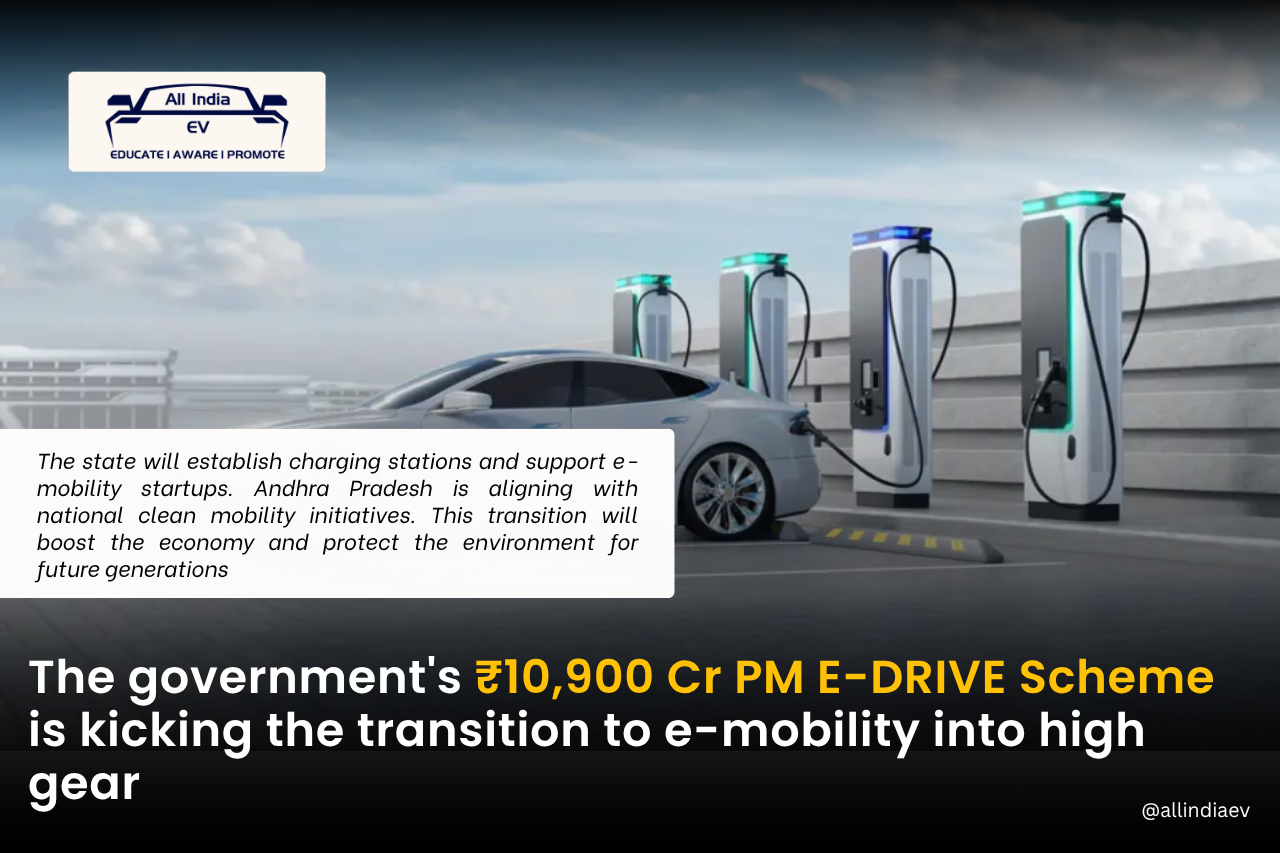
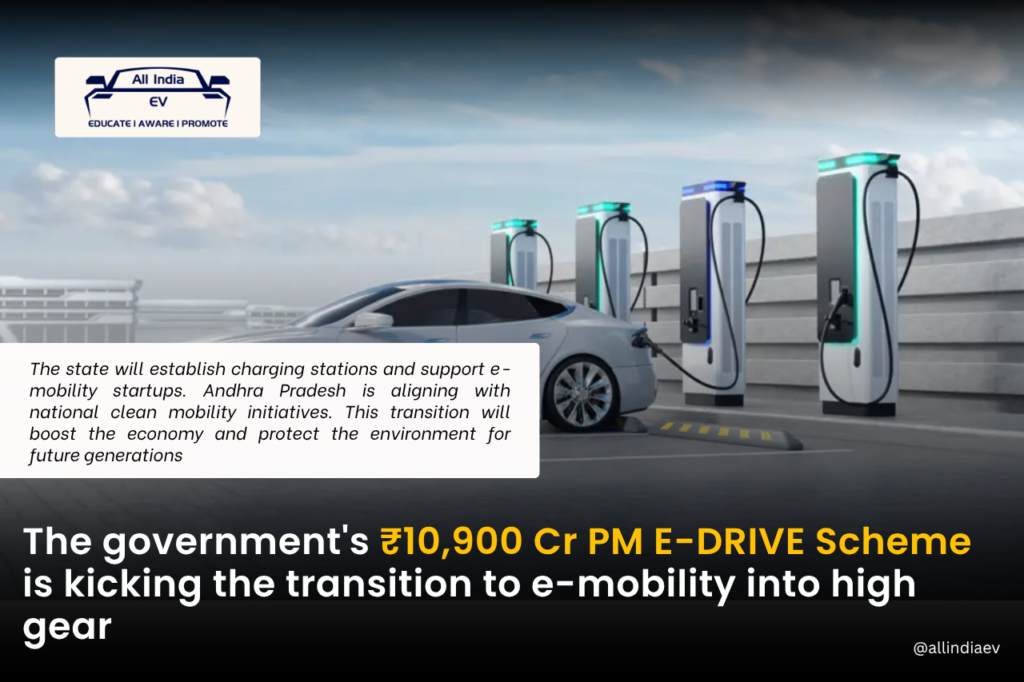
In a major boost to India’s electric mobility mission, the Ministry of Heavy Industries (MHI) has rolled out an ambitious plan to install 72,000 electric vehicle (EV) chargers across the country under the ₹10,900 crore PM E-Drive scheme. To fast-track this initiative, the Centre is offering ₹2,000 crore in incentives to states that secure land, build infrastructure, and appoint nodal agencies to manage the rollout.

According to officials aware of the development, discussions with state governments have already begun, focusing on how each state can aggregate demand for chargers, allocate suitable land parcels, and develop upstream infrastructure like transformers and grid connections. States with high EV adoption, including Chandigarh, Delhi, and Maharashtra, are expected to be early participants, given their existing progress in electric mobility.


Under the plan, state governments, central ministries, and central public sector enterprises (CPSEs) can submit proposals to claim incentives for charger installation. The Centre will bear 80% of the upstream infrastructure cost—which includes transformers, cables, and power connectivity—while downstream costs such as chargers and software will also receive partial financial support.

Currently, India has just over 29,200 public charging stations (as of August 2025), highlighting the urgent need for expansion. The limited number of functional chargers has been a key bottleneck in EV adoption, as many users suffer from range anxiety, or the fear of running out of charge mid-journey.

To address this, the government’s new guidelines—notified on 26 September 2025—state that chargers installed on government premises like schools, hospitals, and offices will be fully funded by the Centre and accessible to the public. For chargers on state and national highways, 80% of upstream and 70% of downstream costs will be covered. For private or non-government locations, the incentive will apply only to upstream costs.


Additionally, the Centre has identified priority corridors such as the Mumbai-Pune, Delhi-Jaipur, and Delhi-Agra highways for early EV charger deployment, ensuring intercity connectivity for electric vehicles.

More EV News
Nissan and Honda Ink Memorandum of Understanding for Electric Vehicle Collaboration
Lectrix EV Unveils E2W at Price of INR 49,999 With Battery Subscription Model
India Needs Rs 16,000 Crore to Scale Up EV Charging Infrastructure: FICCI Report
E-FILL Electric Boosts payments with UPI-Enabled EV Charging
BYD India Aims for 90% EV Market Share

A crucial component of this initiative is localisation. The MHI has emphasised that all chargers must comply with domestic manufacturing norms under the Phased Manufacturing Programme (PMP). This ensures that most charger components—including charging guns, panels, software, and controllers—are made in India. Under PMP, manufacturers are allowed to import select components only for a limited time, after which all production must shift to domestic units.

One senior official explained, “The focus is on localisation—ensuring both hardware and software of chargers are indigenous. This will not only strengthen India’s manufacturing ecosystem but also reduce dependency on imports.”


The policy push follows a recent NITI Aayog report, which flagged that most of India’s installed chargers remain non-operational. As of early 2025, only 251 of 4,500 chargers installed under the FAME-II scheme were energised, meaning they were connected to the power grid and ready for use. The report urged states to set up dedicated nodal agencies and conduct feasibility studies before finalising charger locations.

Experts believe that this new incentive scheme could be the turning point for EV infrastructure in India. Nakul Zaveri, Partner and Co-Head of Climate Investment Strategy at LeapFrog Investments, said, “Government funding is vital to kickstart large-scale charging networks. Once the foundation is in place, market dynamics will ensure long-term sustainability, similar to what we’ve seen in the battery-swapping sector.”

He added that fast, efficient charging will be essential for commercial fleets and public transport, where vehicle utilisation is high. “EV charging must evolve beyond convenience—it needs to be part of operational efficiency,” he said.


The cost of installing an EV charger currently ranges between ₹8–10 lakh, depending on the manufacturer. While the downstream equipment makes up a significant portion, upstream expenses—like transformers and grid connections—are even more critical, particularly in rural and semi-urban areas.

To overcome these challenges, the Centre’s 80% subsidy for upstream costs is expected to make private investment in charging infrastructure more viable, especially along key logistics routes and urban clusters.

The new policy aims not just to increase charger numbers, but to build a scalable, standardised ecosystem. Officials say that by 2027, the goal is to have a public charging station every 25 km along major highways and every 3 km within urban limits, ensuring EV users can travel across states without worrying about range.

In the broader context, the PM E-Drive scheme—with its ₹10,900 crore budget—is India’s most significant clean mobility programme to date. It seeks to accelerate EV adoption, local manufacturing, and charging infrastructure through an integrated, multi-sector approach.

With the latest ₹2,000 crore incentive package, the government aims to mobilise states, engage private partners, and transform India’s EV landscape into a robust, future-ready network.

As India gears up for this nationwide rollout, the focus remains clear: local production, large-scale adoption, and sustainable infrastructure—key ingredients for driving India’s electric revolution.


Comment by Author:

India’s renewed EV infrastructure push under the PM E-Drive scheme reflects a strategic shift from piecemeal projects to a coordinated national network. 

By linking incentives with localization and state participation, the government is not only addressing range anxiety but also strengthening manufacturing capabilities. 

If executed effectively, this initiative could set the foundation for a self-sustaining electric mobility ecosystem and make EV adoption a mainstream reality.

Join All India EV Community

Click here for more such EV Updates

Loading
OTO Forges Strategic Partnership with Mufin Green Finance to Revolutionize Electric Vehicle Financing
Tamil Nadu Announces ₹20,000 E-Scooter Subsidy for Gig Workers
GFCL EV Launches LiPF6 Project to Boost Worldwide EV and Energy Storage Battery Supply
Emobi Teams Up with Musashi and Honda Power Pack Energy for Electric Scooters
Ford and Reside o’s Joint Simulation Project to Explore the Potential of EV Batteries for Home Energy Use

Sign Up For Daily Newsletter

Be keep up! Get the latest breaking news delivered straight to your inbox.
Loading
By signing up, you agree to our Terms of Use and acknowledge the data practices in our Privacy Policy. You may unsubscribe at any time.
Share This Article
Facebook Whatsapp Whatsapp LinkedIn Copy Link Print
1 Comment
  • Pingback: NITI Aayog Launches India Electric Mobility Index

Leave a Reply Cancel reply

Your email address will not be published. Required fields are marked *

Follow US
XFollow
InstagramFollow
YoutubeSubscribe
LinkedInFollow
EV push could raise import bill faster than it cuts crude oil dependence initially
15 May 2026
Musashi India signs LOI with Kinetic Green for 2W EV powertrain supply
15 May 2026
What: Eicher has completed a Kashmir-to-Kanyakumari (K2K) endurance run using its fully loaded Eicher Pro X EV commercial truck, positioning the campaign as a real-world validation of electric logistics capability in India. The company claims the vehicle became the first and fastest electric commercial vehicle to complete the route under loaded operating conditions. The Number: The Eicher Pro X EV covered over 4,000 km in six days across diverse terrain and temperature conditions ranging from approximately -2°C to 40°C, while setting four India Book of Records milestones during the journey. The Impact: The Eicher Pro X EV Kashmir Kanyakumari run directly addresses one of the biggest concerns in India’s electric commercial vehicle segment — operational reliability over long distances. The campaign also highlights the growing viability of public charging infrastructure for commercial EV deployment. The Core News VE Commercial Vehicles, through its Eicher Trucks and Buses division, has launched a proof-focused electric mobility campaign centred around the Eicher Pro X EV’s successful Kashmir-to-Kanyakumari expedition. The campaign, branded around the “#XpertHaiTohPossibleHai” initiative, is aimed at demonstrating practical commercial EV readiness instead of relying solely on specification-based marketing claims. The vehicle reportedly completed the Srinagar-to-Kanyakumari route while operating under fully loaded conditions, travelling through highways, plains, ghats, urban corridors, and varying climate zones. Eicher stated that the vehicle depended on public charging infrastructure accessed through the MyEicher App ecosystem during the expedition. The company used third-party validation through the India Book of Records to independently verify route compliance, charging stops, distance covered, and operational conditions. The campaign reflects a broader shift underway in India’s commercial EV industry, where manufacturers are increasingly focusing on operational economics, fleet confidence, uptime assurance, and infrastructure reliability rather than only announcing vehicle launches. Long-haul and mid-mile logistics remain one of the most difficult electrification segments due to concerns around charging availability, payload impact, range predictability, and route downtime. Eicher’s demonstration appears strategically designed to reduce these concerns for fleet operators evaluating electric truck adoption. Breaking Down the Update • The Eicher Pro X EV completed a Kashmir-to-Kanyakumari expedition under loaded commercial operating conditions • The journey covered more than 4,000 km in six days across multiple terrain conditions • Eicher claims the run established four India Book of Records milestones • Public charging infrastructure was used throughout the route via the MyEicher App ecosystem • The campaign focused on proving operational reliability instead of conventional promotional messaging • The route included highways, mountainous regions, urban corridors, and coastal stretches • The initiative targets commercial fleet operators evaluating electric logistics deployment • The campaign aligns with India’s broader decarbonisation and green logistics objectives How Eicher Pro X EV Kashmir Kanyakumari run will help Indian EV Market The Eicher Pro X EV Kashmir Kanyakumari run could become an important reference point for India’s electric commercial vehicle sector because it focuses on real operational validation instead of controlled test conditions. One of the largest barriers to electric truck adoption in India has been fleet operator hesitation around range reliability, charging access, payload capability, and uptime consistency during long-distance movement. By completing a loaded multi-state logistics route using public charging infrastructure, Eicher is attempting to demonstrate that electric commercial vehicles can gradually move beyond short urban delivery applications into more demanding logistics operations. This is particularly important for India’s mid-mile and intra-city freight segments, where electrification potential remains significant but operational confidence is still developing. The campaign also indirectly highlights improvements in India’s charging infrastructure ecosystem. Commercial EV adoption depends heavily on charger availability, route planning tools, energy management systems, and service support networks. Demonstration runs like this help validate ecosystem readiness for fleet operators who typically evaluate vehicles based on total operational efficiency rather than environmental positioning alone. If more OEMs begin showcasing real-world logistics deployment data instead of laboratory claims, the Indian commercial EV sector could move faster toward practical fleet electrification and wider private-sector adoption. Conclusion & Next Steps The Eicher Pro X EV Kashmir Kanyakumari run reflects a growing maturity in India’s electric commercial vehicle market, where operational proof is becoming more valuable than launch announcements alone. The next challenge will involve scaling charging reliability, lowering fleet transition costs, and ensuring consistent uptime performance under commercial deployment conditions. As electric logistics adoption expands, real-world validation exercises like this are likely to become increasingly important for fleet decision-making across India’s freight sector
Eicher sets new EV benchmark with K2K campaign
15 May 2026
All India EV: Edition 49
What all happened in April 2026?
Click Here
All India EV

Daily EV Industry updates for you…

Categories

  • EV News
  • EV Launch
  • Investments & Funding
  • Market Insights
  • Guest Articles
  • EV Engineering

Quick Links

  • Community
  • Content Services
  • Branding Services
  • My EV Charger
  • Substack

© Developed and Managed by “The Energy Log”

Welcome Back!

Sign in to your account

Username or Email Address
Password

Lost your password?

Not a member? Sign Up