

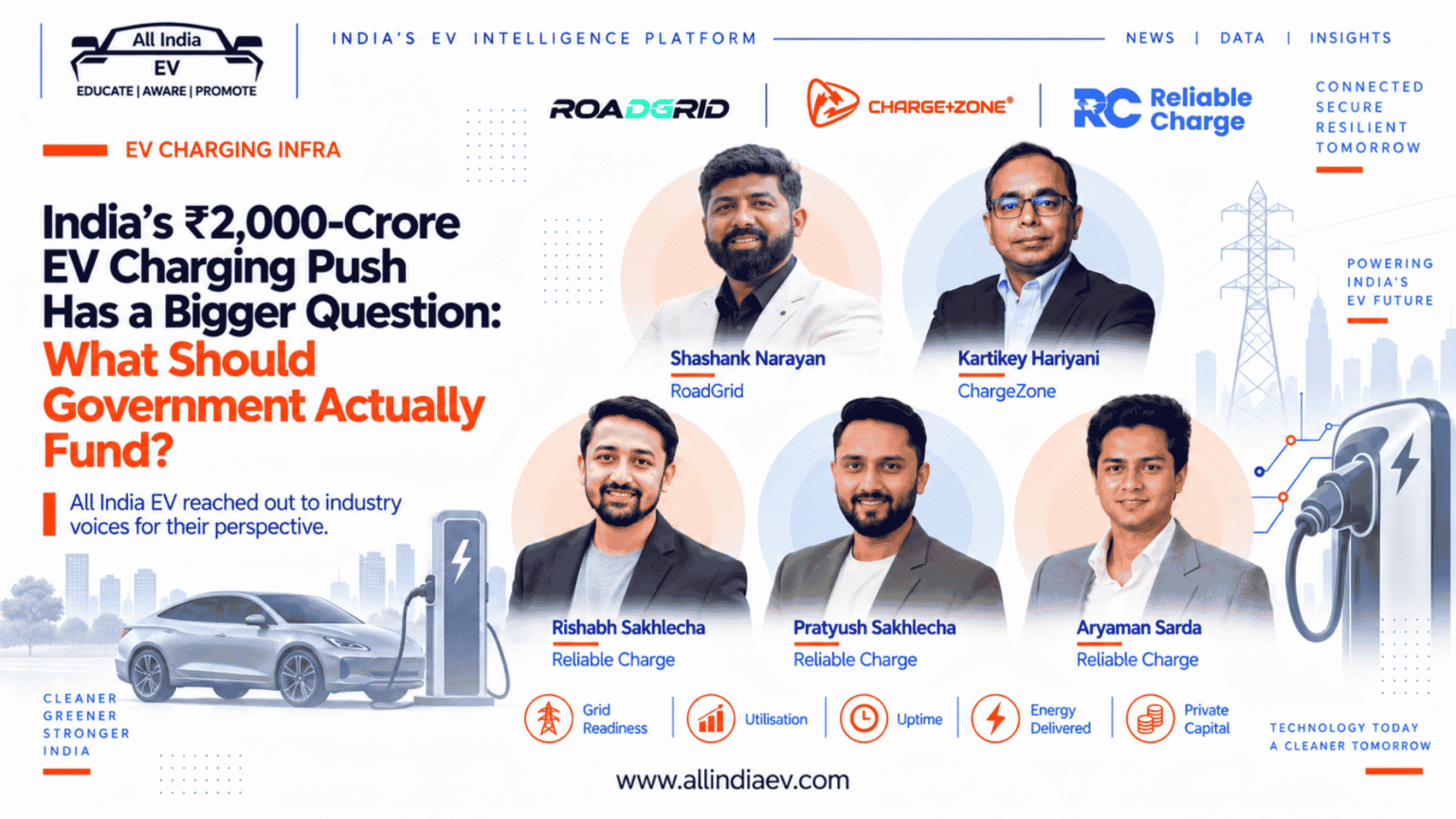
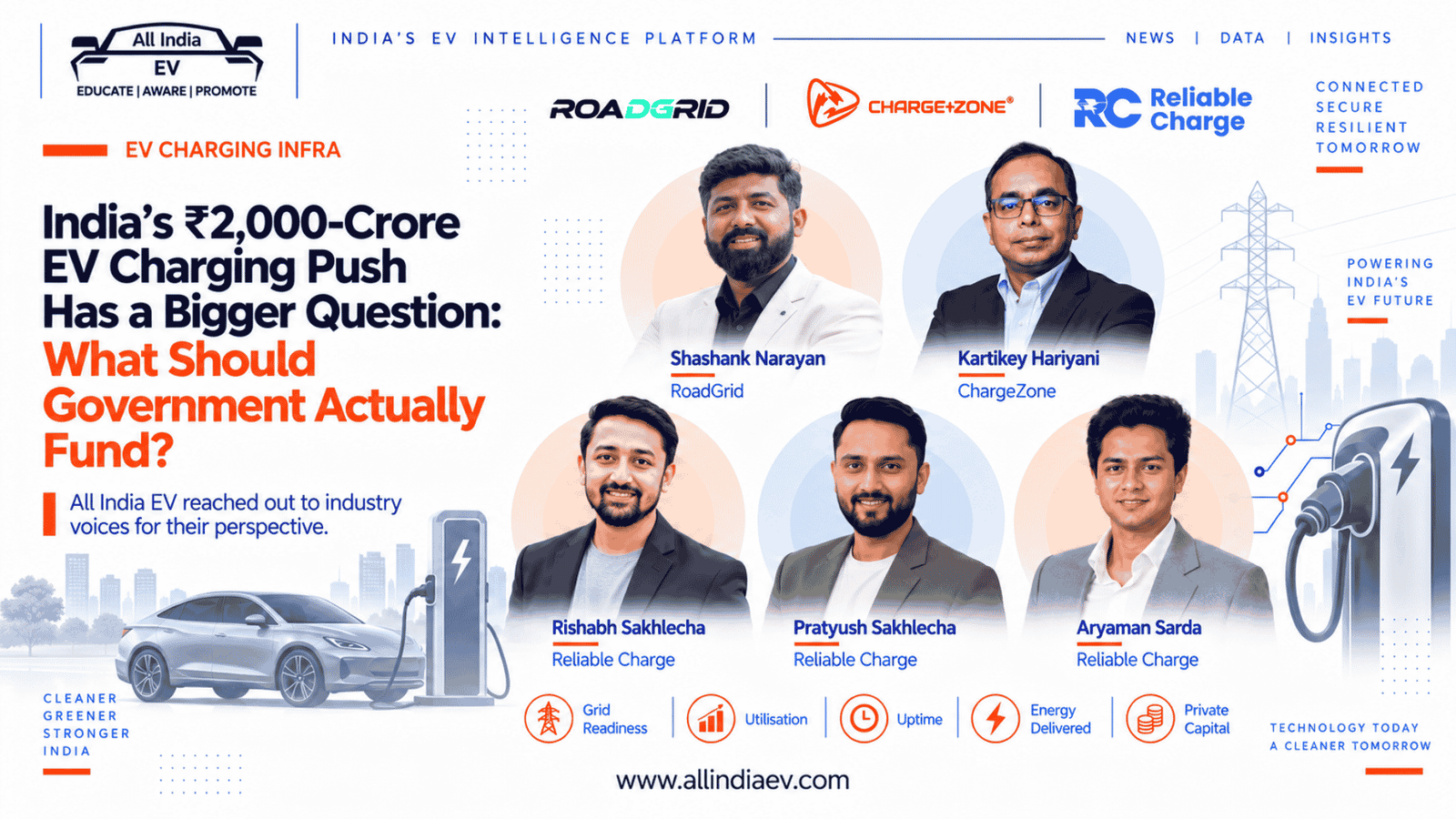
When the IEEFA report landed, showing that India’s ₹2,000-crore PM E-DRIVE charging allocation could support under 2% of the estimated 1.32 million chargers needed by 2030, it read like another grim infrastructure statistic. But at All India EV, we didn’t want to just report the number and move on. We wanted to find out what it actually means for the people building this infrastructure on the ground.
- The ₹2,000 Crore Was Never Meant to Do This Alone
- Charger Count Is the Wrong Scoreboard
- The Charger Isn’t the Expensive Part Anymore
- Where All Three Actually Agree: Move the Subsidy Upstream
- Utilisation: The Metric Everyone Distrusts
- The Real Story: This Is a Risk-Allocation Argument, Not a Funding-Size Argument
- What This Means
So we reached out to Reliable Charge, ChargeZone and RoadGrid, industry leaders operating across different layers of India’s charging ecosystem, and asked them directly: is the funding gap the real problem, or are we even measuring the right thing?
Their answers, taken together, suggest the ₹2,000-crore debate may be asking the wrong question entirely.
The ₹2,000 Crore Was Never Meant to Do This Alone
Rishabh Sakhlecha, Founder & Director at Reliable Charge, argues the allocation should be read as catalytic capital, not total infrastructure funding. Dividing ₹2,000 crore across the scheme’s earlier ambition of over 72,000 chargers works out to roughly ₹2.8 lakh per charger, a number, he says, that was “designed to seed a network, not build one.” Government funding, in his framing, has always existed to de-risk early sites so private capital follows, not to replace it.
That shifts the real question: not whether ₹2,000 crore can fund India’s eventual charger requirement, but whether it removes enough early-stage risk for substantially more private capital to follow it in.
Charger Count Is the Wrong Scoreboard
This is where all three companies converge most strongly.
Kartikey Hariyani of ChargeZone frames it from the driver’s seat: an EV driver pulling onto a highway isn’t looking for a statistic, “they are looking for a green light and a working plug.” He argues the real indicators of readiness are available capacity, uptime, utilisation and energy actually dispensed across key corridors.
Shashank Narayan of RoadGrid pushes furthest, rejecting installed-charger count outright: “Govt should stop treating ‘sanctioned’, ‘installed’, ‘commissioned’ and ‘usable’ as the same thing. They are not.” His preferred scorecard: MW actually energised, MWh delivered, verified uptime, successful sessions and genuine geographic coverage, a framing that lines up with IEEFA’s own 2024 finding that 84% of sampled Delhi chargers were non-functional.
Reliable Charge arrives at a similar place commercially, focusing on energy throughput and recurring site revenue rather than deployment count as the end goal.
The Charger Isn’t the Expensive Part Anymore
Ask what actually slows deployment, and the charger itself barely features.
Aryaman Sarda, Founder & Director at Reliable Charge, points to power availability and sanctioned load as the binding constraint for higher-capacity DC charging. A site and hardware can be ready, but without timely sanctioned load, transformer capacity or grid connection, “the entire deployment can be delayed.”
ChargeZone’s Hariyani puts a number on the entry cost: a well-equipped station typically starts at ₹20 to 30 lakh, once land, power infrastructure, civil work and DISCOM approvals are factored in, with early-stage low utilisation adding further pressure before a site turns viable.
RoadGrid’s Narayan offers the sharpest split: infrastructure requirements, sanctioned load, transformers, substations, DISCOM processes, land, civil works, account for 50 to 60% of setting up a public station, against roughly 40% for the charger itself. “Many are still in a perception that EV charging is plug and play infrastructure,” he said. “The pain behind installing these chargers is unknown to many.”
The pattern: a charger can be manufactured and priced competitively. Grid capacity cannot always be created at the same speed.
Where All Three Actually Agree: Move the Subsidy Upstream
This is the clearest consensus in the piece.
Pratyush Sakhlecha, Founder & Director at Reliable Charge, argues public money creates a stronger multiplier when it reduces the upfront burden of sanctioned load, transformers and electrical infrastructure, letting private operators put their own capital into equipment, software, maintenance and expansion instead.
ChargeZone’s Hariyani extends this to recurring costs: demand charges, levied on sanctioned load regardless of actual consumption, range from ₹0/kVA in Andhra Pradesh, Jharkhand, Rajasthan and Goa to ₹309/kVA in Tamil Nadu. He argues for concessional long-term financing for grid work, paired with cutting GST on public charging and battery swapping from 18% to 5%, a recommendation that mirrors IEEFA’s own.
RoadGrid’s Narayan states the division most bluntly: chargers no longer need subsidy because “there are many NBFCs to fund the charger.” What operators can’t absorb is infrastructure risk. “Government should build the road to the charger; we can build the charging business on top of it,” he said, proposing public money fund substations, transformers, HT/LT infrastructure, cable routes, land and time-bound connections, while CPOs are measured on outcomes: verified uptime, successful sessions, fault-resolution time.
Utilisation: The Metric Everyone Distrusts
Reliable Charge declines to set one universal benchmark. Viability, in Sarda’s view, depends on charger capacity, tariffs, demand charges, land cost and financing, assessed site by site. Fleet and depot demand tends to be predictable; urban and highway sites need a longer runway.
RoadGrid’s Narayan makes a measurement critique: comparing a 60kW urban charger with a 240kW highway unit on session counts or plugged-in hours is misleading. He argues for energy delivered against theoretical available capacity instead.
ChargeZone is the only one to name a number: economics improve materially as utilisation nears 20%, and its own hubs, built around high-frequency B2B fleets like e-trucks and logistics, run at 18 to 25%, a predictable demand base that can underwrite a site while personal EV usage catches up.
The Real Story: This Is a Risk-Allocation Argument, Not a Funding-Size Argument
Strip away the differences in emphasis, and the three companies aren’t really asking government to fund more chargers. They’re describing different categories of risk, and arguing over who should carry each:
- Grid risk: will enough electrical capacity reach the site
- Execution risk: how fast sanctioned load, transformers and approvals actually arrive
- Demand risk: whether enough EVs show up to use it
- Financing risk: how long capital sits idle before utilisation matures
- Technology/operating risk: uptime, reliability, software, customer experience
RoadGrid’s division is the cleanest expression of this: public institutions absorb infrastructure-enablement risk; private operators absorb technology and operating risk. Reliable Charge frames government money as the foundation private capital scales on top of. ChargeZone adds a third layer, that even after a site is built, financing costs, electricity tariffs and GST continue to shape whether it survives.
What This Means
The ₹2,000 crore vs. 1.32 million chargers comparison is a useful headline, but an incomplete one. What matters more, according to the people actually deploying this infrastructure, is how much private capital each rupee of public money is able to unlock upstream, in grid capacity, not chargers.
If India’s charging build-out shifts from counting installed units to measuring usable capacity, energy delivered, uptime and capital mobilised, the ₹2,000-crore scheme’s real success may end up being judged less by the chargers it directly paid for, and more by the private investment it made commercially possible.