
All India EVAll India EVAll India EV
Notification
Font ResizerAa
  • Home
  • EV News
  • EV Launch
  • Market Insights
  • Investments & Funding
  • Guest Articles
  • EV Engineering
  • Contact
Reading: India’s EV Boom Faces Energy Roadblocks: Can Green Power Keep Up?
Share
All India EVAll India EV
Font ResizerAa
  • Home
  • EV News
  • EV Launch
  • Market Insights
  • Guest Articles
  • EV Engineering
  • Contact
Search
  • Home
    • Home 1
    • Home 2
    • Home 3
    • Home 4
    • Home 5
  • Home
  • Categories
    • Electric
  • Categories
  • Shows
    • Rap
  • More Foxiz
    • Blog Index
    • Contact
  • Bookmarks
    • Customize Interests
    • My Bookmarks
  • More Foxiz
    • Blog Index
    • Sitemap
Have an existing account? Sign In
Follow US
Green Energy
Home » Blog » India’s EV Boom Faces Energy Roadblocks: Can Green Power Keep Up?
EV News

India’s EV Boom Faces Energy Roadblocks: Can Green Power Keep Up?

Sunita
By
Sunita
Last updated: 17 June 2025
Share
5 Min Read
SHARE

Contents
  • ✅ EV Growth Amidst Energy Challenges
    • Is India’s EV Transition Truly Green?
  • ✅ The Reality of India’s Green Energy Mix
  • ✅ Smart Grid Systems: The Key to Efficient Integration
    • Expert Insights
  • ✅ Decentralized Renewable Energy: A Game Changer for EV Charging
    • Key Benefits of Decentralized EV Charging
  • ✅ Green Energy Open Access: Democratizing Renewable Power for EVs
  • ✅ Meeting Peak Demand with Hybrid Energy Solutions
    • Strategic Charging Infrastructure Placement
  • ✅ The Role of Policy in Strengthening India’s EV Future
    • Vehicle-to-Grid (V2G) Technology: A Game Changer
  • ✅ The Road Ahead: India’s Path to a Sustainable EV Future

India EV: India’s Rapid EV Growth Faces Green Energy Hurdles

India’s electric vehicle (EV) market is growing rapidly, but concerns over renewable energy integration and grid stability present significant challenges. Ensuring a sustainable EV ecosystem requires a strong push towards clean energy solutions.


✅ EV Growth Amidst Energy Challenges

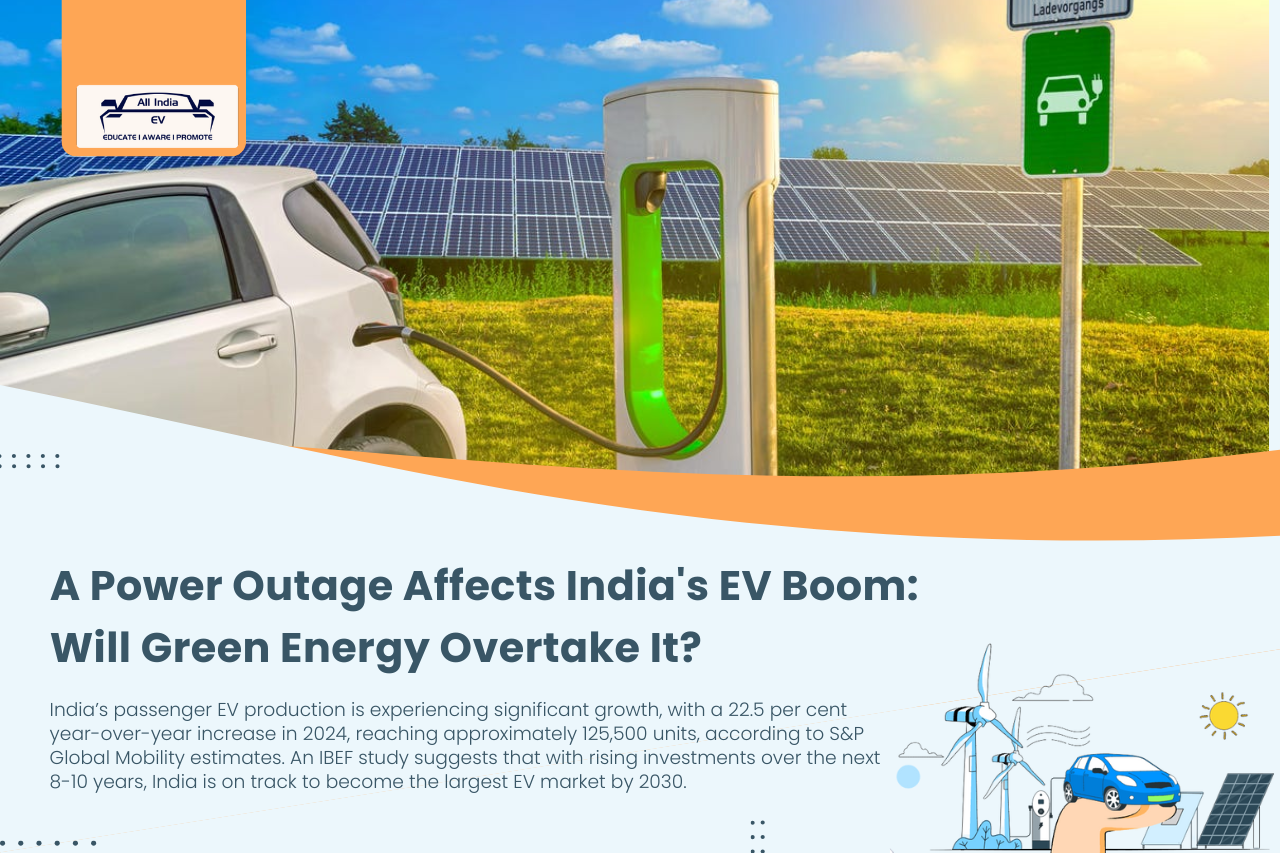
According to S&P Global Mobility estimates, India’s passenger EV production surged 22.5% year-over-year in 2024, reaching approximately 125,500 units. An IBEF report projects that India could become the largest EV market by 2030. The Indian EV battery market, valued at USD 16.77 billion, is expected to grow to USD 27.70 billion by 2028.

Is India’s EV Transition Truly Green?

While EVs offer a cleaner alternative to fossil-fuel-powered vehicles, their environmental benefits depend on the source of electricity used for charging. If the majority of EVs run on coal-based energy, the net carbon savings are significantly reduced. This highlights the urgent need for a robust renewable energy infrastructure to truly support India’s green mobility goals.


✅ The Reality of India’s Green Energy Mix

As of January 31, 2025:

  • 46.3% of India’s electricity comes from renewable sources.
  • 47.29% of the national grid still relies on coal-based power.
  • Only one-third of EVs in India are currently charged using clean energy.

Beyond power generation, grid inefficiencies (such as double-digit transmission and distribution losses) pose another major hurdle. Without immediate action, these inefficiencies could slow down India’s EV revolution.

More EV News

green logistics
India Expands Green Logistics: EV Charging Infrastructure to be Installed at Ports
The Electric Revolution: New Cars Coming in 2024
BGauss Ramps Up Electric Vehicle Production in Maharashtra
Ather Energy : Losses Shrink to ₹84.6 Crore as Scooter Sales Hit Record Highs
Why the Ampere Nexus is the Ultimate Electric Scooter for Every Indian Rider

✅ Smart Grid Systems: The Key to Efficient Integration

The government’s Smart Grid Mission aims to modernize India’s electricity network through automation, communication, and IT solutions. Experts recommend integrating battery storage and vehicle-to-grid (V2G) technology to manage fluctuations in renewable energy availability.

Expert Insights

  • Devansh Jain, Chair of the Wind Energy Committee at PHDCCI, suggests implementing time-of-use pricing and AI-driven demand forecasting to optimize EV charging during peak renewable energy generation hours.
  • Rakesh Jha, Partner at BDO India’s Energy Sector Solutions, emphasizes the role of government incentives in supporting storage integration and smart grid development.

✅ Decentralized Renewable Energy: A Game Changer for EV Charging

Decentralized renewable energy (DRE) systems, such as solar, wind, and biomass power, can improve EV charging accessibility, especially in rural and semi-urban areas.

Key Benefits of Decentralized EV Charging

  • Reduced dependence on centralized grids
  • Lower transmission losses
  • Improved energy resilience
  • Cost savings on electricity
  • Job creation and community-driven solutions

Jain highlights that solar-powered EV charging stations can significantly reduce operational costs and provide stable power in remote areas.


✅ Green Energy Open Access: Democratizing Renewable Power for EVs

Experts advocate for Green Energy Open Access, allowing EV charging operators to procure renewable electricity directly from generators. This model bypasses traditional utility monopolies, ensuring cost-efficient green energy supplies.

By removing regulatory barriers, this approach accelerates India’s transition to a decentralized and cleaner energy ecosystem.


✅ Meeting Peak Demand with Hybrid Energy Solutions

India’s peak electricity demand occurs in the evening, while solar energy production peaks during the day. To balance this mismatch, experts suggest integrating:

  • Solar and wind energy
  • Battery storage systems
  • Pumped storage plants (PSP)
  • Predictive algorithms for charging optimization

Strategic Charging Infrastructure Placement

Jain emphasizes that placing charging stations in locations with complementary energy sources will improve grid stability and reliability.


✅ The Role of Policy in Strengthening India’s EV Future

Government incentives and strong policies are crucial for promoting renewable-powered EV charging infrastructure.

Vehicle-to-Grid (V2G) Technology: A Game Changer

Jha points out that V2G technology can enhance grid stability by allowing:

  • EVs to store excess renewable energy during high production periods.
  • EVs to supply power back to the grid during low production periods.
  • Bidirectional energy flow for optimal renewable energy utilization.

✅ The Road Ahead: India’s Path to a Sustainable EV Future

While India’s EV market continues to grow, ensuring a truly sustainable transition depends on:

  • A cleaner energy grid
  • Enhanced energy storage solutions
  • Grid modernization efforts
  • Supportive government policies

With strategic investments and policy reforms, India has the potential to create a self-sustaining EV ecosystem that sets a global benchmark for clean mobility.

Join All India EV Community

Click here for more such EV Updates

Renault Group unveils futuREady India to power its next phase of international growth
Renault Group unveils futuready India to power its next phase of international growth
Maxvolt Energy Gears Up for IPO, Fueled by Exponential Growth
Zevo India Aims for 50% Solar-Powered EVs in Logistics by End of FY25
Servotech Power Systems signs a Contract with Adani TotalEnergies E-Mobility for EV Chargers
The Energy-Mobility Flywheel. How Carbon Policy Fueled EV Markets

Sign Up For Daily Newsletter

Be keep up! Get the latest breaking news delivered straight to your inbox.
Loading
By signing up, you agree to our Terms of Use and acknowledge the data practices in our Privacy Policy. You may unsubscribe at any time.
Share This Article
Facebook Whatsapp Whatsapp LinkedIn Copy Link Print
Leave a Comment

Leave a Reply Cancel reply

Your email address will not be published. Required fields are marked *

Follow US
XFollow
InstagramFollow
YoutubeSubscribe
LinkedInFollow
OHM Automotive joins hands with KINWIN and CHTC to introduce CATL battery-powered electric buses in India
19 May 2026
Annapurna Finance Partners with Piaggio Group India for Sustainable Mobility
19 May 2026
What: The Bhubaneswar Municipal Corporation (BMC) has decided to deploy electric vehicles for official staff movement as part of its urban sustainability and clean mobility strategy. The move is linked to the city’s broader push toward low-emission municipal operations. The Number: BMC has already floated an Expression of Interest (EOI) process for EV deployment and fleet engagement under its civic mobility transition programme. The Impact: The Bhubaneswar civic body EV adoption plan could accelerate municipal fleet electrification across tier-2 Indian cities, especially where urban governance bodies are under pressure to reduce fuel costs and urban emissions. The Core News The Bhubaneswar civic body EV adoption initiative reflects a growing trend among Indian municipal administrations to electrify official transport fleets. According to reports, staff members of the Bhubaneswar Municipal Corporation will increasingly use electric vehicles for official duties as the city administration attempts to align governance operations with sustainability targets and cleaner urban mobility policies. The transition is strategically important because municipal fleets operate daily within dense urban zones where fuel consumption, emissions, and maintenance costs directly impact civic expenditure. Unlike private EV adoption, government fleet electrification creates predictable utilisation cycles, making electric mobility economically more viable over time. BMC’s move also complements Bhubaneswar’s Smart City infrastructure programme, which has increasingly focused on integrated urban transport modernisation and sustainable city operations. The development comes at a time when Indian cities are gradually shifting beyond symbolic EV announcements toward operational deployment models. Several urban local bodies are now evaluating EVs not only for environmental reasons but also for lifecycle cost savings, lower fuel dependency, and simplified fleet management. Bhubaneswar’s decision could become a reference model for other municipal corporations looking to electrify internal administrative transport without immediately requiring large-scale public EV infrastructure rollouts. Breaking Down the Update • Bhubaneswar Municipal Corporation staff will use EVs for official work • The move is linked to the city’s sustainability and clean mobility objectives • BMC has initiated EOI processes related to EV engagement and deployment • The programme aligns with Bhubaneswar Smart City initiatives • Municipal fleet electrification can reduce long-term fuel and maintenance expenditure • Government-led EV adoption improves visibility and institutional acceptance of electric mobility • Tier-2 cities are increasingly becoming active participants in India’s EV transition How Bhubaneswar civic body EV adoption will help Indian EV Market The Bhubaneswar civic body EV adoption initiative could strengthen India’s municipal EV ecosystem by demonstrating how local governments can become early institutional adopters of electric mobility. Unlike private consumers, civic administrations operate predictable fleets with fixed routes and regular usage cycles, making EV economics easier to optimise. Municipal EV deployment also creates secondary market opportunities across charging infrastructure, battery servicing, fleet software, telematics, and maintenance operations. As more civic bodies shift toward electric fleets, demand for fleet-oriented EV platforms is expected to rise, especially in compact passenger mobility and utility transport segments. The Bhubaneswar civic body EV adoption model is particularly relevant for India’s tier-2 and tier-3 cities where pollution levels, fuel costs, and operational inefficiencies are increasing but large-scale metro-style transit systems remain limited. Electrifying government vehicles can help build confidence in EV reliability while simultaneously reducing public-sector fuel expenditure. Another important factor is policy signalling. When municipal administrations themselves adopt EVs, it improves institutional confidence among businesses, contractors, and urban residents. This can indirectly support broader EV adoption in public transport, delivery fleets, sanitation vehicles, and administrative mobility services across India. Conclusion & Next Steps The Bhubaneswar civic body EV adoption programme now moves into the implementation phase, where procurement quality, charging infrastructure readiness, and operational efficiency will determine long-term success. If executed effectively, the initiative could become an important template for municipal fleet electrification in India’s emerging smart cities.
Bhubaneswar civic body staff to use EVs for official work
19 May 2026
All India EV: Edition 49
What all happened in April 2026?
Click Here
All India EV

Daily EV Industry updates for you…

Categories

  • EV News
  • EV Launch
  • Investments & Funding
  • Market Insights
  • Guest Articles
  • EV Engineering

Quick Links

  • Community
  • Content Services
  • Branding Services
  • My EV Charger
  • Substack

© Developed and Managed by “The Energy Log”

Welcome Back!

Sign in to your account

Username or Email Address
Password

Lost your password?

Not a member? Sign Up