
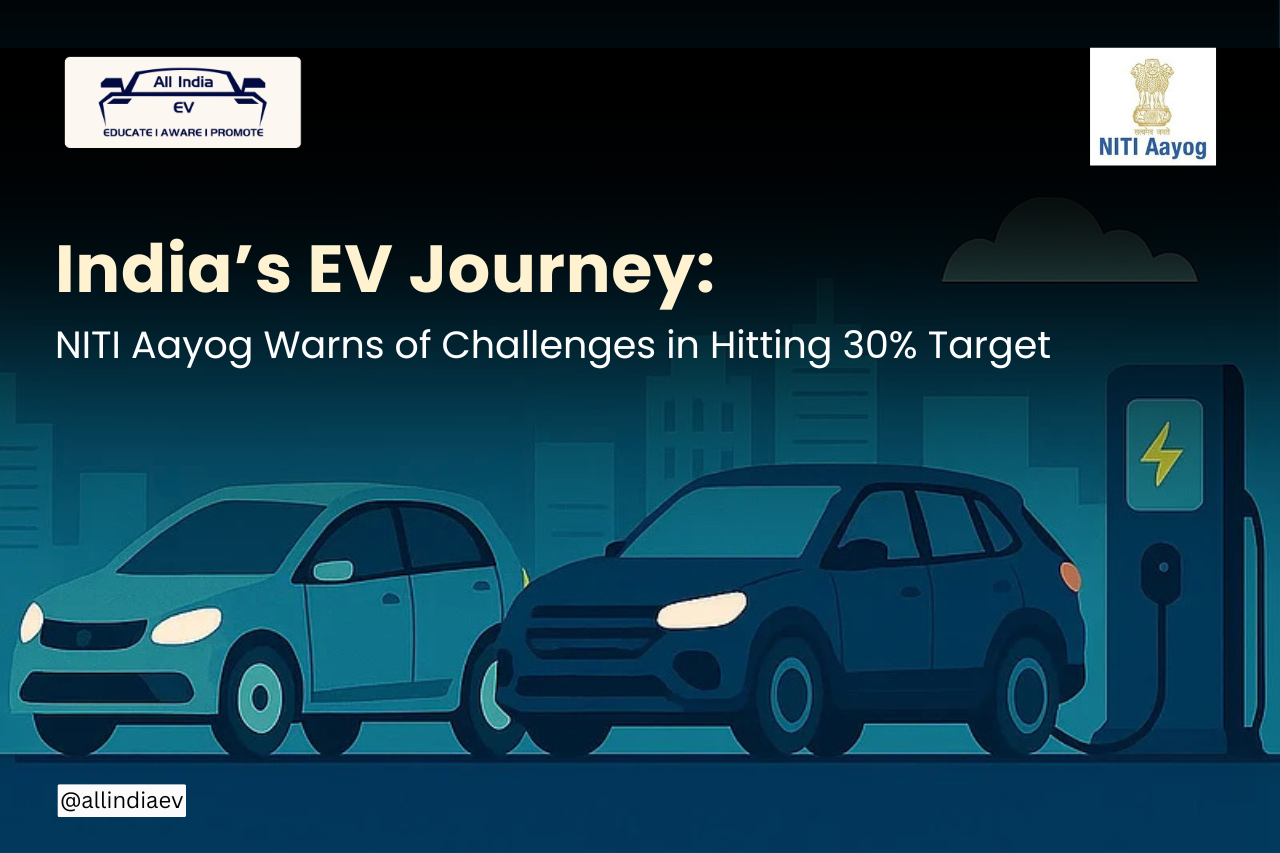

NITI Aayog’s EV Reality Check: Despite ₹40,000 Cr Spend, India Holds Just 9% Global EV Share, Faces Uphill Battle to Reach 30% by 2030
India has set itself an ambitious goal — achieving 30% electric vehicle (EV) penetration by 2030. But a recent report by NITI Aayog, titled “Unlocking a USD 200 Billion Opportunity: Electric Vehicles in India”, provides a sobering assessment of where the country stands.
Despite spending more than ₹40,000 crore on incentives over the last decade, India’s EV penetration reached just 7.6% in 2024. This figure is far below the global average of 16.5% and leaves the nation well short of its 2030 target.
India Pushes Electric Motorcycle Adoption Before EV Incentives Expire in Seven Months
The Scale of the Challenge
The numbers underline the gravity of the situation. India took nearly 10 years to reach 7.6% penetration, which now leaves the country with the daunting task of adding more than 22 percentage points in just six years. That requires a four-fold acceleration in EV adoption compared to the current pace.
While EV sales grew from 50,000 in 2016 to 2.08 million in 2024, this progress pales in comparison with the 18.78 million EVs sold globally during the same year. India’s contribution to the global EV stock remains just 9%, even though it is the world’s fourth-largest automobile market.
The report stresses that “this calls for measures to give a stronger push to the transition.”
More EV News
Where India Excels — and Where It Falls Behind
India’s EV journey is not without successes. The country leads globally in electric three-wheelers and shows strong performance in two-wheelers, competing with markets like China and Europe.
But the picture changes sharply in other segments:
- Electric trucks remain a glaring weakness. Out of 834,578 trucks sold in 2024, only 6,220 were electric. Of these, a mere 280 were long-haul trucks above 3.5 tonnes — even though these vehicles contribute 34% of CO₂ emissions and 53% of particulate matter emissions, despite making up just 3% of the vehicle fleet.
- This imbalance highlights a missed opportunity: while trucks and buses represent just 4% of vehicles, they generate more than half of transport-related emissions.
India’s reliance on subsidies has also shown diminishing returns. After FAME I (₹895 crore, 2015–2019), FAME II (₹11,500 crore, 2019–2024), and the ongoing PM e-Drive scheme (₹10,900 crore, 2024–2026), the results remain far below expectations.
Critical Barriers Identified
Through consultations with industry stakeholders, NITI Aayog highlights four major obstacles slowing EV adoption:
- Financing Challenges:
- Electric buses and trucks cost 2–3 times more than ICE equivalents.
- 80% of truck owners and 94% of bus operators are small businesses, unable to afford high upfront costs.
- Electric buses and trucks cost 2–3 times more than ICE equivalents.
- Charging Infrastructure Paradox:
- India has a ratio of 14 cars per charging station, better than many countries.
- Yet utilisation remains poor due to weak power connections, high costs, and poor station placement.
- India has a ratio of 14 cars per charging station, better than many countries.
- Awareness Deficit:
- Misconceptions around fire safety, battery degradation, and total cost of ownership deter buyers.
- Misconceptions around fire safety, battery degradation, and total cost of ownership deter buyers.
- Data and Regulatory Gaps:
- A lack of reliable EV performance data and regulatory inconsistencies make evidence-based policymaking difficult.
- A lack of reliable EV performance data and regulatory inconsistencies make evidence-based policymaking difficult.
India’s Unique EV Context
India’s challenges differ significantly from those of developed markets:
- Two-wheelers dominate India’s roads, accounting for 75% of vehicles, compared to just 13% cars in the West.
- 98% of the Indian vehicle fleet is small vehicles or public transport, while cars costing above ₹10 lakh make up only 2%.
- 80% of truck owners operate fewer than five vehicles, meaning capital-heavy EV purchases are unrealistic without new financing models.
Another major hurdle is the slow adoption by legacy automakers. While startups led the charge in two-wheelers, market leaders like Maruti Suzuki and Hyundai have hesitated, often pushing hybrids over EVs. Tata Motors has emerged as the market leader in four-wheelers, largely due to a lack of aggressive competition.
At the same time, India lacks a full-stack battery manufacturer, keeping nearly 40% of EV costs outside the domestic ecosystem. China’s dominance in battery materials and technology further complicates local manufacturing ambitions.
The Path Forward
The NITI Aayog report calls for a shift from blanket incentives to strategic mandates. Key recommendations include:
- Targeting High-Impact Segments:
- Focus on buses and commercial vehicles, which represent only 4% of vehicles but account for over 50% of emissions.
- Focus on buses and commercial vehicles, which represent only 4% of vehicles but account for over 50% of emissions.
- Geographic Saturation Approach:
- Instead of spreading resources thinly, the report suggests selecting five pilot cities where:
- 100% of buses, para-transit, and urban freight vehicles can become electric within five years.
- This creates visible success stories, spurs replication, and provides data from scaled operations.
- 100% of buses, para-transit, and urban freight vehicles can become electric within five years.
- Instead of spreading resources thinly, the report suggests selecting five pilot cities where:
- Innovative Financing Solutions:
- Establish pooled financing funds backed by public budgets and multilateral banks to offer low-interest loans for e-buses and e-trucks.
- Promote Battery-as-a-Service (BaaS) models, allowing operators to lease batteries, which account for 40% of EV costs. This reduces upfront investment and makes EVs accessible for small fleet owners.
- Establish pooled financing funds backed by public budgets and multilateral banks to offer low-interest loans for e-buses and e-trucks.
- Leveraging Renewable Energy:
- The report points to synergies with schemes like PM-KUSUM, which can establish dedicated solar plants for EV charging, ensuring affordable power supply and extending charging hours with storage.
- The report points to synergies with schemes like PM-KUSUM, which can establish dedicated solar plants for EV charging, ensuring affordable power supply and extending charging hours with storage.
A Race Against Time
With just six years left to 2030, India faces the daunting task of quadrupling EV adoption speed while addressing financing, infrastructure, and policy hurdles.
The stakes are enormous:
- Success could make India a global EV leader, reduce oil import dependency, and boost domestic manufacturing.
- Failure risks leaving India behind in the global clean mobility race, undermining both climate commitments and energy security.
As things stand, the 30% EV target may be achievable only through two- and three-wheelers and city bus networks in select cities. Heavy-duty trucks and long-haul buses remain far behind the curve.
The report also warns against repeating past mistakes, such as the ethanol blending mandate, which was pushed aggressively without adequate communication or long-term sustainability planning.
Conclusion
India’s EV journey is at a crossroads. While awareness and adoption in certain segments have grown rapidly, the structural barriers remain formidable. NITI Aayog’s report makes it clear that business-as-usual approaches will not deliver the 2030 targets.