

All India EV Intelligence | Powertrain Series — Part 4: Previous Part
- The foundation: control over the motor and controller
- How the rare-earth-free programme developed
- Rare-earth-free still means magnets are present
- How this could reduce dependence on China
- The missing measure: deployment at scale
- Government support operates through different channels
- The business must sustain the engineering
- What This Means
India’s response to rare-earth magnet dependence is taking shape through different business models. Specialist motor developers are creating alternatives for vehicle manufacturers. Component suppliers are building technologies for multiple customers. Ola Electric represents another route: a vehicle manufacturer developing the motor, controller and software within its own organisation.
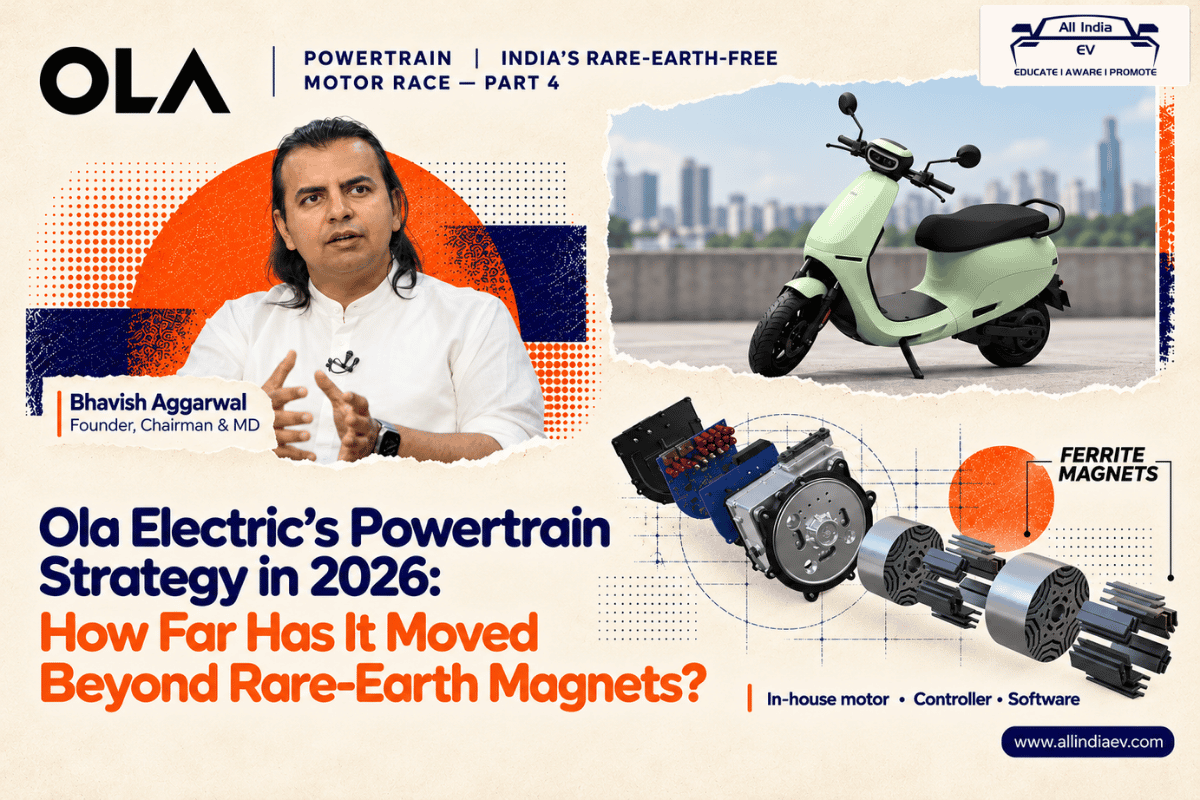
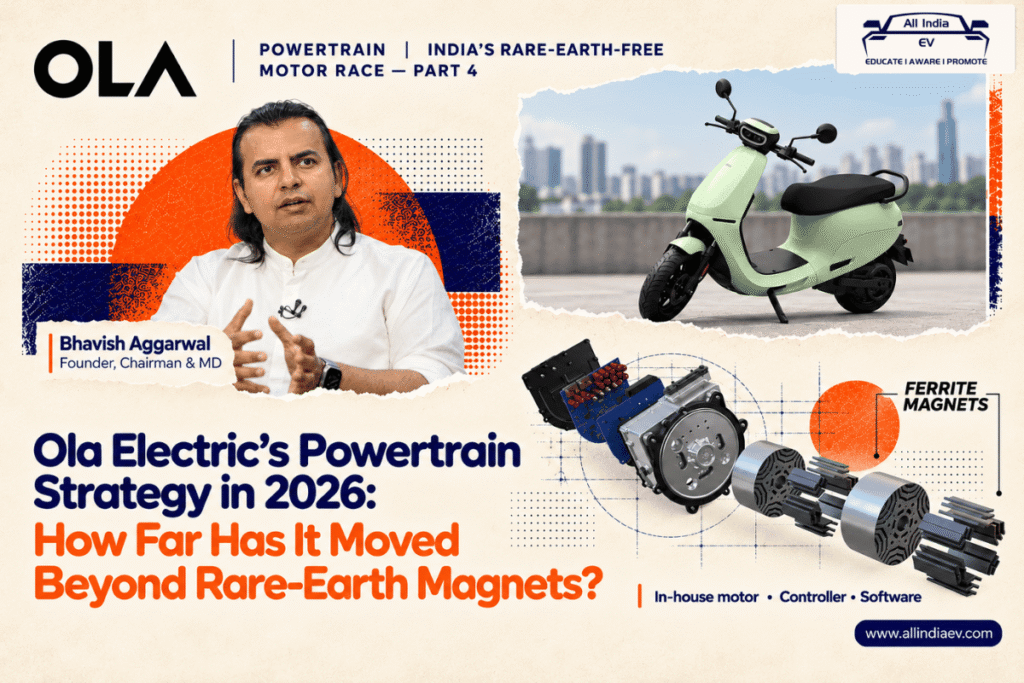
Its ferrite-motor programme asks a commercially important question: can an Indian OEM reduce rare-earth dependence by redesigning the powertrain inside its own vehicles?
Ola has documented in-house motor capabilities and reported government certification for its rare-earth-free ferrite motor. The next measure of success is deployment: which vehicles use it, how many reach customers and how the technology performs over time.
The foundation: control over the motor and controller
Ola’s powertrain work extends beyond the ferrite announcement.
In its July 2025 investor disclosures, the company said that motors and motor controllers across its Gen 3 S1 and Roadster line-up were developed in-house, using mid-mounted motors with attached controllers. It also described engineering the motor, controller and software internally as an advantage in responding to rare-earth supply disruptions.
This matters because replacing a critical material requires control over more than procurement. Our assessment is that owning the engineering gives an OEM greater freedom to change hardware, adjust control software and validate the resulting vehicle as a system.
It also creates responsibility. The manufacturer must translate its design decisions into consistent production, reliability and serviceability.
How the rare-earth-free programme developed
Ola’s July 2025 shareholder letter said it had been developing rare-earth-free motors for several years and accelerated the programme in April 2025 following supply restrictions. Its immediate response also included inventory management and sourcing rare-earth magnets from alternative countries.
These were complementary measures. Alternative sourcing could support production continuity while engineering work pursued a motor that would no longer need rare-earth magnets.
The public milestones followed:
| Date | Disclosed development |
|---|---|
| July 2025 | Ola described its accelerated rare-earth-free motor programme |
| August 2025 | Ferrite motor unveiled at Sankalp 2025 |
| 6 October 2025 | Company announced GARC certification for its ferrite motor |
According to Ola’s certification announcement, the Global Automotive Research Centre, Tamil Nadu, conducted performance verification and mandatory motor-power tests under AIS 041. The company reported that its 7 kW and 11 kW variants matched the net power of the corresponding rare-earth permanent-magnet motors.
That is a substantive milestone. However, the reported net-power result should not be extended into an independently established claim of equivalent efficiency, durability or thermal performance across every operating condition.
Rare-earth-free still means magnets are present
A ferrite motor uses magnets without rare-earth elements. It therefore offers a route to removing rare-earth magnets from the motor while retaining a permanent-magnet design.
The distinction remains central to this series:
Rare-earth-free does not mean magnet-free.
Ola’s announced Gen 4 roadmap separately identified internal permanent-magnet, ferrite-based and magnetless motor options. These are different technology pathways; an announced platform roadmap should not be read as evidence that every architecture is already deployed commercially.
The broader engineering challenge is to deliver an attractive combination of performance, efficiency, size, cost and reliability. Research programmes internationally also pursue alternative materials and motor architectures to reduce rare-earth use while maintaining those characteristics.
For OEMs, the relevant outcome is the complete drive system that customers use.
How this could reduce dependence on China
Ola’s approach addresses demand for the vulnerable material.
Where a ferrite motor replaces a rare-earth-magnet motor, the vehicle no longer needs rare-earth magnets for that traction application. At sufficient production volumes, this could reduce the manufacturer’s exposure to rare-earth magnet availability, pricing and export restrictions.
This is different from establishing domestic rare-earth magnet manufacturing. One route develops a local supply of the material; the other changes the vehicle’s need for it.
Nevertheless, rare-earth-free cannot automatically be described as China-free. Establishing that would require evidence about the sourcing of ferrite magnets, electronics, other materials and manufacturing inputs.
The supported conclusion is narrower and valuable: Ola’s design provides a potential way to remove a specific critical-material dependency from its traction motors.
The missing measure: deployment at scale
Ola’s October 2025 announcement said it would begin integrating the ferrite motor across its product line-up. That statement established intent at the time.
In the public sources reviewed for this article, we could not establish a clear model-by-model deployment tally or cumulative customer deliveries specifically using ferrite motors.
That limits how progress should be described. Certification, production readiness and fleet adoption are separate milestones.
The next useful disclosures would identify vehicle variants, production volumes, field kilometres, efficiency across representative riding conditions and warranty experience. Those measures would show how the technology contributes to supply-chain resilience in practice.
Government support operates through different channels
The first channel is testing and certification. GARC’s reported involvement provides a formal verification milestone for the motor.
The second is support for domestic vehicle manufacturing. Ola’s investor-announcements page records an August 2026 announcement securing ₹95.81 crore under PLI-Auto. Separately, the government states that PLI-Auto incentivises eligible advanced automotive products meeting a minimum 50% domestic value addition requirement.
These should be distinguished carefully. A PLI-Auto incentive for eligible manufacturing does not, by itself, establish a dedicated grant for ferrite-motor research.
Battery-cell support under ACC PLI is another separate programme. Its relevance lies in Ola’s wider localisation strategy; it should not be counted as direct financial support for the motor.
The business must sustain the engineering
Ola’s latest reported quarter available on its financial-results page is Q1 FY2026–27, covering April–June 2026.
The company reported 39,192 vehicle deliveries, ₹455 crore in revenue from operations and a 30.5% consolidated gross margin. These are company-wide operating measures, rather than ferrite-motor deployment figures.
Its earnings call also reported negative consolidated adjusted operating EBITDA of ₹195 crore. This places the technology programme within a business still working towards sustainable profitability.
Our assessment is that engineering ownership creates an opportunity, while manufacturing discipline, customer demand and financial capacity determine how widely it can be realised.
What This Means
Ola belongs in India’s rare-earth-free motor discussion because it has documented in-house powertrain development and a reported certification milestone for its ferrite motor.
Its distinctive opportunity is to carry the technology directly into its own vehicles.
The next chapter should be measured in vehicles delivered, kilometres accumulated and rare-earth magnets displaced. Those results will determine how much Ola’s motor programme contributes to India’s industrial independence.