
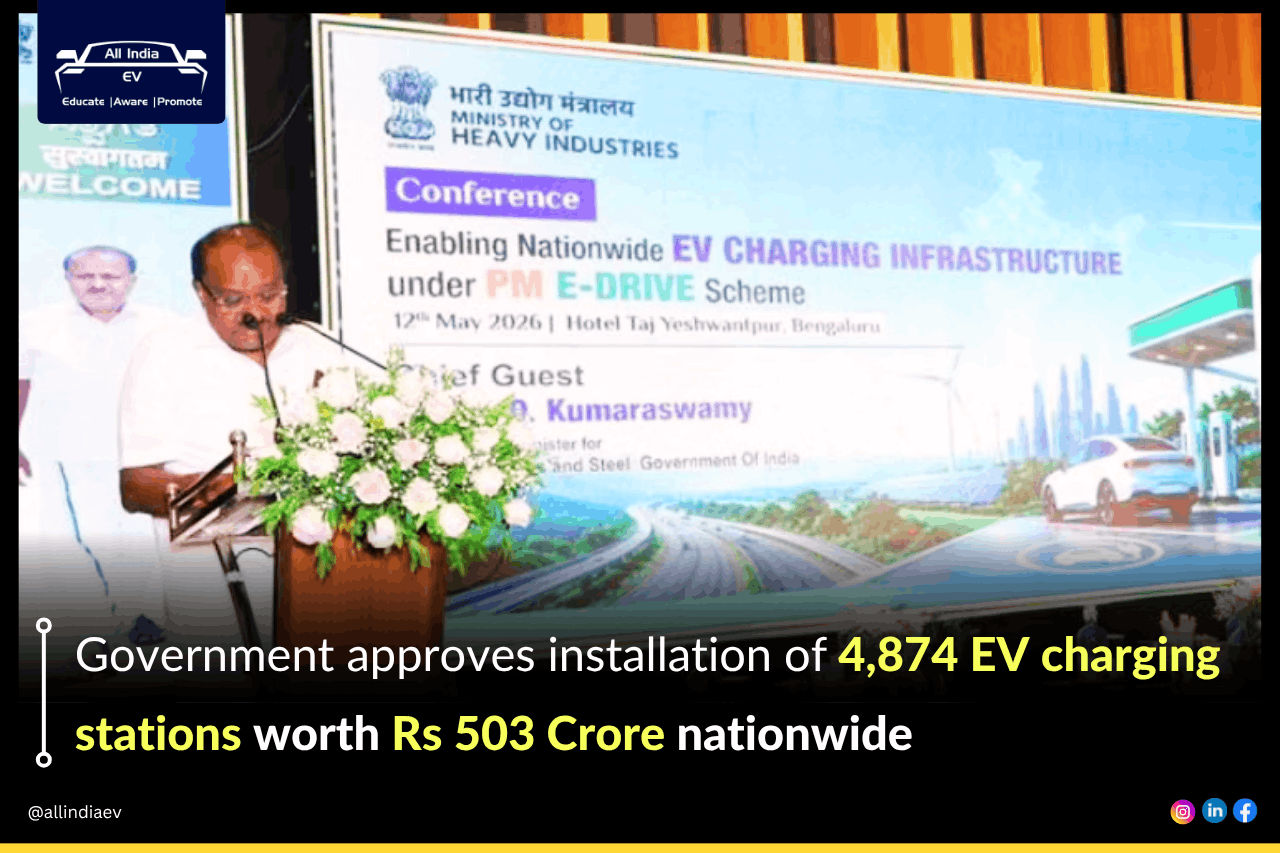

What: The Government of India has approved proposals worth ₹503.86 crore for deploying 4,874 EV charging stations across multiple states under the PM E-DRIVE scheme. The expansion will be executed through public sector oil marketing companies and state-led projects.
The Number: The approved deployment includes 4,874 chargers with a total financial outlay of ₹503.86 crore. Karnataka alone has received approval for 1,243 chargers worth ₹123.26 crore.
The Impact: The large-scale rollout of the PM E-DRIVE EV chargers network is expected to strengthen public charging accessibility, reduce range anxiety, and accelerate adoption across electric two-wheelers, three-wheelers, passenger vehicles, buses, and commercial fleets.

The Core News
The Core News The approval of the PM E-DRIVE EV chargers deployment marks one of the largest recent public charging infrastructure pushes under India’s broader electric mobility transition strategy. Announced during a national conference organised by the Ministry of Heavy Industries in Bengaluru, the initiative aims to establish a nationwide charging backbone capable of supporting multiple vehicle categories and regional EV adoption growth.
The charging infrastructure will be rolled out across Rajasthan, Andhra Pradesh, Uttar Pradesh, Gujarat, Kerala, Telangana, Karnataka, and Tamil Nadu. Public sector oil marketing companies including Indian Oil Corporation, Bharat Petroleum Corporation Limited, and Hindustan Petroleum Corporation Limited are among the key implementing agencies. The chargers are expected to be installed primarily across fuel retail networks and strategic public mobility corridors.
More EV News

The project forms a critical component of the PM E-DRIVE scheme, which carries a total outlay of ₹10,900 crore. Out of this, ₹2,000 crore has been earmarked specifically for public charging infrastructure development. The scheme also includes demand incentives for electric two-wheelers and three-wheelers, alongside funding support for over 14,000 electric buses nationwide. Industry stakeholders view the charging expansion as essential because infrastructure gaps remain one of the biggest barriers to large-scale EV adoption outside major metro clusters.
Breaking Down the Update
• The government has approved 4,874 EV chargers under the PM E-DRIVE scheme
• Total approved investment stands at ₹503.86 crore
• Karnataka received ₹123.26 crore allocation for 1,243 chargers
• Chargers will be deployed across multiple Indian states
• Oil PSUs including IOCL, BPCL, and HPCL will lead implementation
• Infrastructure will support electric two-wheelers, three-wheelers, cars, buses, and trucks
• PM E-DRIVE has a total financial outlay of ₹10,900 crore
• ₹2,000 crore has been reserved specifically for public charging infrastructure
• The government is also working on Unified Bharat eCharge for interoperable charging access
• Standardisation and coordinated deployment were key discussion themes during the Bengaluru conference
How PM E-DRIVE EV chargers will help Indian EV Market
The rollout of PM E-DRIVE EV chargers can significantly improve the operational viability of electric mobility across India by addressing one of the sector’s biggest structural bottlenecks — public charging accessibility. While EV adoption has grown steadily in urban markets, charging density outside major cities and premium corridors remains inconsistent. Large-scale charger deployment is therefore critical for mainstream adoption.
The government-backed charging expansion will support multiple vehicle categories, especially electric two-wheelers, three-wheelers, fleet vehicles, buses, and logistics-focused commercial EVs. By leveraging fuel station networks operated by public sector oil companies, the initiative can accelerate infrastructure deployment without requiring entirely new land acquisition models.
The PM E-DRIVE EV chargers network can also improve investor confidence in the broader EV ecosystem. Faster infrastructure rollout reduces range anxiety, supports intercity EV movement, and improves utilisation rates for fleet operators. This becomes especially important as India pushes toward commercial vehicle electrification and electric public transport expansion.
Another important factor is interoperability. The government’s proposed Unified Bharat eCharge platform could create a UPI-style integrated charging ecosystem, simplifying charger discovery, access, and payments across networks. If executed effectively, the combined infrastructure and software ecosystem could become a foundational layer for India’s long-term EV adoption strategy.
Way Forward ….
The approval of the PM E-DRIVE EV chargers rollout signals a stronger policy shift from demand incentives toward enabling infrastructure creation at scale. The next challenge will be execution speed, charger uptime reliability, interoperability standards, and equitable deployment beyond Tier-1 cities. As EV penetration rises across passenger and commercial segments, charging infrastructure quality and accessibility will increasingly determine the pace of India’s electric mobility transition
Read More: Catch up on All India EV’s related coverage on India’s evolving commercial EV subsidies and battery swapping policies at All India EV