
All India EVAll India EVAll India EV
Notification
Font ResizerAa
  • Home
  • EV News
  • EV Launch
  • Market Insights
  • Investments & Funding
  • Guest Articles
  • EV Engineering
  • Contact
Reading: Samarth E-Mobility develops indigenous full-stack EV technology platform
Share
All India EVAll India EV
Font ResizerAa
  • Home
  • EV News
  • EV Launch
  • Market Insights
  • Guest Articles
  • EV Engineering
  • Contact
Search
  • Home
    • Home 1
    • Home 2
    • Home 3
    • Home 4
    • Home 5
  • Home
  • Categories
    • Electric
  • Categories
  • Shows
    • Rap
  • More Foxiz
    • Blog Index
    • Contact
  • Bookmarks
    • Customize Interests
    • My Bookmarks
  • More Foxiz
    • Blog Index
    • Sitemap
Have an existing account? Sign In
Follow US
Samarth E-Mobility develops indigenous full-stack EV technology platform
Home » Blog » Samarth E-Mobility develops indigenous full-stack EV technology platform
EV News

Samarth E-Mobility develops indigenous full-stack EV technology platform

Ankit Sharma
By
Ankit Sharma
ByAnkit Sharma
Follow:
Last updated: 12 March 2026
Share
4 Min Read
SHARE
Samarth E-Mobility develops indigenous full-stack EV technology platform

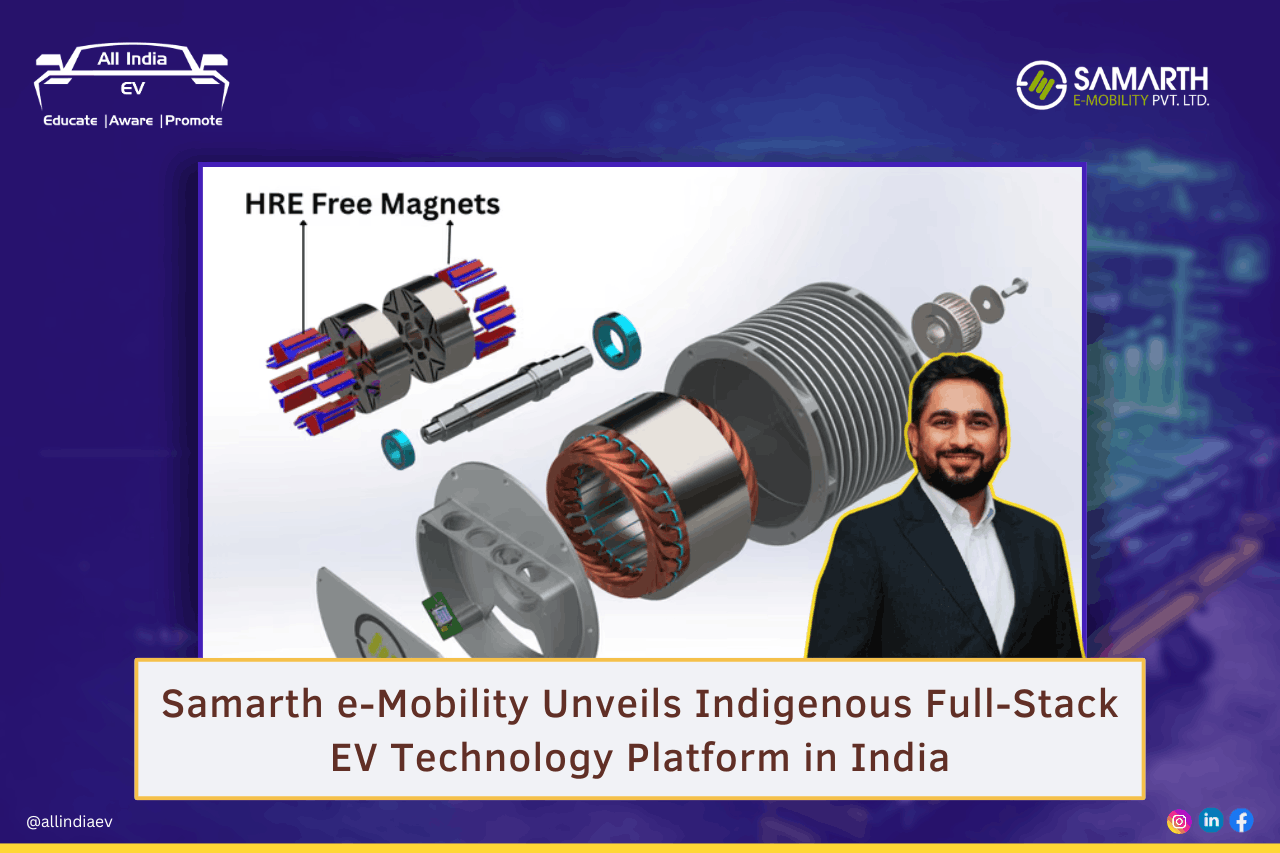
Samarth E-Mobility develops indigenous full-stack EV technology platform, signalling a deeper push toward homegrown EV engineering at a time when India is trying to localise more of its electric mobility value chain. The company said the platform was developed at its Kalol, Gujarat R&D centre and brings together several key EV systems under one in-house architecture, including the battery pack, battery management system, motor, motor controller, and power electronics.

All India EV – Resource Hub

Beyond the core propulsion stack, the platform also includes an AI-controlled onboard fast charger with ~1500W charging capacity, a DC-DC converter, an instrument cluster, and a proprietary operating system. That matters because the real value of a full-stack EV platform is not just in making components locally, but in controlling how those components talk to each other in real-world vehicle conditions.

Samarth said it has spent three years building this platform in-house, and that the system will power its upcoming electric motorcycle. The company added that its battery pack has been tested and homologated by NATRAX, while the in-house BMS has been validated by ICAT. It also claimed the technology has undergone more than 51,000 km of real-world riding tests, along with durability and dynamometer testing.

On the manufacturing side, Samarth E-Mobility said it operates a facility in Chhatral, Gujarat, with a monthly production capacity of more than 45,000 electric two-wheelers. The company plans to launch its first electric motorcycle in India later this year, positioning the platform as the technological base for its entry into the premium aspirational segment.

From an All India EV perspective, this is more than a startup technology announcement. It reflects a wider trend in the market: EV companies are increasingly realising that long-term competitiveness will depend not only on assembling vehicles, but on owning the intelligence layer across batteries, controls, software, and charging systems.


How This Will Help the Indian EV Market

This development matters because it addresses one of the most important structural gaps in India’s EV ecosystem: technology dependence. A large part of the EV industry still relies on imported subsystems or semi-integrated kits, especially in areas such as motors, controllers, BMS software, and power electronics. When a company claims to build a full-stack platform locally, it suggests India is slowly moving from EV assembly toward EV engineering.

More EV News
GreenCell gets INR 300 cr credit from Sumitomo Mitsui Bank for UP e-bus project
TPEM Partners with Vertelo to Drive E-Mobility Growth in India
Tata Motors Unveils New Manufacturing Hub in Tamil Nadu
Indian’s KABIL will invest US$25M in Argentina lithium industry
Ola Breaks Ground: Four EV Scooters Secure PLI

That shift can help the market in three ways. First, tighter in-house integration can improve vehicle efficiency, reliability, and diagnostics because the hardware and software are designed to work together from day one. Second, deeper localisation can reduce supply-chain exposure over time, especially when global component markets become volatile. Third, it creates a stronger domestic knowledge base in exactly the areas where India wants to become more self-reliant: battery systems, embedded electronics, control software, and powertrain integration.

There is also a commercial angle. If such platforms prove reliable in the field, Indian EV makers may be able to improve margins, respond faster to market needs, and build more differentiated products instead of competing only on price. In plain terms, this is the kind of groundwork that can help India build not just more EVs, but better EV companies.

Click here for more EV Updates

Basement Charging
India’s EV Adoption Faces Threat as New Building Code Proposes Basement Charging Restrictions
BATX Energies: Leading the Charge in Climate Consciousness
Himachal Pradesh Introduces e-Taxi Initiative to Promote Sustainable Transportation and Foster Job Opportunities
India Plans Major Push for Electric Trucks with New Incentives
Honeywell Introduces Li-ion Battery Safety Sensors & PPE Collection for EV Worker

Sign Up For Daily Newsletter

Be keep up! Get the latest breaking news delivered straight to your inbox.
Loading
By signing up, you agree to our Terms of Use and acknowledge the data practices in our Privacy Policy. You may unsubscribe at any time.
Share This Article
Facebook Whatsapp Whatsapp LinkedIn Copy Link Print
Leave a Comment

Leave a Reply Cancel reply

Your email address will not be published. Required fields are marked *

Follow US
XFollow
InstagramFollow
YoutubeSubscribe
LinkedInFollow
EV push could raise import bill faster than it cuts crude oil dependence initially
15 May 2026
Musashi India signs LOI with Kinetic Green for 2W EV powertrain supply
15 May 2026
What: Eicher has completed a Kashmir-to-Kanyakumari (K2K) endurance run using its fully loaded Eicher Pro X EV commercial truck, positioning the campaign as a real-world validation of electric logistics capability in India. The company claims the vehicle became the first and fastest electric commercial vehicle to complete the route under loaded operating conditions. The Number: The Eicher Pro X EV covered over 4,000 km in six days across diverse terrain and temperature conditions ranging from approximately -2°C to 40°C, while setting four India Book of Records milestones during the journey. The Impact: The Eicher Pro X EV Kashmir Kanyakumari run directly addresses one of the biggest concerns in India’s electric commercial vehicle segment — operational reliability over long distances. The campaign also highlights the growing viability of public charging infrastructure for commercial EV deployment. The Core News VE Commercial Vehicles, through its Eicher Trucks and Buses division, has launched a proof-focused electric mobility campaign centred around the Eicher Pro X EV’s successful Kashmir-to-Kanyakumari expedition. The campaign, branded around the “#XpertHaiTohPossibleHai” initiative, is aimed at demonstrating practical commercial EV readiness instead of relying solely on specification-based marketing claims. The vehicle reportedly completed the Srinagar-to-Kanyakumari route while operating under fully loaded conditions, travelling through highways, plains, ghats, urban corridors, and varying climate zones. Eicher stated that the vehicle depended on public charging infrastructure accessed through the MyEicher App ecosystem during the expedition. The company used third-party validation through the India Book of Records to independently verify route compliance, charging stops, distance covered, and operational conditions. The campaign reflects a broader shift underway in India’s commercial EV industry, where manufacturers are increasingly focusing on operational economics, fleet confidence, uptime assurance, and infrastructure reliability rather than only announcing vehicle launches. Long-haul and mid-mile logistics remain one of the most difficult electrification segments due to concerns around charging availability, payload impact, range predictability, and route downtime. Eicher’s demonstration appears strategically designed to reduce these concerns for fleet operators evaluating electric truck adoption. Breaking Down the Update • The Eicher Pro X EV completed a Kashmir-to-Kanyakumari expedition under loaded commercial operating conditions • The journey covered more than 4,000 km in six days across multiple terrain conditions • Eicher claims the run established four India Book of Records milestones • Public charging infrastructure was used throughout the route via the MyEicher App ecosystem • The campaign focused on proving operational reliability instead of conventional promotional messaging • The route included highways, mountainous regions, urban corridors, and coastal stretches • The initiative targets commercial fleet operators evaluating electric logistics deployment • The campaign aligns with India’s broader decarbonisation and green logistics objectives How Eicher Pro X EV Kashmir Kanyakumari run will help Indian EV Market The Eicher Pro X EV Kashmir Kanyakumari run could become an important reference point for India’s electric commercial vehicle sector because it focuses on real operational validation instead of controlled test conditions. One of the largest barriers to electric truck adoption in India has been fleet operator hesitation around range reliability, charging access, payload capability, and uptime consistency during long-distance movement. By completing a loaded multi-state logistics route using public charging infrastructure, Eicher is attempting to demonstrate that electric commercial vehicles can gradually move beyond short urban delivery applications into more demanding logistics operations. This is particularly important for India’s mid-mile and intra-city freight segments, where electrification potential remains significant but operational confidence is still developing. The campaign also indirectly highlights improvements in India’s charging infrastructure ecosystem. Commercial EV adoption depends heavily on charger availability, route planning tools, energy management systems, and service support networks. Demonstration runs like this help validate ecosystem readiness for fleet operators who typically evaluate vehicles based on total operational efficiency rather than environmental positioning alone. If more OEMs begin showcasing real-world logistics deployment data instead of laboratory claims, the Indian commercial EV sector could move faster toward practical fleet electrification and wider private-sector adoption. Conclusion & Next Steps The Eicher Pro X EV Kashmir Kanyakumari run reflects a growing maturity in India’s electric commercial vehicle market, where operational proof is becoming more valuable than launch announcements alone. The next challenge will involve scaling charging reliability, lowering fleet transition costs, and ensuring consistent uptime performance under commercial deployment conditions. As electric logistics adoption expands, real-world validation exercises like this are likely to become increasingly important for fleet decision-making across India’s freight sector
Eicher sets new EV benchmark with K2K campaign
15 May 2026
All India EV: Edition 49
What all happened in April 2026?
Click Here
All India EV

Daily EV Industry updates for you…

Categories

  • EV News
  • EV Launch
  • Investments & Funding
  • Market Insights
  • Guest Articles
  • EV Engineering

Quick Links

  • Community
  • Content Services
  • Branding Services
  • My EV Charger
  • Substack

© Developed and Managed by “The Energy Log”

Welcome Back!

Sign in to your account

Username or Email Address
Password

Lost your password?

Not a member? Sign Up