

China Bets on LFP as Dominant Battery Tech, Halts NMC Expansion; Epsilon’s Vikram Handa Says India Holds Late-Mover Advantage in EV Battery Industry
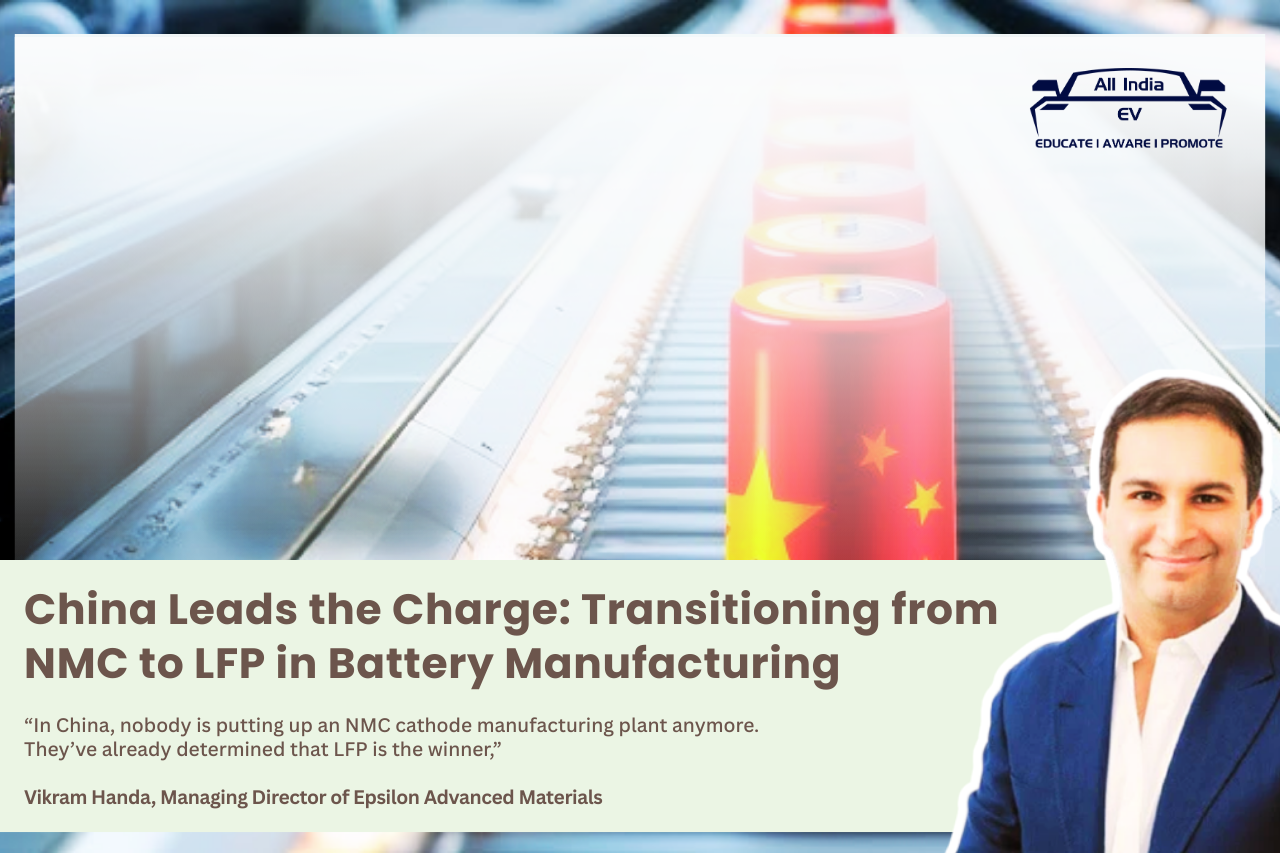
China, the world’s largest battery producer, has effectively declared lithium iron phosphate (LFP) as the winner in the race against nickel manganese cobalt (NMC) batteries. According to Vikram Handa, Managing Director of Epsilon Advanced Materials, “In China, nobody is putting up an NMC cathode manufacturing plant anymore. They’ve already determined that LFP is the winner.”
Cost drives the shift
The debate between NMC and LFP battery chemistries has dominated the EV industry for years. While NMC batteries offer slightly better energy density, LFP packs now deliver 95% of NMC’s performance at nearly 30% lower cost. “That 30 per cent saving makes all the difference,” Handa explained.
LFP is increasingly being adopted for mass-market EVs, two-wheelers, and energy storage systems, where affordability and durability are paramount. In contrast, NMC is now largely confined to premium cars and heavy-duty vehicles. Globally, LFP batteries accounted for 40–45% of EV production in 2023–24, driven by Tesla, BYD and CATL.
China’s rapid innovation
China produces more than 70% of the world’s batteries, giving it unmatched scale. Manufacturers there are now producing third-generation LFP cathodes, with fourth-generation products already in development. “A Gen 2 cathode might give 200–250 km range, while Gen 3 delivers over 300 km. If you want to sell cars, you need the Gen 3 product,” said Handa.
However, China has restricted exports of its most advanced LFP materials, creating a two-tier market. “You can buy the inferior product and make an inferior cell. But your car will not perform like a Chinese car without the best materials,” Handa warned.
India’s late start could be an advantage
India’s battery manufacturing sector is still in its early stages, but that may prove to be a blessing. “Four years ago, the world thought NMC was the winner. Fortunately, India didn’t invest heavily then. We came in late, and by then, LFP had emerged stronger,” Handa said.
More EV News

Major Indian companies including Exide, Ola Electric, Amara Raja, and Reliance are now investing directly in LFP technology, which suits India’s hot climate, mass-market EV needs, and grid storage requirements.
But building capacity in such a fast-changing industry carries risks. “By the time you build a plant, your technology can already be obsolete,” Handa cautioned.
Epsilon bets on IP and global reach
Epsilon Advanced Materials, India’s first fully integrated battery materials company, is building 100,000-tonne production plants for both graphite anode and LFP cathode materials in India by 2030. The company began with graphite anode technology, developing over 40 patents in just six years, and rapidly expanded into LFP by acquiring Johnson Matthey’s German cathode unit, which came with 120+ patents and an operational commercial plant.
“If you don’t own your IP, you cannot succeed in this industry,” Handa stressed. This intellectual property strength allows Epsilon to manufacture third-generation LFP cathodes for next-generation EV and energy storage applications.
The company is also building a graphite anode plant in the US to meet local sourcing requirements. “Our strategy is simple: build in India to supply the world, build in the US for America, and eventually build in India for India as domestic demand scales up,” Handa said.
What India needs next
India is now witnessing the emergence of a complete battery ecosystem — from anode and cathode materials to electrolytes and separators. But success will require long-term policy stability and patient capital investment.
“With supportive policy and sustained investment, India can become a global hub for advanced battery materials,” Handa added.
As the global EV industry pivots firmly toward LFP, India’s opportunity is clear: leapfrog outdated chemistries and build a future-ready domestic supply chain.