


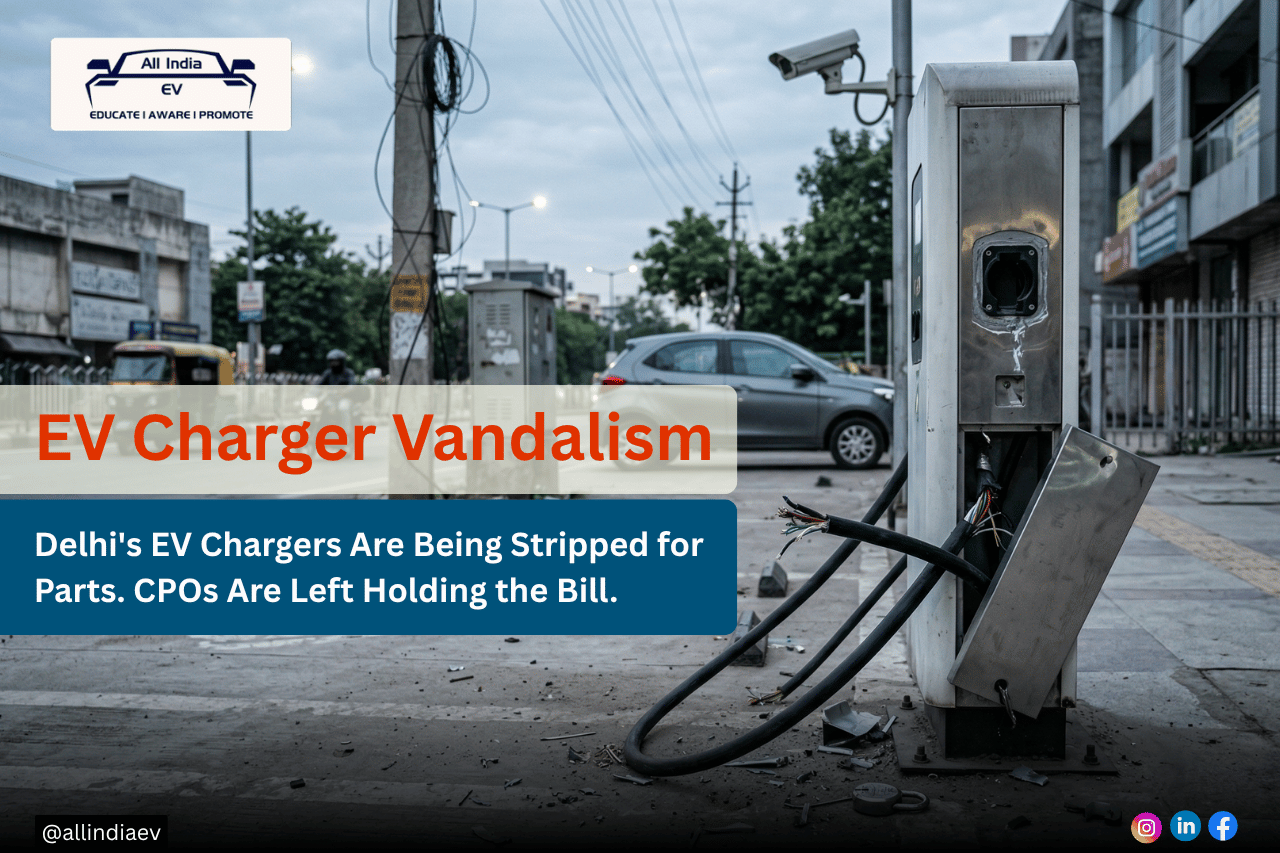
On the night of March 18, unidentified suspects walked up to an EV charging facility near Bhairon Mandir on Tilak Marg in Delhi and cut off two CCS2 charging guns. Estimated loss: ₹1 lakh. A private firm’s operations engineer filed a complaint the next morning. FIR registered. CCTV footage secured. Investigation underway.
That alone would be alarming. But here’s what makes it worse — it wasn’t even a single incident.
The same night, thefts were reported at a station in Munirka. Earlier incidents had already hit stations in Bhogal and near IIT Gate. By the time police began tallying the damage, the cumulative losses across these four locations over just four months had reached ₹4.5 lakh — and those are only the cases that were formally reported.
Police and industry sources confirm that while the recent spike has been concentrated in Delhi, similar patterns of vandalism and equipment theft have appeared in other Indian cities, pointing to a structural vulnerability in public charging infrastructure that’s now too large to ignore.
The CPO’s Nightmare: No Theft. No Coverage. No Recourse.
For Charge Point Operators managing multi-site networks across Delhi — and increasingly across India — each of these incidents translates into the same painful outcome: full replacement cost, zero insurance coverage.
CCS2 charging guns. DC fast charger units. Copper cabling. Ancillary hardware. None of it is cheap. None of it is insured. When it walks out the door, the CPO absorbs the hit entirely.
The Delhi vandalism cluster is now forcing a conversation that India’s EV charging industry has avoided for too long: Where is the insurance product for EV charging assets?
More EV News

Theft. Physical damage. Vandalism. Business interruption from downed stations. These are real, documented, recurring risks — and there is currently no mainstream insurance product in India that addresses them in the context of EV charging infrastructure. That gap is no longer theoretical.
The Security Problem Is Just as Urgent
The thefts aren’t happening because criminals are sophisticated. They’re happening because the infrastructure invites it.
Charging guns tethered with standard cables. Equipment installed in open, poorly-lit areas. No physical enclosures. No on-ground monitoring. CCTV present in some locations, absent in others — and even where it exists, it’s reactive rather than preventive.
Experts and EV users have flagged these vulnerabilities for some time, alongside a related but distinct problem: non-functional and poorly maintained stations that frustrate EV owners relying on public chargers. Stations shown as active on maps are routinely found inoperative on the ground — sometimes because of technical faults, sometimes because equipment has gone missing entirely. The result is compounding charging anxiety that undermines user trust in the entire public network.
Addressing the physical security gap requires:
- Anti-cut, armoured cable protection on tethered charging guns
- Lockable, tamper-evident enclosures for charger hardware
- Integrated CCTV with remote monitoring tied into network management dashboards
- Smart tamper alerts that flag offline status, physical interference, or unusual access in real time
These aren’t futuristic features. In mature CPO markets across Europe and Southeast Asia, hardened charger designs are increasingly standard spec. In India, they remain optional add-ons — which means most deployments don’t have them.
Delhi’s Expansion Plans Can’t Ignore This
The Delhi government is actively pushing to scale the city’s charging network — kerbside chargers, thousands of new charging points across the capital, deeper integration with its EV policy. That ambition is real and necessary.
But authorities are now also reviewing security measures at existing charging sites and calling on stakeholders to strengthen surveillance and physical safeguards across EV charging hubs. The message from police and industry: you cannot keep deploying assets into the field without a protection framework to match.
Scaling a vulnerable network just creates a larger attack surface.
What Needs to Happen
The Delhi incidents make the ask clear:
- Insurers need to develop EV charging asset products — covering theft, vandalism, accidental damage, and revenue loss from downtime
- Charger OEMs and hardware providers need to offer anti-tamper, hardened designs as default configurations for Indian market deployments
- CPOs and network aggregators need to run security audits across existing sites and enforce minimum physical security specs on new installations
- Policymakers need to embed physical security standards into public charging tenders, DISCOM partnerships, and subsidy frameworks
The Bottom Line
Four sites. Four months. ₹4.5 lakh in losses. CCTV footage. FIRs filed. Investigations ongoing.
And still no insurance. Still no security standard. Still no industry-wide response.
Delhi’s charging vandalism problem isn’t a law enforcement story. It’s a CPO viability story — and a test of whether India’s EV infrastructure buildout is serious about protecting the assets it’s spending billions to deploy.
All India EV is tracking developments in EV charging security, CPO risk, and infrastructure protection. If you’re a CPO, insurer, or security solutions provider working in this space — reach us at allindiaev@gmail.com