
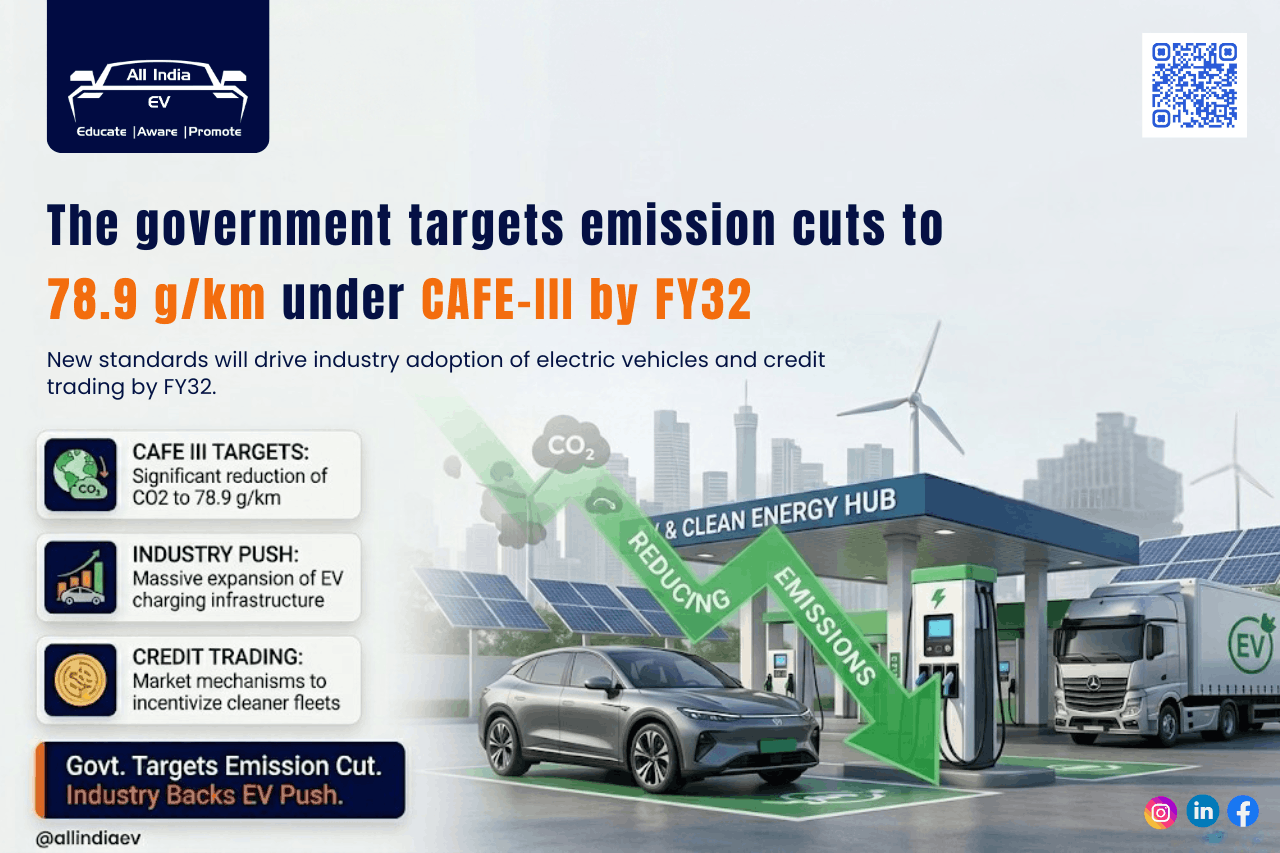

What: The Indian government has proposed tighter Corporate Average Fuel Efficiency (CAFE-III) norms to cut passenger vehicle emissions to 78.9 g/km by FY32.
The Number: 78.9 g/km CO₂ target (down from ~113 g/km by FY27).
The Impact: This is India’s most aggressive emission reduction cycle yet, pushing automakers toward EVs, hybrids, and efficiency technologies.

The Core News
India’s upcoming CAFE-III emission norms mark a structural shift in how passenger vehicle emissions will be regulated, with the government targeting a reduction to 78.9 g/km by FY32. This sharp drop from the current 113 g/km baseline introduces one of the steepest decarbonisation curves in the country’s automotive policy history.
The framework, expected to be implemented from April 2027, applies to all M1 category passenger vehicles, including imports. It evaluates compliance at the manufacturer level based on fleet-wide averages, allowing flexibility through mechanisms such as credit banking, pooling, and carry-forward provisions across defined compliance cycles.
A notable addition is the introduction of a formal credit trading system, enabling automakers to offset emission gaps by buying credits or monetising over-compliance. With credit prices rising from ₹2,500 to ₹4,500 per gCO₂/km by FY32, the policy creates a financial incentive structure aligned with cleaner technologies. Simultaneously, EVs, hybrids, and efficiency innovations receive weighted incentives, reinforcing the broader transition toward electrified mobility.
More EV News
Breaking Down the Update
• Emission targets tightened from 113 g/km to 78.9 g/km by FY32
• Implementation timeline begins April 2027
• Credit trading introduced with rising price bands (₹2,500–₹4,500)
• EVs and range-extended EVs get highest “super credit” multiplier (3.0)
• Hybrid and flex-fuel technologies also incentivised
• Compliance flexibility via pooling and carry-forward mechanisms
• Financial penalties remain significant for non-compliance
How CAFE-III emission norms will help Indian EV Market
The rollout of CAFE-III emission norms is expected to act as a regulatory catalyst for India’s EV transition, not just a compliance framework. By tightening fleet-level emission targets, the policy indirectly forces OEMs to increase the share of low- and zero-emission vehicles in their portfolios.
The inclusion of “super credits” significantly improves the compliance value of EVs. With a 3.0 multiplier, automakers can offset emissions from internal combustion engine (ICE) vehicles more efficiently by scaling electric vehicle production. This effectively lowers the marginal cost of compliance through electrification rather than incremental ICE efficiency improvements.
The introduction of credit trading also changes capital allocation strategies. Automakers with strong EV pipelines can generate tradable surplus credits, creating a new revenue stream. Conversely, lagging players may face rising compliance costs, accelerating industry consolidation or partnerships.
Additionally, the policy aligns with India’s broader energy goals reducing oil imports and improving energy security while supporting domestic EV manufacturing ecosystems. Over time, this regulatory push is likely to increase EV penetration, strengthen supply chains, and drive investment into battery technologies and charging infrastructure.
Way Forward …..
The CAFE-III emission norms signal a decisive policy push toward electrification, backed by market-based mechanisms like credit trading. The next critical step is timely notification and clarity on implementation details, as OEMs will need a clear roadmap to align product strategies and investments before 2027. Execution risks remain around compliance costs and technology readiness, but the direction is firmly set toward a lower-emission, EV-driven passenger vehicle market.
Read More: Catch up on All India EV’s related coverage on India’s evolving commercial EV subsidies and battery swapping policies at All India EV