

What: EV Charger Installation at Office is emerging as a critical part of India’s workplace electrification strategy, as companies increasingly integrate charging infrastructure into office campuses to support employee EV adoption and fleet electrification.
The Number: Tata Power-backed charging ecosystem expansion aligns with India’s broader target of scaling EV charging access to hundreds of thousands of charging points over the next few years. Tata Motors alone plans to help expand charging access to nearly 400,000 points by 2027.
The Impact: Office charging is becoming a strategic infrastructure layer for India’s EV ecosystem by solving daytime charging gaps, improving charging convenience, and reducing dependence on public charging corridors.

The Core News
EV Charger Installation at Office is increasingly being positioned as a practical solution for accelerating electric vehicle adoption in urban India. Tata Power’s EV charging ecosystem highlights workplace charging as a key component alongside home and public charging infrastructure, especially for users without dedicated residential parking access.
The workplace charging model is technically important because employee vehicles remain parked for long durations during office hours. This enables efficient deployment of AC Level 2 charging systems, which balance charging speed, installation cost, and grid load management. Industry guidance indicates Level 2 chargers delivering nearly 7 kW can replenish most urban commuter EV requirements within a standard workday.
From an infrastructure perspective, office charging also reduces pressure on public fast-charging stations. Instead of relying solely on highway or destination charging, EV owners gain access to predictable daytime charging cycles integrated into their daily commute. Tata Power and Tata Motors have already expanded workplace and commercial charging discussions as part of broader EV ecosystem development, including fleet charging, commercial hubs, and metro-city fast charging networks.
More EV News

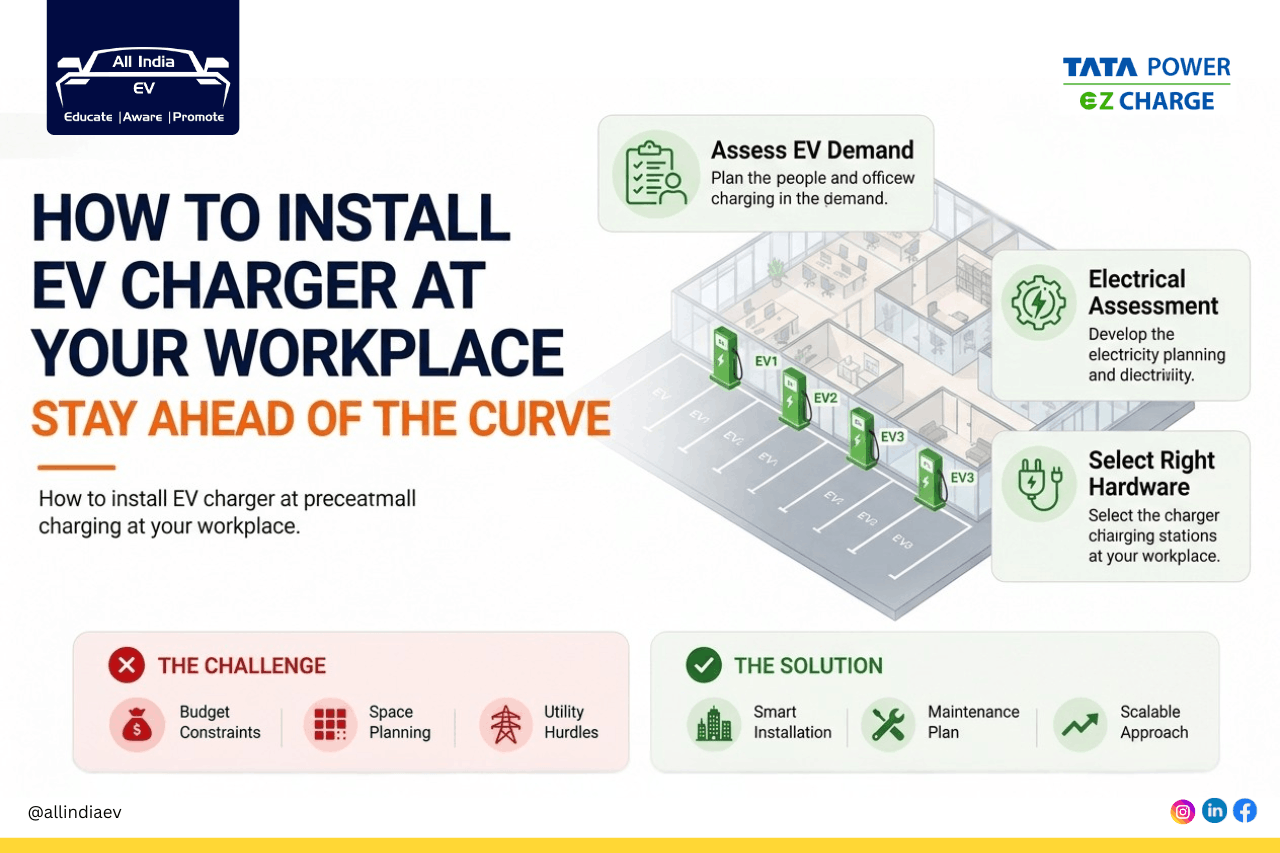
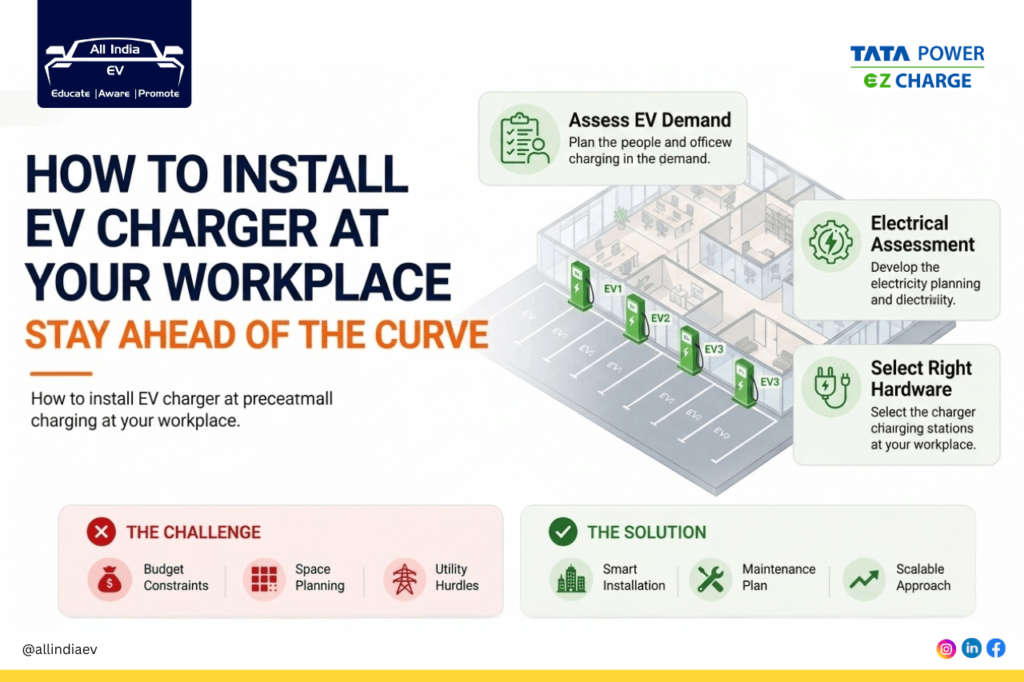
For corporates, workplace charging is gradually becoming part of ESG positioning and employee mobility benefits. Businesses installing EV chargers can improve sustainability metrics while preparing for future electrified employee fleets. At the same time, charging deployment requires careful consideration of sanctioned electrical load, parking layouts, charging hardware selection, and future scalability.
Breaking Down the Update
• Workplace EV charging supports employees who lack dedicated home charging access
• AC Level 2 chargers are currently the most practical office charging format
• Long office parking durations make workplace charging operationally efficient
• Office charging reduces dependency on public charging stations during peak hours
• Grid load management and sanctioned power capacity remain critical planning factors
• Tata Power’s EZ Charge ecosystem is actively expanding commercial and workplace charging solutions
• India’s larger EV charging expansion strategy is increasingly integrating office infrastructure into urban charging networks
• Workplace charging may become a standard employee mobility and ESG offering for large enterprises
How EV Charger Installation at Office will help Indian EV Market
EV Charger Installation at Office can significantly strengthen India’s EV adoption curve by addressing one of the country’s biggest urban mobility barriers — dependable charging access. A large share of urban residents live in apartments or rented accommodations where private charger installation remains difficult. Workplace charging directly bridges this gap.
Office charging also creates predictable daytime energy demand patterns. Since most vehicles remain parked for 7–9 hours, companies can use slower and more grid-friendly AC charging systems instead of expensive fast chargers. This improves infrastructure economics while lowering stress on distribution networks.
For employees, workplace charging reduces range anxiety and dependence on overcrowded public charging stations. This becomes especially important in metro cities where public charger density is still evolving. The convenience factor alone can influence EV purchase decisions among office-going professionals.
From the industry side, workplace charging expands utilization rates for charging operators and supports ecosystem maturity. It also opens opportunities for smart charging systems, energy management software, and eventually vehicle-to-grid integration in commercial buildings.
As India targets large-scale EV penetration by 2030, office charging infrastructure can become one of the most scalable and operationally efficient charging models for urban passenger EV adoption.
Conclusion & Next Steps
The next phase of India’s EV infrastructure expansion will depend heavily on distributed charging access beyond highways and public stations. EV Charger Installation at Office is emerging as a commercially viable and operationally efficient layer within that ecosystem. The key challenge ahead will be execution — including grid readiness, parking integration, charger uptime, and standardized deployment policies across commercial real estate and corporate campuses.
Read More: Catch up on All India EV’s related coverage on India’s evolving commercial EV subsidies and battery swapping policies at All India EV