
All India EVAll India EVAll India EV
Notification
Font ResizerAa
  • Home
  • EV News
  • EV Launch
  • Market Insights
  • Investments & Funding
  • Guest Articles
  • EV Engineering
  • Contact
Reading: EV push could raise import bill faster than it cuts crude oil dependence initially
Share
All India EVAll India EV
Font ResizerAa
  • Home
  • EV News
  • EV Launch
  • Market Insights
  • Guest Articles
  • EV Engineering
  • Contact
Search
  • Home
    • Home 1
    • Home 2
    • Home 3
    • Home 4
    • Home 5
  • Home
  • Categories
    • Electric
  • Categories
  • Shows
    • Rap
  • More Foxiz
    • Blog Index
    • Contact
  • Bookmarks
    • Customize Interests
    • My Bookmarks
  • More Foxiz
    • Blog Index
    • Sitemap
Have an existing account? Sign In
Follow US
EV push could raise import bill faster than it cuts crude oil dependence initially
Home » Blog » EV push could raise import bill faster than it cuts crude oil dependence initially
EV News

EV push could raise import bill faster than it cuts crude oil dependence initially

Piyush
By
Piyush
Last updated: 15 May 2026
Share
5 Min Read
SHARE
EV push could raise import bill faster than it cuts crude oil dependence initially

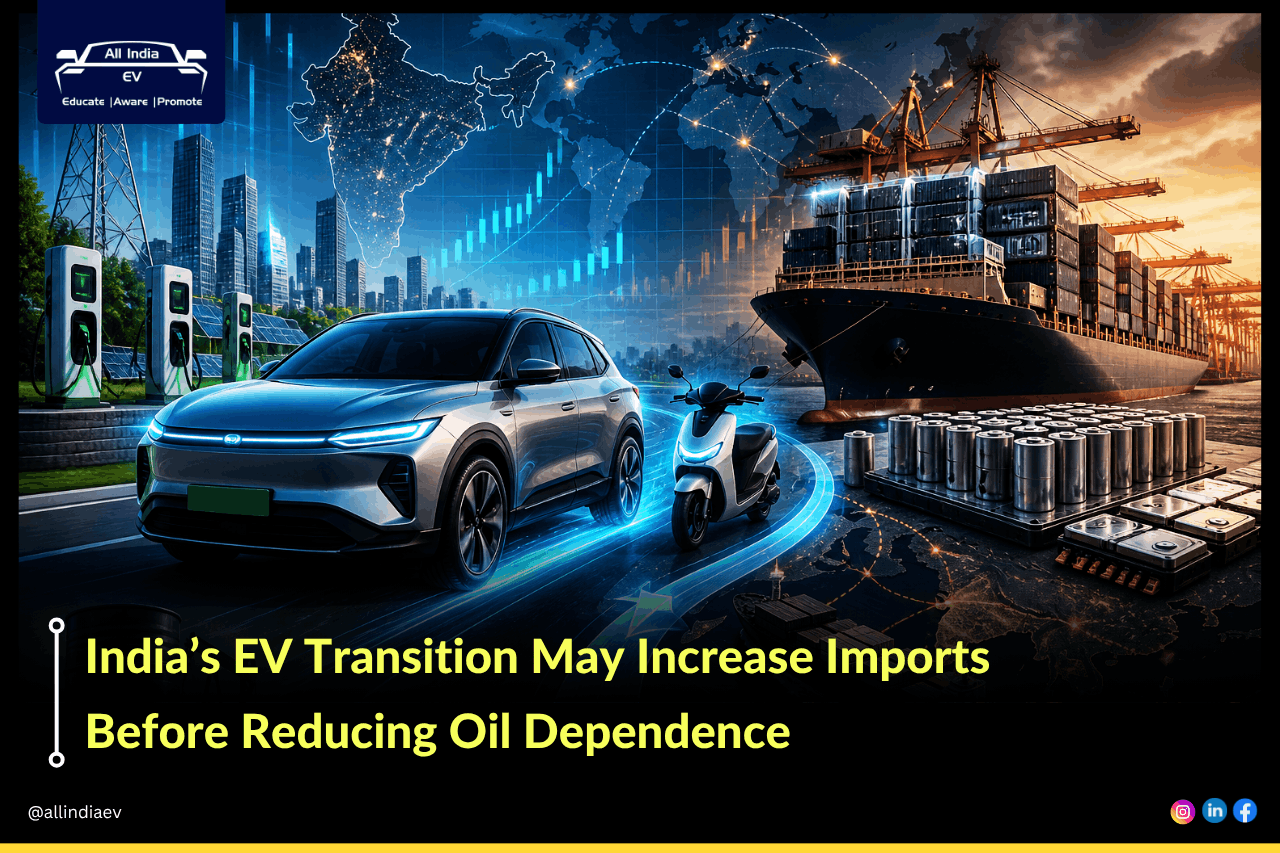
What: India’s aggressive EV transition could increase the country’s import dependence in the short term as battery material and cell imports rise faster than immediate savings from reduced crude oil consumption.

Contents
  • The Core News
  • Breaking Down the Update
  • How EV battery import bill India will help Indian EV Market
  • Conclusion & Next Steps

The Number: At 30% electric passenger vehicle penetration, India’s battery-linked import bill could touch $26.4 billion. At full EV transition levels, imports could rise to nearly $87.9 billion, according to estimates cited in the report.

The Impact: The EV battery import bill India challenge highlights a critical gap in the country’s EV strategy reducing oil imports alone will not

guarantee energy independence unless battery manufacturing and raw material localization scale simultaneously.

The Core News

The EV battery import bill India debate is gaining attention as policymakers push faster electrification to reduce dependence on imported fossil fuels. While electric mobility is expected to lower crude oil consumption over the long term, current supply-chain realities indicate India may initially face a parallel surge in imports linked to lithium-ion batteries, critical minerals, and cell manufacturing components.

The concern becomes more significant as EV penetration accelerates across passenger vehicles and two-wheelers. India’s electric two-wheeler market has already crossed 12.9 lakh annual unit sales with penetration reaching 6.3% of the total segment, while passenger EV adoption remains relatively low at 4.4%. However, scaling these numbers aggressively would substantially increase dependence on imported lithium, nickel, cobalt, graphite, battery cells, and electronic components unless domestic refining and manufacturing ecosystems mature quickly.

This creates a strategic policy dilemma. India currently spends heavily on crude imports, but replacing oil dependency with battery material dependency could simply shift the external trade burden rather than eliminate it. The government has already launched PLI schemes, battery manufacturing incentives, and mineral security partnerships to address this issue, but domestic upstream capacity remains limited. The next phase of India’s EV transition will therefore depend less on vehicle adoption alone and more on how rapidly the country can localize battery chemistry, refining, recycling, and cell production infrastructure.

More EV News
Ather Energy
Ather Energy Faces Delays in ₹26 Crore Incentive Claim Amid Rare Earth Magnet Crunch
The Geopolitical Crossroads: Why India Must Fast-Track Its Transition to Electric Vehicles
Birla Carbon completed the acquisition of Nanocyl SA
BluSmart Secures $24 Million from Current Investors, Founders, and Leadership Squad
Matter Aera Electric Motorcycle Slated for Delivery in Q1 2024

Breaking Down the Update

• EV adoption may initially increase India’s non-oil import exposure
• Battery cells and critical minerals remain heavily import-dependent
• Passenger EV penetration in India currently stands at 4.4%
• Electric two-wheelers have crossed 12.9 lakh annual sales
• A 30% passenger EV penetration scenario could raise battery imports to $26.4 billion
• Full-scale EV transition could push battery-linked imports near $87.9 billion
• Oil import savings may remain relatively smaller during early adoption phases
• Localization of battery manufacturing is becoming strategically critical
• Battery recycling and mineral processing could become major policy focus areas

How EV battery import bill India will help Indian EV Market

The EV battery import bill India challenge could ultimately accelerate the development of India’s domestic EV manufacturing ecosystem. Rising import exposure often forces faster industrial policy execution, and the EV sector is already witnessing stronger focus on battery localization, mineral security, and advanced manufacturing investments.

India’s Production Linked Incentive (PLI) schemes for Advanced Chemistry Cells (ACC) are designed specifically to reduce dependency on imported battery cells over the next decade. As EV demand scales, domestic manufacturers are expected to increase investments in lithium-ion cell assembly, battery pack manufacturing, thermal management systems, and recycling infrastructure.

The situation may also push Indian companies toward alternative chemistries such as LFP batteries and sodium-ion technologies that reduce exposure to expensive imported minerals like cobalt and nickel. Simultaneously, recycling could emerge as a major industry because recovering lithium, nickel, and other materials from used batteries can significantly reduce future import pressure.

For India’s EV market, this transition phase may create short-term trade challenges, but it could also strengthen long-term industrial capability. Companies able to localize battery supply chains early are likely to gain significant cost advantages as EV adoption expands across two-wheelers, passenger cars, commercial fleets, and public transport.

Conclusion & Next Steps

The EV battery import bill India issue underlines that electrification alone is not enough to guarantee energy security. The next stage of India’s EV policy will likely focus heavily on battery manufacturing, recycling, mineral partnerships, and localized supply-chain development. The real test now is whether India can scale EV adoption while simultaneously reducing strategic dependence on imported battery ecosystems.

Read More: Catch up on All India EV’s related coverage on India’s evolving commercial EV subsidies and battery swapping policies at All India EV
Made-in-India Tesla inches closer: Agreement with Musk's co in works
Made-in-India Tesla inches closer: Agreement with Musk’s co in works
BatX Energies and MG Motor India collaborate to launch off-grid solar EV charger using reused batteries
Hubject Partners with Exicom to Enhance EV Charging Experience in India
Erisha E Mobility Inks Deal INR 6,900 Crore for Green Hydrogen and Mega EV Park in Gujarat
Vidyut Raises $10 Million in Series A to Transform EV Ownership for Indian SMBs

Sign Up For Daily Newsletter

Be keep up! Get the latest breaking news delivered straight to your inbox.
Loading
By signing up, you agree to our Terms of Use and acknowledge the data practices in our Privacy Policy. You may unsubscribe at any time.
Share This Article
Facebook Whatsapp Whatsapp LinkedIn Copy Link Print
Leave a Comment

Leave a Reply Cancel reply

Your email address will not be published. Required fields are marked *

Follow US
XFollow
InstagramFollow
YoutubeSubscribe
LinkedInFollow
EV push could raise import bill faster than it cuts crude oil dependence initially
15 May 2026
Musashi India signs LOI with Kinetic Green for 2W EV powertrain supply
15 May 2026
What: Eicher has completed a Kashmir-to-Kanyakumari (K2K) endurance run using its fully loaded Eicher Pro X EV commercial truck, positioning the campaign as a real-world validation of electric logistics capability in India. The company claims the vehicle became the first and fastest electric commercial vehicle to complete the route under loaded operating conditions. The Number: The Eicher Pro X EV covered over 4,000 km in six days across diverse terrain and temperature conditions ranging from approximately -2°C to 40°C, while setting four India Book of Records milestones during the journey. The Impact: The Eicher Pro X EV Kashmir Kanyakumari run directly addresses one of the biggest concerns in India’s electric commercial vehicle segment — operational reliability over long distances. The campaign also highlights the growing viability of public charging infrastructure for commercial EV deployment. The Core News VE Commercial Vehicles, through its Eicher Trucks and Buses division, has launched a proof-focused electric mobility campaign centred around the Eicher Pro X EV’s successful Kashmir-to-Kanyakumari expedition. The campaign, branded around the “#XpertHaiTohPossibleHai” initiative, is aimed at demonstrating practical commercial EV readiness instead of relying solely on specification-based marketing claims. The vehicle reportedly completed the Srinagar-to-Kanyakumari route while operating under fully loaded conditions, travelling through highways, plains, ghats, urban corridors, and varying climate zones. Eicher stated that the vehicle depended on public charging infrastructure accessed through the MyEicher App ecosystem during the expedition. The company used third-party validation through the India Book of Records to independently verify route compliance, charging stops, distance covered, and operational conditions. The campaign reflects a broader shift underway in India’s commercial EV industry, where manufacturers are increasingly focusing on operational economics, fleet confidence, uptime assurance, and infrastructure reliability rather than only announcing vehicle launches. Long-haul and mid-mile logistics remain one of the most difficult electrification segments due to concerns around charging availability, payload impact, range predictability, and route downtime. Eicher’s demonstration appears strategically designed to reduce these concerns for fleet operators evaluating electric truck adoption. Breaking Down the Update • The Eicher Pro X EV completed a Kashmir-to-Kanyakumari expedition under loaded commercial operating conditions • The journey covered more than 4,000 km in six days across multiple terrain conditions • Eicher claims the run established four India Book of Records milestones • Public charging infrastructure was used throughout the route via the MyEicher App ecosystem • The campaign focused on proving operational reliability instead of conventional promotional messaging • The route included highways, mountainous regions, urban corridors, and coastal stretches • The initiative targets commercial fleet operators evaluating electric logistics deployment • The campaign aligns with India’s broader decarbonisation and green logistics objectives How Eicher Pro X EV Kashmir Kanyakumari run will help Indian EV Market The Eicher Pro X EV Kashmir Kanyakumari run could become an important reference point for India’s electric commercial vehicle sector because it focuses on real operational validation instead of controlled test conditions. One of the largest barriers to electric truck adoption in India has been fleet operator hesitation around range reliability, charging access, payload capability, and uptime consistency during long-distance movement. By completing a loaded multi-state logistics route using public charging infrastructure, Eicher is attempting to demonstrate that electric commercial vehicles can gradually move beyond short urban delivery applications into more demanding logistics operations. This is particularly important for India’s mid-mile and intra-city freight segments, where electrification potential remains significant but operational confidence is still developing. The campaign also indirectly highlights improvements in India’s charging infrastructure ecosystem. Commercial EV adoption depends heavily on charger availability, route planning tools, energy management systems, and service support networks. Demonstration runs like this help validate ecosystem readiness for fleet operators who typically evaluate vehicles based on total operational efficiency rather than environmental positioning alone. If more OEMs begin showcasing real-world logistics deployment data instead of laboratory claims, the Indian commercial EV sector could move faster toward practical fleet electrification and wider private-sector adoption. Conclusion & Next Steps The Eicher Pro X EV Kashmir Kanyakumari run reflects a growing maturity in India’s electric commercial vehicle market, where operational proof is becoming more valuable than launch announcements alone. The next challenge will involve scaling charging reliability, lowering fleet transition costs, and ensuring consistent uptime performance under commercial deployment conditions. As electric logistics adoption expands, real-world validation exercises like this are likely to become increasingly important for fleet decision-making across India’s freight sector
Eicher sets new EV benchmark with K2K campaign
15 May 2026
All India EV: Edition 49
What all happened in April 2026?
Click Here
All India EV

Daily EV Industry updates for you…

Categories

  • EV News
  • EV Launch
  • Investments & Funding
  • Market Insights
  • Guest Articles
  • EV Engineering

Quick Links

  • Community
  • Content Services
  • Branding Services
  • My EV Charger
  • Substack

© Developed and Managed by “The Energy Log”

Welcome Back!

Sign in to your account

Username or Email Address
Password

Lost your password?

Not a member? Sign Up