
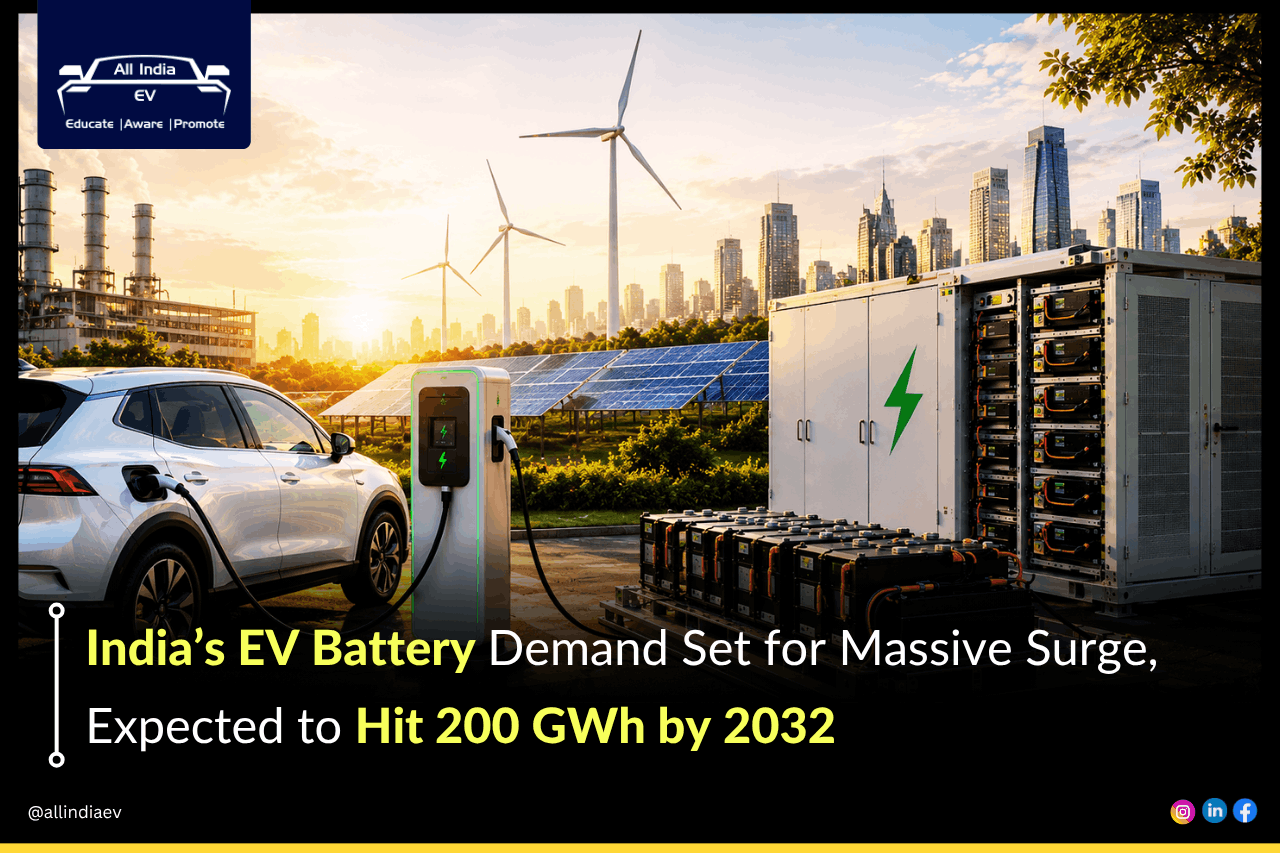

What: India’s EV battery demand to grow 10 times to 200 GWh by 2032: IESA according to a new industry study by the India Energy Storage Alliance (IESA) and Customized Energy Solutions (CES), highlighting rapid expansion in the country’s electric mobility ecosystem.
The Number: India’s EV battery demand is projected to rise from 20 GWh in 2025 to 200 GWh by 2032. EV sales in 2025 have already crossed 2.5 million units, including 1.5 million electric two-wheelers and 0.7 million electric three-wheelers.
The Impact: The projected battery demand surge signals a major industrial opportunity for India in cell manufacturing, localisation, recycling, mineral sourcing, and EV supply chain development.

The Core News
India’s EV battery demand to grow 10 times to 200 GWh by 2032: IESA as the country’s electric mobility transition enters a manufacturing-intensive phase. According to the industry body, India’s battery ecosystem is moving beyond vehicle assembly toward deeper localisation of battery cells, power electronics, and component supply chains. The findings are part of the upcoming “India EV & EV Component Market Outlook 2025-2034” report scheduled to be released during India Energy Storage Week (IESW) in July.
The forecast reflects the rapid acceleration of India’s EV market, particularly in electric two-wheelers and three-wheelers that currently dominate national EV volumes. Rising adoption, stricter emission targets, fuel price volatility, and government manufacturing incentives are collectively driving demand for lithium-ion battery capacity. Industry stakeholders increasingly view batteries not just as an automotive component, but as a strategic industrial sector tied to energy security and clean technology leadership.
IESA also indicated that future growth will depend heavily on advanced battery chemistries, resilient raw material supply chains, and domestic manufacturing capacity. India still relies significantly on imported battery materials and cells, creating strategic vulnerabilities around pricing, logistics, and geopolitical supply risks. The projected scale-up toward 200 GWh could accelerate investments into gigafactories, recycling infrastructure, and critical mineral partnerships over the next decade.
More EV News
Breaking Down the Update
• India’s EV battery demand is projected to rise from 20 GWh to 200 GWh by 2032
• The estimate comes from IESA and Customized Energy Solutions (CES)
• India crossed 2.5 million EV sales in 2025
• Electric two-wheelers remain the largest EV segment in the country
• Localisation and supply-chain resilience are emerging as strategic priorities
• Battery manufacturing is becoming central to India’s EV industrial policy
• Demand growth could trigger new investments in gigafactories and recycling
• Critical mineral sourcing remains a major long-term challenge for India
• Battery demand growth will also increase pressure on charging and energy infrastructure
How India’s EV battery demand to grow 10 times to 200 GWh by 2032: IESA will help Indian EV Market
The projection that India’s EV battery demand to grow 10 times to 200 GWh by 2032: IESA could significantly reshape India’s automotive and energy sectors over the next decade.
A large domestic battery market creates economies of scale for Indian manufacturers, potentially reducing battery pack costs — the single largest expense in an electric vehicle. Lower battery costs can directly improve EV affordability for mass-market consumers, especially in the two-wheeler and small commercial vehicle categories.
The expected growth may also accelerate India’s push for local battery cell production under various PLI and advanced chemistry cell manufacturing schemes. Greater localisation can reduce dependence on imported cells from China and other global suppliers while improving supply security for Indian automakers.
Additionally, rising battery demand can strengthen adjacent industries including recycling, battery management systems, thermal management, charging infrastructure, and raw material processing. This could create a broader EV industrial ecosystem instead of isolated vehicle assembly operations.
From an energy perspective, battery manufacturing growth also supports renewable energy integration and stationary storage deployment. As EV penetration rises, India’s battery ecosystem could become strategically linked to grid balancing, energy storage, and long-term decarbonisation goals.
Way Forward ..
As India’s EV battery demand to grow 10 times to 200 GWh by 2032: IESA, the country now faces a critical execution phase involving manufacturing scale-up, mineral sourcing, recycling capacity, and technology development. The next decade will determine whether India becomes merely a large EV consumption market or evolves into a globally competitive battery manufacturing and clean energy hub.
Read More: Catch up on All India EV’s related coverage on India’s evolving commercial EV subsidies and battery swapping policies at All India EV