

The Quick Update
What Happened
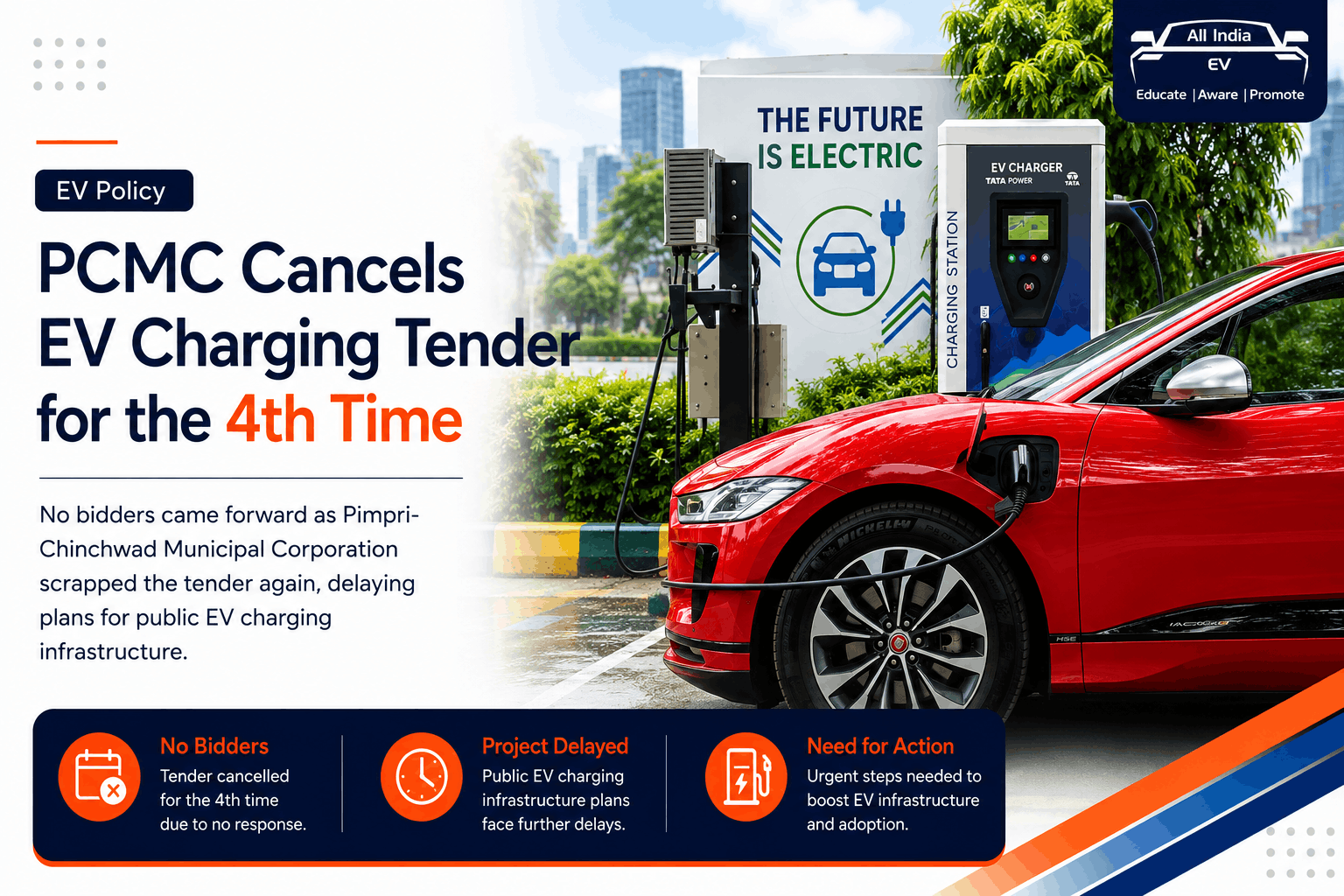
The Pimpri-Chinchwad Municipal Corporation (PCMC) has cancelled its tender to establish public EV charging stations for the fourth consecutive time after receiving no bids from private operators. The civic body now plans to revise the tender conditions before inviting fresh proposals.
The Key Number
Fourth unsuccessful tender attempt since the project was initiated, despite plans to develop charging stations at 21–22 locations across the city.
Why It Matters
The repeated failure highlights the commercial and operational challenges associated with public EV charging projects. While EV adoption continues to grow in Pimpri-Chinchwad, inadequate charging infrastructure could become a bottleneck unless project economics become more attractive for private investors.
The Core News
PCMC EV charging station tender has once again failed to attract private participation, forcing the Pimpri-Chinchwad Municipal Corporation to cancel the bidding process for the fourth time. The project, first proposed in 2022 under a build-own-operate model, aimed to establish a network of public EV charging stations across key locations in the city. However, the latest tender received no bids, prompting the civic body to prepare a revised tender with modified terms and conditions.
The repeated delays come despite a rapid increase in electric vehicle adoption across Pimpri-Chinchwad. The city has around 1.5 lakh registered electric vehicles but only 17 operational private charging stations, most of which are located at petrol pumps and commercial premises. Previous attempts to award the project also faced setbacks, including one selected bidder withdrawing before work commenced and earlier contracts failing to progress beyond the approval stage.
The latest development underscores a broader challenge facing India’s charging infrastructure sector. While government policies encourage EV adoption, charging projects must also offer commercially viable business models for private operators. The outcome of the revised PCMC EV charging station tender could provide valuable insights into how municipal authorities can structure public-private partnerships to accelerate charging infrastructure deployment in rapidly growing urban EV markets.
Breaking Down the Update
- Authority: Pimpri-Chinchwad Municipal Corporation (PCMC)
- Project: Public EV charging station network
- Tender Status: Cancelled for the fourth consecutive time
- Reason: No bidders participated in the latest tender
- Project Model: Build, Own, Operate (BOO)
- Proposed Locations: 21–22 sites across the city
- Current Public Infrastructure: Only 17 private charging stations operational
- Registered EVs: Approximately 1.5 lakh in Pimpri-Chinchwad
- Next Step: PCMC will revise tender terms and issue fresh bids
- Objective: Expand public charging infrastructure to support rising EV adoption.
How PCMC EV charging station tender Will Help the Indian EV Market
The challenges faced by the PCMC EV charging station tender highlight an important reality of India’s EV transition: infrastructure deployment depends not only on policy support but also on commercially sustainable business models. While vehicle adoption continues to accelerate, charging infrastructure projects require predictable demand, attractive revenue opportunities and supportive regulatory frameworks to encourage private investment.
For municipal corporations, the experience demonstrates the need to balance public objectives with commercial viability. Revising concession terms, improving land allocation policies and offering incentives could make future charging projects more attractive to operators while accelerating deployment.
A successful charging network in Pimpri-Chinchwad would significantly benefit local EV owners by reducing range anxiety and improving access to public charging. It could also serve as a replicable model for other Indian cities planning similar infrastructure through public-private partnerships.
As India’s EV market expands, overcoming these implementation challenges will be critical to ensuring that charging infrastructure grows in parallel with electric vehicle adoption, enabling a smoother transition toward sustainable urban mobility.
Conclusion & Next Steps
The repeated cancellation of the PCMC EV charging station tender reflects the practical challenges of developing public charging infrastructure despite strong EV adoption. The success of the revised tender will depend on whether updated commercial terms can attract experienced charging operators. For India’s EV ecosystem, the outcome will be closely watched as cities increasingly rely on public-private partnerships to bridge the charging infrastructure gap and support long-term electric mobility growth.