

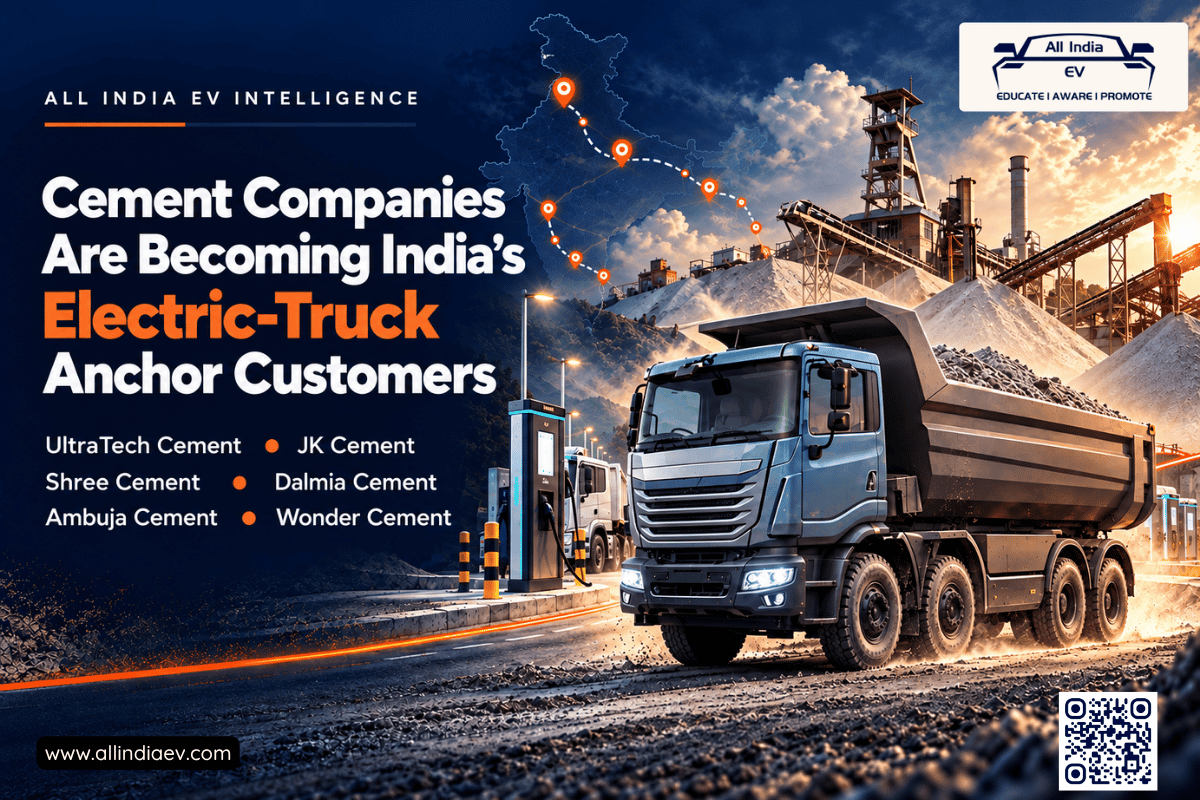
From a five-truck route trial in 2024 to multi-company fleet contracts in 2026, electric trucks in India’s cement industry have become heavy electric freight’s most credible early market. The catch: trucks promised are not trucks running.
- Electric trucks in India’s cement industry: the transition, year by year
- Cement electric trucks in India: announced versus running
- Why cement is an early market for electric trucks in India
- What the 2026 electric truck numbers in cement really mean
- How investment in cement electric trucks is changing
- Electric truck deals in cement: MoU, contract, flag-off and fleet
- Why financiers matter for electric trucks in India
- Policy for electric trucks in India: support is real, eligibility matters
- 2027 outlook for electric trucks in India’s cement industry: three cases
- Base case: more contracted corridors
- Upside case: a replicable freight service
- Constraint case: trucks wait for infrastructure or utilisation
- What we will track in India’s cement electric-truck market
All India EV Intelligence Research Desk
Electric trucks in India’s cement industry have moved from a pilot to a proving ground for heavy freight. UltraTech’s 600-plus-truck target, JK Cement’s 150-plus programme and Wonder Cement’s 250-truck commitment show serious buying intent. None of them yet establishes a fleet of that size on the road.
89UltraTech electric trucks operating as of FY26
600+UltraTech target by December 2026, across seven states
~5 mn tAnnual material UltraTech says a full fleet would carry
₹9.6 lakhMaximum PM E-DRIVE incentive per eligible truck
Electric trucks in India’s cement industry: the transition, year by year
| Period | What the evidence shows | What changed |
|---|---|---|
| 2024 Prove the route | UltraTech introduced 5 electric trucks moving clinker between Dhar (Madhya Pradesh) and Dhule (Maharashtra), with three charging stations including one en route. In November it signed a service contract for about 100 trucks on the same roughly 400 km round trip. That 100 was a contracted deployment, not an operating count. | A cement producer could test vehicles, charging and drivers on a repeatable industrial route. |
| 2025 Build the operating model | UltraTech had announced an ambition of 500 trucks by June 2025, but its FY25 account describes a contract for about 100. Ashok Leyland began delivering 24 trucks to ASAT Logistics, a Shree Cement transport partner; 4 were handed over by October. The government launched its electric-truck incentive in July. | Procurement spread to truck makers, logistics firms and cement offtakers sharing the task. |
| 2026 Expand across routes | UltraTech reported 89 operating trucks at FY26 and began deploying 45 on a Rajasthan–Delhi-NCR clinker route in June, then announced contracts toward 600-plus. JK Cement and BillionE announced 150-plus, starting at Muddapur. Wonder Cement and Montra announced about 250, with 30 flagged off. Dalmia’s partner DRIVN flagged off 30 in Assam on 10 September. | Electric trucking moved from one corridor toward several cement networks, at very different maturity levels. |
| 2027 Execution test | The 2026 contracts create a potential step-up, if trucks, chargers, grid connections and contracts arrive on schedule. No verified industry-wide 2027 forecast emerges from company disclosures. | The measure becomes tonnes moved and cost per tonne, not summed targets. |
The reality check is UltraTech. Its earlier goal was 500 trucks by June 2025; its later disclosure reported 89 as of FY26. That does not invalidate the business case. It shows why a target must never be charted as a deployment. The new 600-plus goal implies a steep acceleration that must be checked against later operating disclosures.
Cement electric trucks in India: announced versus running
| Programme | Numbers | Status | Signal |
|---|---|---|---|
| UltraTech | 600+ by Dec 2026 | 89 operating at FY26; 45 deploying on Rajasthan–NCR route | Target |
| Wonder Cement / Montra | ~250 trucks | 30 initially flagged off; corridor plans 13 charging stations, 39 chargers | Commitment |
| JK Cement / BillionE | 150+ this financial year | Initial Muddapur rollout (JK: 18 flagged off; BillionE: 20) | Programme |
| Shree Cement / ASAT | 24 trucks | First 4 delivered by October 2025 | Delivery |
| Dalmia / DRIVN | 30 trucks | 30 flagged off in Assam, 10 Sep 2026 | Flag-off |
| Ambuja | Not disclosed | FY26 report describes EV pilots, no operating fleet count | Pilot |
JK Cement’s 18 and BillionE’s 20 may reflect different dates or batches. They should be reconciled with the companies before any single operating count is published.
Why cement is an early market for electric trucks in India
Cement is an early customer for electric trucks in India because it offers large, recurring loads between known locations.
UltraTech’s first route linked a clinker plant to a grinding unit; its 2026 northern route links an integrated plant with grinding units over a 250 km lead distance.
A defined route lets operators plan charging, trip timing, driver training and maintenance around a contracted flow of material. This is our analysis of why deployments are appearing here, not a published industry-wide cost comparison.
The commercial structure matters as much as the truck. Cement companies commit freight volumes while specialist partners arrange vehicles, charging, finance and operations. Shree Cement’s truck order sits with its logistics partner, ASAT. JK Cement uses BillionE’s electric-mobility service model. How costs and risks are split in each contract is not public.
What the 2026 electric truck numbers in cement really mean
UltraTech says a fully operating 600-plus fleet would carry about five million tonnes a year across seven states, displace the equivalent of 39 million litres of diesel, and cut net emissions by more than 117,000 tonnes of CO₂ annually. These are company projections conditional on full deployment, not measured 2026 savings.
How investment in cement electric trucks is changing
| Company | Participants | Publicly visible commitment |
|---|---|---|
| UltraTech, 2024 | Service contract, ~100 trucks, Dhar–Dhule | Three pilot charging stations; proposed 75,000 tonnes of clinker a month. No contract value disclosed. |
| Shree Cement chain, 2025 | Ashok Leyland → ASAT Logistics | Logistics firm is the vehicle customer. Price, financing and charging investment not disclosed. |
| UltraTech, 2026 | Tata Motors, Ashok Leyland, IPLTech, EIM, Sany and logistics providers | Five million tonnes a year across seven states. No capex, vehicle price or charger split published. |
| JK Cement, 2026 | BillionE (trucks, operations, routes); ChargeZone (corridor charging) | Charging and fleet capacity bundled; rupee investment undisclosed. |
| Wonder Cement, 2026 | Montra Electric, Rhino trucks, Rajasthan to Dahej and Tuna ports | 13 charging stations, 39 chargers; investment and financing undisclosed. |
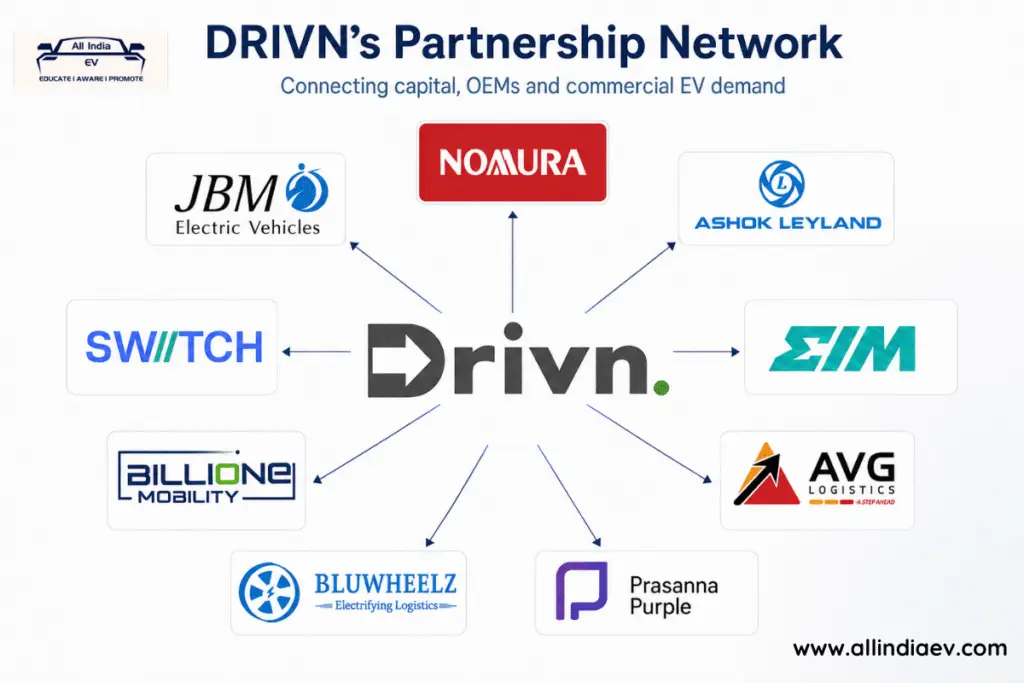
| Dalmia, 2026 | Dalmia (freight), AVG Logistics (service), IPLTech (OEM), DRIVN (finance) | DRIVN says it arranged 100% financing for the 30-truck project; no rupee amount given. |
Editorial rule: we do not attach an estimated ₹-crore “investment” to these programmes by multiplying truck counts by a retail price. Ownership, service, charging and financing differ deal by deal. Trucks and chargers committed are visible far more often than capital actually invested.
Electric truck deals in cement: MoU, contract, flag-off and fleet
- MoU: intent to collaborate. Ashok Leyland and DRIVN signed one in August 2026 on financing, leasing and fleet ownership; it names no committed cement-truck count or disbursed loan.
- Transport service contract: a freight relationship, though trucks may still await delivery. UltraTech’s roughly 100-truck Dhar–Dhule contract is the clearest example.
- Flag-off or first delivery: an initial milestone, not proof the whole programme is running or well utilised.
- Operating fleet: the strongest measure, ideally with tonnes, trips, kilometres, charger uptime and freight cost. UltraTech’s 89 at FY26 says more than its 600-plus target.
The cement deals above are service contracts and commercial partnerships. They should not be collectively called “MoUs between cement companies and truck makers” without an MoU for each named pair.
Why financiers matter for electric trucks in India
Switching from diesel to electric means someone must fund a costlier vehicle before operating savings arrive. That opens a role for financiers and fleet operators:
- the cement company supplies the route and recurring freight;
- the logistics provider runs trucks against a contract;
- the financier or lessor supplies vehicle capital;
- the OEM supplies vehicles, warranty and service; the charging partner supplies power access.
The Dalmia and JK Cement models show this risk-sharing in practice. Neither disclosure proves delivered cost per tonne already beats diesel.
Policy for electric trucks in India: support is real, eligibility matters
| Policy | What it offers | Limit for cement freight |
|---|---|---|
| PM E-DRIVE truck incentive (July 2025) | Up to ₹9.6 lakh per eligible N2/N3 electric truck as an upfront price cut; ₹500 crore central allocation. Requires scrapping an old truck; sets battery and vehicle warranty terms. | A cement contract does not establish eligibility. Category, certification and scrappage must be checked per vehicle. |
| Maharashtra EV Policy 2025 | Up to ₹20 lakh each for the first 1,000 eligible heavy electric goods vehicles registered in the state. | Applies to state registration and policy conditions, not to any truck merely passing through. |
| Delhi–NCR PARIVARTAN (approved June 2026) | Replacement of older trucks and buses; 5% loan interest subvention for five years; state tax or registration concessions. | A conditional replacement scheme for eligible NCR-registered vehicles, not a general clinker-truck subsidy. |
2027 outlook for electric trucks in India’s cement industry: three cases
Base case: more contracted corridors
Producers and transport partners add trucks on routes with predictable freight and dependable charging. Public operating counts rise more slowly than contract announcements.
Upside case: a replicable freight service
If the big 2026 programmes deliver reliable availability, fast charging turnaround and competitive delivered cost per tonne, logistics providers can sell a proven service across more plants. UltraTech’s multi-state fleet is the key test, and its December 2026 target still needs verification.
Constraint case: trucks wait for infrastructure or utilisation
A vehicle can be ordered before its route has dependable charging and enough daily trips. A subsidy can ease upfront cost, but it cannot create workable route economics.
Our thesis: 2027 will test whether electric trucks in India’s cement industry can become a financeable freight category. Winners will be routes where a cement company guarantees freight, operators achieve high utilisation, chargers stay available at loading or rest points, and a lender can read predictable cash flows.
What we will track in India’s cement electric-truck market
| Measure | Why it matters |
|---|---|
| Trucks contracted / delivered / operating | Shows conversion from announcement to service |
| Capital provider and contract length | Shows who carries vehicle and charger risk |
| Charger count, power, uptime, queue time | Shows whether a corridor can sustain daily freight |
| Loaded and empty km per truck per day | Tests utilisation and route economics |
| Tonnes carried; delivered cost per tonne | Tests the cement buyer’s commercial case |
| Subsidy received, if any | Separates policy-supported from underlying economics |
| Measured electricity use and emissions method | Tests environmental claims against real operation |
For electric trucks in India’s cement industry, the question is whether cement is creating a repeatable electric-freight market or accumulating ambitious announcements. Trucks contracted, delivered, operating, and tonnes actually carried will tell us which.