

All India EV Intelligence | Powertrain Series — Part 3
India’s motor industry faces two connected challenges: securing the magnets used in today’s vehicles and developing technologies that need fewer critical materials tomorrow.
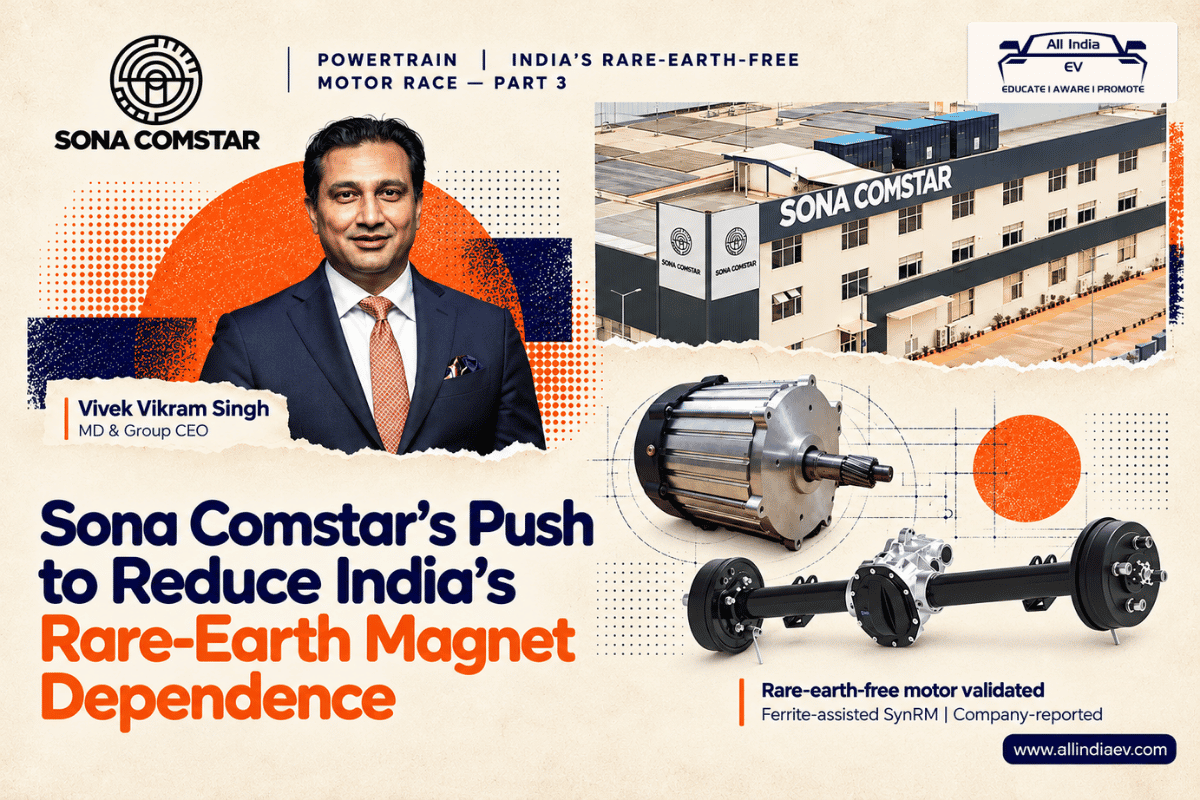
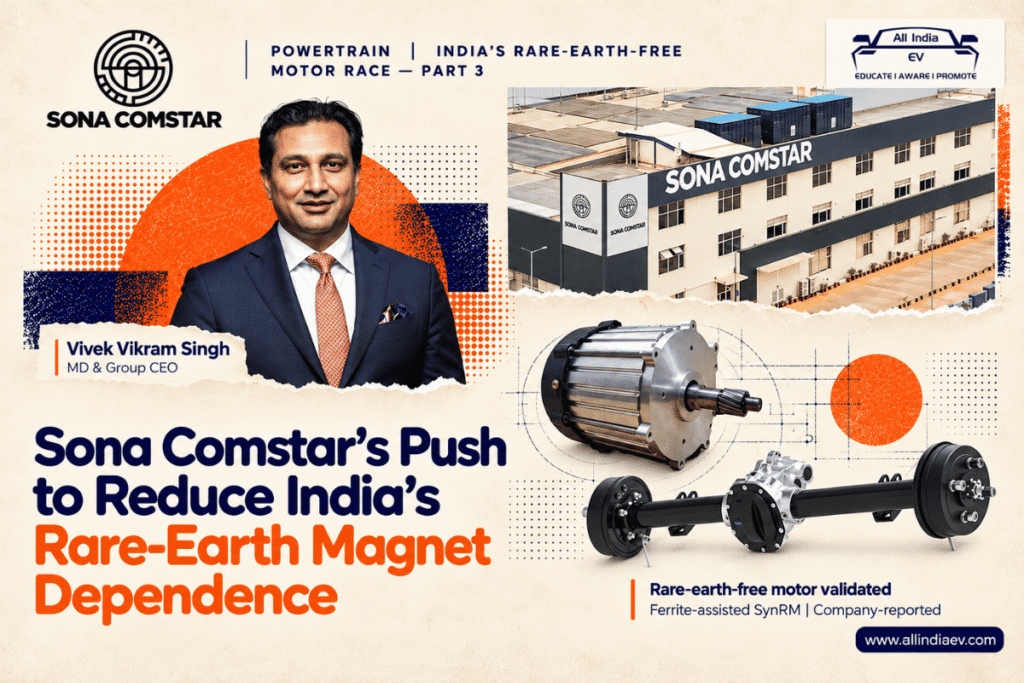
Sona Comstar is working on both the immediate engineering response and a longer-term alternative. It has shifted its existing motor business towards light rare-earth alternatives and developed a rare-earth-free, ferrite-assisted synchronous reluctance motor. These are different achievements—and understanding that difference is essential to assessing its contribution to India’s industrial independence.
The evidence shows meaningful progress. It does not yet establish that Sona’s entire motor portfolio is rare-earth-free, or that the company has created a fully independent domestic magnet supply chain.
An established supplier with the capacity to industrialise new technology
Sona Comstar, formally Sona BLW Precision Forgings, is a Gurugram-headquartered mobility technology company supplying drivetrain components, motors and related systems. Its importance in this debate comes from its existing manufacturing business and customer relationships.
For FY2025–26, the company reported revenue of ₹4,475.1 crore and battery-electric-vehicle revenue of ₹1,154.2 crore. BEVs accounted for 35% of automotive revenue. That denominator matters: the percentage should not be presented as BEVs’ share of total consolidated revenue, which includes other businesses.
Its latest reported quarterly results, for April–June 2026, or Q1 FY2026–27, show continued expansion:
| Indicator | Q1 FY2026–27 |
|---|---|
| Consolidated revenue | ₹1,310 crore |
| Revenue growth | 54% year-on-year |
| EBITDA | ₹303 crore |
| Profit after tax | ₹181 crore |
| BEV revenue growth | 107% year-on-year |
| BEV share of automotive revenue | 44% |
These figures describe the wider company, rather than sales specifically attributable to its rare-earth-free motor. Nevertheless, they establish that Sona’s alternative-motor work sits within a substantial operating business.
The first response: remove the dependence on heavy rare earths
During its 23 July 2026 earnings call, management said almost all its current work used light rare-earth alternatives. It also stated that the shift had addressed the magnet shortage affecting its traction-motor business.
This is a significant supply-risk response, but its meaning must remain precise.
Heavy-rare-earth-free does not mean rare-earth-free. A motor can avoid heavy rare-earth materials while continuing to use light rare-earth magnets. Nor does changing the material automatically establish independence from Chinese processing or magnet manufacturing.
For All India EV Intelligence, the distinction is between reducing exposure to a particular supply restriction and eliminating the broader dependency. Sona’s reported shift supports the first conclusion. Its disclosures do not establish the second.
The deeper alternative: a motor without rare-earth magnets
In October 2025, Sona announced that it had developed, tested and validated a ferrite-assisted synchronous reluctance motor, targeting electric three-wheelers and light commercial vehicles. The company described the design as developed entirely in-house.
Its disclosed specifications were:
| Parameter | Disclosed range |
|---|---|
| Nominal voltage | 48–115 V |
| Rated power | 5–20 kW |
| Rated torque | 10–30 Nm |
| Maximum speed | 5,000–12,000 rpm |
| Cooling | Air-cooled |
The company also claimed advantages in drive-cycle efficiency, thermal performance, noise and vibration, and high-speed operation. These remain manufacturer claims; the disclosure does not provide a complete independently verified comparison across operating conditions.
The terminology carries an important lesson from our Chara article: rare-earth-free is not necessarily magnet-free. Sona’s architecture uses ferrite assistance while removing rare-earth magnets.
Its strategic promise is therefore demand reduction. Where such a motor meets an OEM’s requirements, the vehicle can avoid needing rare-earth magnets in its traction motor. That offers a different route to resilience from finding another supplier for the same component.
The commercial question remains open
Sona’s Q1 FY2026–27 presentation reported 69 awarded EV programmes across 36 customers, covering its wider EV portfolio. It also disclosed two electric-two-wheeler hub-motor programmes adding ₹90 crore to its order book. These figures should not be labelled orders for its ferrite-assisted motor without a specific company disclosure establishing that connection.
That leaves several milestones to watch: a named production programme, vehicle-level validation, manufacturing volumes, field performance and the economics of the complete motor-controller system.
Our assessment is that validated development creates an industrial option; sustained customer deployment determines its impact on import dependence.
DENSO adds another dimension to the powertrain strategy
In July 2026, Sona announced a partnership with Japan’s DENSO involving two proposed joint ventures.
The two- and three-wheeler venture envisages 51% ownership and management control for Sona, using its technology. The high-voltage venture for passenger and commercial vehicles envisages 51% ownership and management control for DENSO, using DENSO technology. The partnership covers a broader range of motors, inverters, generators and electric powertrain systems.
The editorial significance is the combination of domestic engineering and international industrial collaboration. It could strengthen Sona’s ability to serve more vehicle categories and customers. However, the partnership announcement itself does not establish that these products will all use rare-earth-free designs.
Government support: distinguish motor localisation from magnet manufacturing
There is documented support for Sona through PLI-Auto. Its FY2025–26 Board’s Report says it received certification for three additional products: two electric-three-wheeler traction motors and one electric-two-wheeler traction motor, enabling access to incentives under the scheme’s conditions. This establishes product certification, rather than a quantified grant for its ferrite-assisted technology.
Separately, India’s ₹7,280-crore rare-earth permanent magnet scheme targets 6,000 tonnes per year of integrated manufacturing capacity. The government’s March 2026 announcement identified ₹750 crore in capital subsidy and ₹6,450 crore in sales-linked incentives, alongside limited assured NdPr oxide supply from IREL for three selected bidders. These are scheme-wide provisions.
The latest published bidder list reviewed for this article is particularly important. On 13 August 2026, the Ministry of Heavy Industries announced 20 bids. Sona Comstar was not named on that list. The published list therefore does not support describing Sona as a direct beneficiary of this magnet-manufacturing tender.
For India, these policies and technologies can complement one another: domestic magnet production addresses supply, while alternative motors can reduce demand for those magnets.
What This Means
Sona Comstar’s contribution is already visible in its engineering response to heavy rare-earth restrictions and its development of a fully rare-earth-free motor architecture.
The next test is measurable industrial substitution. How many vehicles adopt the alternative? What performance and cost do OEMs achieve? How much imported magnet demand does deployment actually remove?
India’s independence will be built through both material capability and motor-design capability. Sona has demonstrated progress in the latter. The scale of its contribution will depend on converting that engineering into repeatable production.