
All India EVAll India EVAll India EV
Notification
Font ResizerAa
  • Home
  • EV News
  • EV Launch
  • Market Insights
  • Investments & Funding
  • Guest Articles
  • EV Engineering
  • Contact
Reading: Battery Energy Storage Systems (BESS) and India’s Energy Future
Share
All India EVAll India EV
Font ResizerAa
  • Home
  • EV News
  • EV Launch
  • Market Insights
  • Guest Articles
  • EV Engineering
  • Contact
Search
  • Home
    • Home 1
    • Home 2
    • Home 3
    • Home 4
    • Home 5
  • Home
  • Categories
    • Electric
  • Categories
  • Shows
    • Rap
  • More Foxiz
    • Blog Index
    • Contact
  • Bookmarks
    • Customize Interests
    • My Bookmarks
  • More Foxiz
    • Blog Index
    • Sitemap
Have an existing account? Sign In
Follow US
Home » Blog » Battery Energy Storage Systems (BESS) and India’s Energy Future
EV News

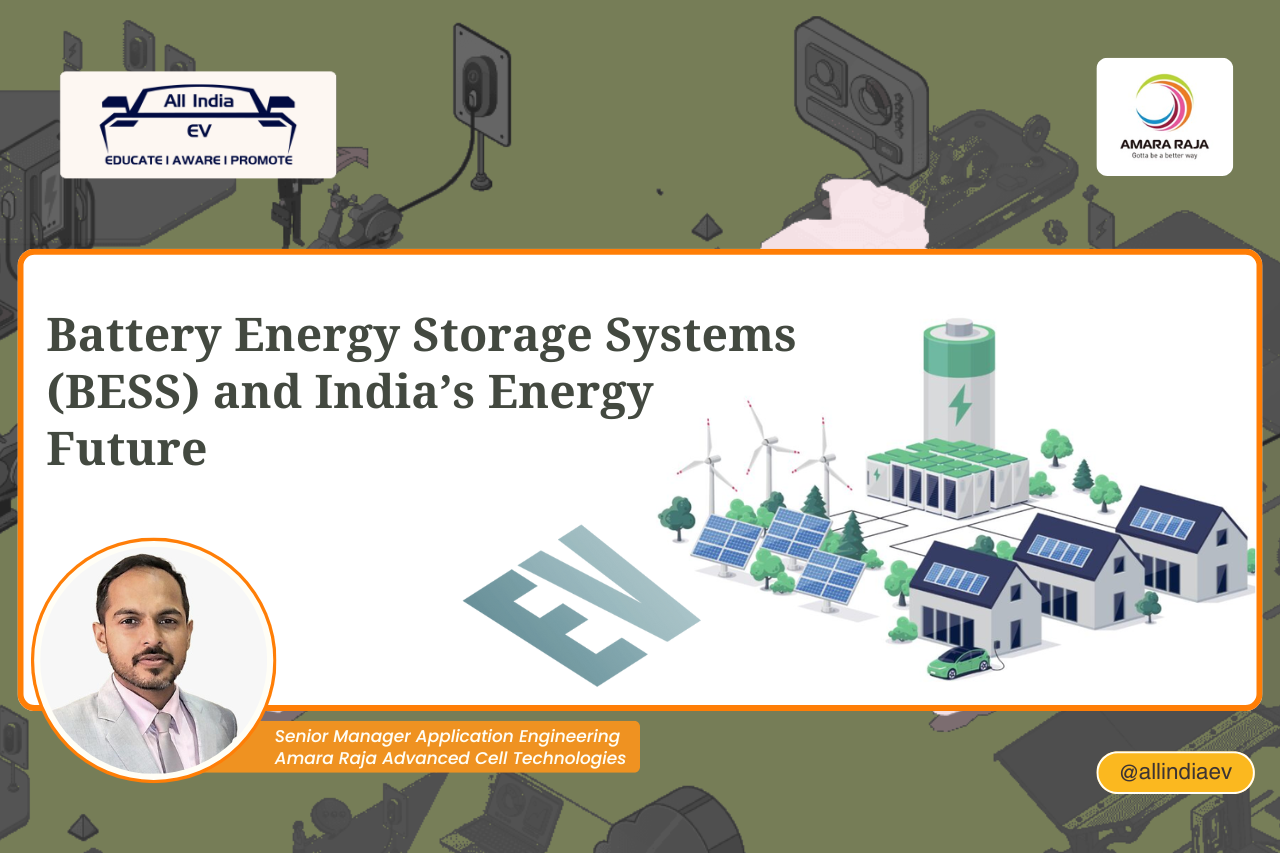
Battery Energy Storage Systems (BESS) and India’s Energy Future

Sunita
By
Sunita
Last updated: 9 September 2025
Share
6 Min Read
SHARE

India’s clean energy transition is accelerating, with ambitious goals of achieving 50% non-fossil installed capacity by 2030. This vision cannot succeed without large-scale energy storage. Battery Energy Storage Systems (BESS) provide the crucial flexibility: they capture excess solar and wind power when available and release it when needed.

This article explores India’s BESS ecosystem – tracing its history, present status, and outlook till 2035 – across the full value chain: from raw materials to manufacturing, skills, applications, policies, and the role of digitalization and AI. It also highlights Indian companies and startups, with a special focus on Amara Raja, as the nation gears up to build a world-class battery industry.


1. The Evolution of Energy Storage

  • Early Era: India’s first large-scale storage was pumped hydro (≈6.4 GW installed; ~61 GW potential). For decades, lead–acid batteries dominated in telecom, UPS, and small solar applications.
  • Global Breakthrough: The 1990s brought lithium-ion batteries (Li-ion), initially for consumer electronics and later EVs.
  • Today: With prices down nearly 90% in the last decade, Li-ion now underpins both EVs and stationary BESS. Utility-scale projects like the 20 MW/40 MWh Delhi system (2025) supply 4-hour backup for ~12,000 homes.
  • Tomorrow: Flow, sodium-ion, and solid-state batteries are emerging for long-duration storage, but Li-ion will remain dominant through 2035.

2. Technologies in Use

Battery TypeEnergy DensityCycle LifeCost (₹/kWh)Applications
Lithium-ion (LiB)150–250 Wh/kg3,000–5,000+15k–20kGrid BESS, EVs, Hybrid RE
Lead–Acid30–40 Wh/kg500–1,0006k–8kUPS, Telecom, Legacy solar
Flow (Vanadium)15–35 Wh/L>10,00025k–30kUtility-scale, Long-duration
Sodium (Na-ion/NaS)~100–150 Wh/kg3,000–5,00010k–12kEmerging; abundant sodium

Key Trend: **Li-ion holds 63% share of India’s BESS market **, but sodium-ion and flow may gain ground for longer-duration needs.


3. The BESS Value Chain

a) Raw Materials & Sourcing

More EV News

Ultraviolette secures
Ultraviolette Secures Million Funding with Strategic Investment from TDK Ventures
How Ola is Launching Electric Scooters with Gen 3 Platform
India’s EV Boom Faces Energy Roadblocks: Can Green Power Keep Up?
India’s Turno Secures $6M in Series-A Extension Funding Round Co-Led by British and Quona Capital
Honda Unveils Aggressive India Growth Plan: 10 New Models, 7 SUVs, and the Zero Series EV by 2030
  • Imports: India imports ~80% of Li-ion cells, mainly from China.
  • Domestic Reserves: Lithium reserves in Rajasthan & J&K could meet ~80% of national demand.
  • Recycling: 2022–23 Battery Waste Rules mandate 70–90% recovery, creating a circular economy.

b) Manufacturing

  • PLI Scheme (ACC): ₹18,100 Cr incentives for 50 GWh capacity.
  • Gigafactories: Reliance, Ola, Amara Raja, Exide, Tata building multi-GWh plants.
  • Example – Amara Raja: ₹9,500 Cr Telangana gigafactory (16 GWh cells, 5 GWh packs); Phase-1 (2 GWh cells, 5 GWh packs) underway.

c) Skills & Tools

  • Dry rooms, electrode coaters, formation testers, and AI-enabled BMS testbeds.
  • Training programs at IITs and private centres to skill technicians.

4. Applications of BESS

  • Grid Balancing: Shifting solar output to evening peak; frequency/voltage support.
  • Hybrid Plants: RE + storage for “round-the-clock” renewable power.
  • C&I Sector: Peak shaving, UPS for hospitals, data centres, telecom towers.
  • EV Charging: Stationary BESS buffers fast-charging hubs.
  • Off-grid & Microgrids: Solar + storage villages in UP/Bihar cut diesel use by ~60% with AI control.

5. Industry, Startups & Case Studies

  • Amara Raja: Transitioning from lead–acid to Li-ion. Partnered with Gotion and InoBat (Slovakia) for LFP/NMC cell tech
  • Exide: 4 GWh Li-ion plant (expandable to 12 GWh) and global tie-ups (SVolt)
  • Tata Group: Pilots in cells and large-scale BESS with NTPC.
  • Startups:
    • Log9 Materials – fast-charging Li-ion packs, scaling to 1 GWh
    • GODI India – NMC811 cells, 275 Wh/kg
    • Nsure – 1 GWh LFP plant
    • Ampere Hour Energy – containerized BESS solutions.

Case Study: Delhi BESS (20 MW/40 MWh) – reduced power cost ~55% and provided reliable supply to low-income consumers.

6. Policies & Regulation

  • PLI-ACC (2021): Incentives for 50 GWh domestic capacity.
  • National ESS Framework (2023): Official recognition of storage as infrastructure.
  • Energy Storage Obligations: Storage included in RPOs.
  • Viability Gap Funding: 20–40% subsidy for 4 GWh projects.
  • Transmission Waiver (2025): No ISTS charges for storage-dispatched energy.

7. Digitalization & AI

  • Smart BMS: AI-based algorithms optimize charge/discharge, extending life.
  • Predictive Maintenance: Digital twins forecast failures, cut downtime.
  • Energy Forecasting: ML predicts solar/wind output for better dispatch.
  • Microgrids: AI-led scheduling reduced diesel use by ~60%.
  • Blockchain & IoT: Enable peer-to-peer energy trades and fast-response markets.

8. Outlook to 2035

  • Capacity Growth: From ~1 GWh today to 50–100 GW by 2035.
  • Technologies: Solid-state Li, sodium-ion, hydrogen integration.
  • Economics: BESS tariffs approaching gas peaker parity (~₹5/kWh).
  • Industry Role: Indian firms (Amara Raja, Exide, Tata) becoming global exporters.
  • Workforce: Thousands of trained engineers in cell design, AI-enabled operations.

Conclusion

Battery Energy Storage is the linchpin of India’s renewable future. From raw material security to AI-driven smart grids, every element of the ecosystem is evolving. With Amara Raja and startups at the forefront, and strong policy support, India is poised not just to adopt but to lead the global BESS revolution by 2035.

Join All India EV Community

Click here for more such EV Updates

TPEM aims to set up 10K+ Charging Stations by FY25 in Collaboration with Charge Point Operators
Revfin and Bajaj Auto Join Forces for Electric Three-Wheeler Opportunities
Delhi’s EV network hits 10,000+ chargers in a record surge
ElectroRide Partners with Battery Smart to Establish 2,500 Battery Swapping Stations Across India
BS6, CNG & EV Commercial Vehicles to Enter Delhi from Nov 1: CM Rekha Gupta Announces Major Clean Air Push

Sign Up For Daily Newsletter

Be keep up! Get the latest breaking news delivered straight to your inbox.
Loading
By signing up, you agree to our Terms of Use and acknowledge the data practices in our Privacy Policy. You may unsubscribe at any time.
Share This Article
Facebook Whatsapp Whatsapp LinkedIn Copy Link Print
Leave a Comment

Leave a Reply Cancel reply

Your email address will not be published. Required fields are marked *

Follow US
XFollow
InstagramFollow
YoutubeSubscribe
LinkedInFollow
EV push could raise import bill faster than it cuts crude oil dependence initially
15 May 2026
Musashi India signs LOI with Kinetic Green for 2W EV powertrain supply
15 May 2026
What: Eicher has completed a Kashmir-to-Kanyakumari (K2K) endurance run using its fully loaded Eicher Pro X EV commercial truck, positioning the campaign as a real-world validation of electric logistics capability in India. The company claims the vehicle became the first and fastest electric commercial vehicle to complete the route under loaded operating conditions. The Number: The Eicher Pro X EV covered over 4,000 km in six days across diverse terrain and temperature conditions ranging from approximately -2°C to 40°C, while setting four India Book of Records milestones during the journey. The Impact: The Eicher Pro X EV Kashmir Kanyakumari run directly addresses one of the biggest concerns in India’s electric commercial vehicle segment — operational reliability over long distances. The campaign also highlights the growing viability of public charging infrastructure for commercial EV deployment. The Core News VE Commercial Vehicles, through its Eicher Trucks and Buses division, has launched a proof-focused electric mobility campaign centred around the Eicher Pro X EV’s successful Kashmir-to-Kanyakumari expedition. The campaign, branded around the “#XpertHaiTohPossibleHai” initiative, is aimed at demonstrating practical commercial EV readiness instead of relying solely on specification-based marketing claims. The vehicle reportedly completed the Srinagar-to-Kanyakumari route while operating under fully loaded conditions, travelling through highways, plains, ghats, urban corridors, and varying climate zones. Eicher stated that the vehicle depended on public charging infrastructure accessed through the MyEicher App ecosystem during the expedition. The company used third-party validation through the India Book of Records to independently verify route compliance, charging stops, distance covered, and operational conditions. The campaign reflects a broader shift underway in India’s commercial EV industry, where manufacturers are increasingly focusing on operational economics, fleet confidence, uptime assurance, and infrastructure reliability rather than only announcing vehicle launches. Long-haul and mid-mile logistics remain one of the most difficult electrification segments due to concerns around charging availability, payload impact, range predictability, and route downtime. Eicher’s demonstration appears strategically designed to reduce these concerns for fleet operators evaluating electric truck adoption. Breaking Down the Update • The Eicher Pro X EV completed a Kashmir-to-Kanyakumari expedition under loaded commercial operating conditions • The journey covered more than 4,000 km in six days across multiple terrain conditions • Eicher claims the run established four India Book of Records milestones • Public charging infrastructure was used throughout the route via the MyEicher App ecosystem • The campaign focused on proving operational reliability instead of conventional promotional messaging • The route included highways, mountainous regions, urban corridors, and coastal stretches • The initiative targets commercial fleet operators evaluating electric logistics deployment • The campaign aligns with India’s broader decarbonisation and green logistics objectives How Eicher Pro X EV Kashmir Kanyakumari run will help Indian EV Market The Eicher Pro X EV Kashmir Kanyakumari run could become an important reference point for India’s electric commercial vehicle sector because it focuses on real operational validation instead of controlled test conditions. One of the largest barriers to electric truck adoption in India has been fleet operator hesitation around range reliability, charging access, payload capability, and uptime consistency during long-distance movement. By completing a loaded multi-state logistics route using public charging infrastructure, Eicher is attempting to demonstrate that electric commercial vehicles can gradually move beyond short urban delivery applications into more demanding logistics operations. This is particularly important for India’s mid-mile and intra-city freight segments, where electrification potential remains significant but operational confidence is still developing. The campaign also indirectly highlights improvements in India’s charging infrastructure ecosystem. Commercial EV adoption depends heavily on charger availability, route planning tools, energy management systems, and service support networks. Demonstration runs like this help validate ecosystem readiness for fleet operators who typically evaluate vehicles based on total operational efficiency rather than environmental positioning alone. If more OEMs begin showcasing real-world logistics deployment data instead of laboratory claims, the Indian commercial EV sector could move faster toward practical fleet electrification and wider private-sector adoption. Conclusion & Next Steps The Eicher Pro X EV Kashmir Kanyakumari run reflects a growing maturity in India’s electric commercial vehicle market, where operational proof is becoming more valuable than launch announcements alone. The next challenge will involve scaling charging reliability, lowering fleet transition costs, and ensuring consistent uptime performance under commercial deployment conditions. As electric logistics adoption expands, real-world validation exercises like this are likely to become increasingly important for fleet decision-making across India’s freight sector
Eicher sets new EV benchmark with K2K campaign
15 May 2026
All India EV: Edition 49
What all happened in April 2026?
Click Here
All India EV

Daily EV Industry updates for you…

Categories

  • EV News
  • EV Launch
  • Investments & Funding
  • Market Insights
  • Guest Articles
  • EV Engineering

Quick Links

  • Community
  • Content Services
  • Branding Services
  • My EV Charger
  • Substack

© Developed and Managed by “The Energy Log”

Welcome Back!

Sign in to your account

Username or Email Address
Password

Lost your password?

Not a member? Sign Up